

In the past, I’ve covered the topic of whether it’s gross to drink airplane coffee, given that it’s brewed with water from the aircraft’s tanks. One certainly wonders how clean all of those systems are. Along those lines, an interesting study has just been released, which might make you think differently about how you use water on planes… at least on some airlines.
In this post:
Study ranks water safety across several airlines
The Center for Food as Medicine and Longevity has released an airline water study, which reveals that the quality of water varies significantly by airline, and claims that many airlines provide passengers with potentially unhealthy water. This is specifically in reference to aircraft tank water, which is used in the lavatories, and to brew coffee and for hot water.
Before we discuss the relative airline rankings, let me share the recommendations that are provided, in order to be “extra safe,” as it’s described:
- NEVER drink any water onboard that isn’t in a sealed bottle
- Do not drink coffee or tea onboard
- Do not wash your hands in the bathroom; use alcohol-based hand sanitizer containing at least 60% alcohol instead
This study ranked the quality of water provided in the tanks onboard flights, during a three year study period, from October 2022 through September 2025, and used over 35,000 samples. Each airline was given a “Water Safety Score” (ranging from 0.00 to 5.00), based on five weighted criteria.
These include violations per aircraft, maximum contaminant level violations for E. coli, indicator-positive rates, public notices, and disinfecting and flushing frequency. A score of 3.50 or better indicates that the airline has relatively safe, clean water, and earns a Grade A or B.
So, how do the major US airlines compare? According to the study, here’s how each airline was graded, ranked from best to worst:
- Delta Air Lines: 5.00 (Grade A)
- Frontier Airlines: 4.80 (Grade A)
- Alaska Airlines: 3.85 (Grade B)
- Allegiant Air: 3.65 (Grade B)
- Southwest Airlines: 3.30 (Grade C)
- Hawaiian Airlines: 3.15 (Grade C)
- United Airlines: 2.70 (Grade C)
- Spirit Airlines: 2.05 (Grade D)
- JetBlue: 1.80 (Grade D)
- American Airlines: 1.75 (Grade D)

My take on this study about airplane tank water
I don’t think any of us expect the water in airplane tanks to be particularly clean. However, at least personally, I am a bit surprised to see such a huge variance in terms of cleanliness between airlines. I suppose some airlines really do take this a lot more seriously than others?
Another thing I find interesting is that the Environmental Protection Agency (EPA) has an Aircraft Drinking Water Rule (ADWR), which despite the name, includes rules surrounding water in airplane tanks (even though all airlines make a point of noting it’s not potable).
The study slams the EPA for not enforcing its rules, and for only rarely issuing penalties for airlines that do a poor job following regulations. That seems like fair criticism, if the difference in water quality between airlines is really that extreme.
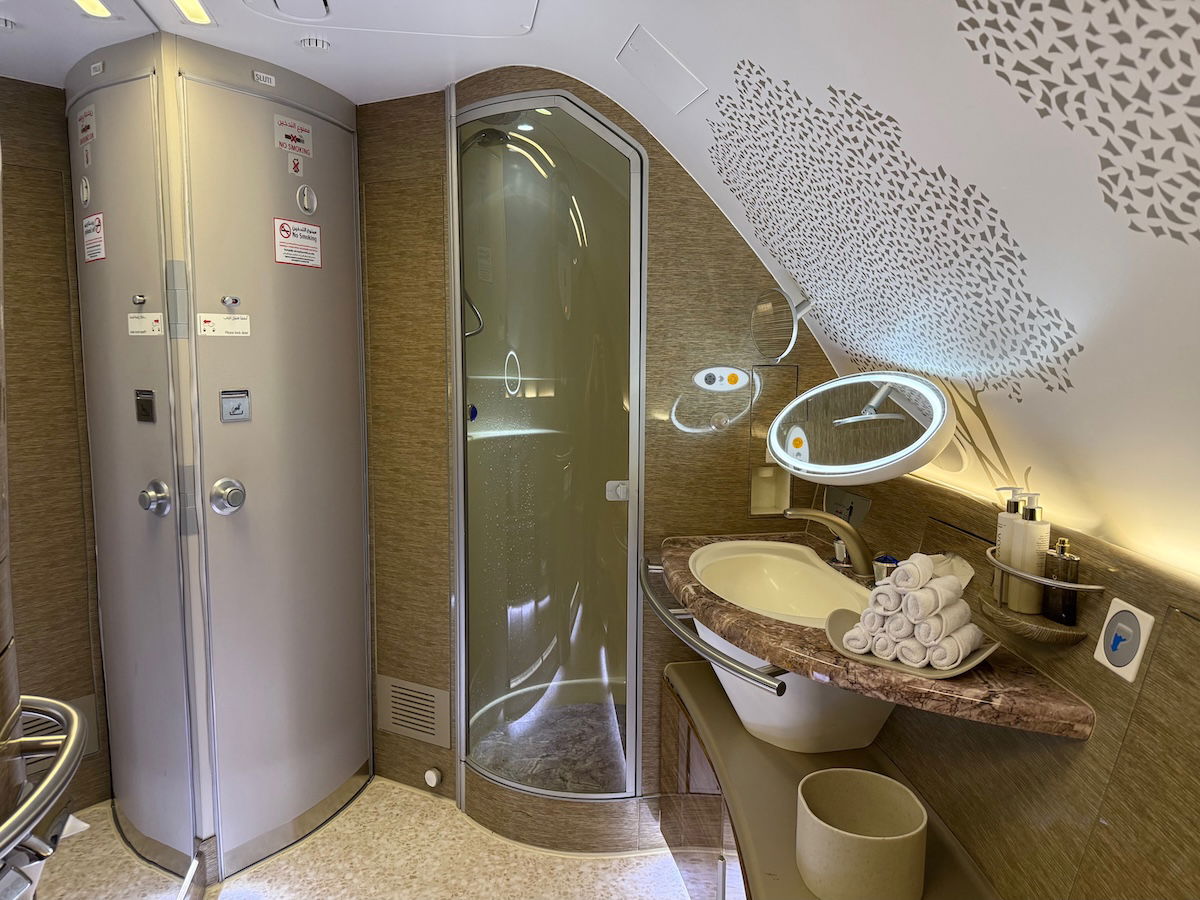
I find this study to be interesting, but what should we actually do with this information? Should we literally just not even wash our hands on any airline? Am I supposed to sacrifice my Emirates A380 first class showers?!? 😉
Even though I’m a selective germaphobe, I put this info in the category of “interesting” and “eek,” but I’m not sure it’ll really impact my decisions going forward.
I guess my uneducated take here is that there’s a difference between an interesting study that covers best practices, vs. something we should actually actively be concerned about. Billions of airline passengers are enplaned every year. How many people suffer any sort of negative results from drinking coffee or tea or washing their hands?
Of course I’d never just drink cold water from the plane’s tanks, but it doesn’t seem to me like anything to be particularly worried about. And I suppose if that’s the case, maybe I would’ve just been better off not knowing this, since American is the airline I fly most? After all, ignorance is bliss!
Bottom line
I don’t think anyone will be surprised to learn that the water in aircraft tanks isn’t consistently of great quality. Perhaps what’s most surprising is how big the variance is — among US airlines, Delta leads the pack, while American is in last pace (which, come to think of it…).
The study recommends never drinking water directly from the plane’s tanks (which is unarguably good advice), but also suggests not having airplane coffee or tea, and not even washing your hands on airplanes. Everyone can do with this information as they please…
What do you make of this study, and does it impact your approach to using water from airplane tanks?




I would be interested in how some of the major foreign airlines rank
Both this report and your commentary are missing a huge piece of the puzzle. I worked airport operations for 2 US Airlines at 3 airports. Onboard water tanks are only one piece of the equation. The larger piece is the water holding tanks provided by the airports themselves. They have an even larger impact on water quality than the planes themselves. Some are filthy, covered with mold and never cleaned. Poor water quality on planes...
Both this report and your commentary are missing a huge piece of the puzzle. I worked airport operations for 2 US Airlines at 3 airports. Onboard water tanks are only one piece of the equation. The larger piece is the water holding tanks provided by the airports themselves. They have an even larger impact on water quality than the planes themselves. Some are filthy, covered with mold and never cleaned. Poor water quality on planes depend on the airports they are serving, more than the maintenance of the planes themselves. Very similar to inadequate/poorly maintained baggage delivery systems, airlines unfairly get blamed for poor airport infrastructure.
"Do not wash your hands in the bathroom; use alcohol-based hand sanitizer containing at least 60% alcohol instead"
Wow
And yet, as @Aero so correctly points out, here we all are. Still alive and well after literally decades of flying. What's become apparent over the years is Ben's undue fixation with (a.) air nozzles, (b.) coffee quality onboard, and (c.) airplane water quality. FFS: bring your own bottled water to brew your coffee and wash your hands already! The problem with people who quibble about these esoteric topics is that they're never prepared to...
And yet, as @Aero so correctly points out, here we all are. Still alive and well after literally decades of flying. What's become apparent over the years is Ben's undue fixation with (a.) air nozzles, (b.) coffee quality onboard, and (c.) airplane water quality. FFS: bring your own bottled water to brew your coffee and wash your hands already! The problem with people who quibble about these esoteric topics is that they're never prepared to take their argument to it's logical conclusion, which is - don't fly if you're so delicate.
Ben, consider covering the topic of fume events as reported by the WSJ. Rare but potentially fatal consequences in contrast to water tanks.
@Gva
He won't. He only bitches whines endlessly about air nozzle and water onboard planes. It's weird, but there you go..
I am being very slow with regard to this topic of conversation.
In common with millions of other airline passengers and crew, I have been exposed to on-board water contamination for decades. I am still here to declare such. From this fact draw your own conclusions.
@Aero
Amen!
The basis on which the waters were rated ie study methodology is not clear.
A more real life study is counting people who reported GI symptoms (subjective) or fever, vomiting, diarrhea (objective), and correlated the microbiology of body excretions with that of the water reservoirs on board.
Show me the dead bodies, I say. Crummy stale water is yucky but may not be causing disease in the current ecosystems.
There is a long explanation at the bottom of the study which makes their methodology clear as mud. It frankly makes no sense and doesn’t seem to follow normal scientific principles for similar studies.
They wrote some gibberish on the methodology. And they haven’t themselves performed any tests but relied on EPA reports. They just came up with a grading system. Further, only 2% of the samples collected by the EPA had contamination. To me that is reassuring that the water safety is not as compromised as this report and Ben’s report make it sound like.
American (my most frequent domestic airline) at the bottom of the listings, ouch.
Ugh, as a public health official, the way they looked at this/generated rankings is beyond flawed. Don’t drink the lav water. Wash your hands with soap. Have as much coffee and tea as you want.
I suspect the ice machines in the catering facilities are dirtier than the aircraft tanks, and in some airports Delta, American, and United are probably getting their food and ice from the same company. Catering facilities might be inspected annually...
Ugh, as a public health official, the way they looked at this/generated rankings is beyond flawed. Don’t drink the lav water. Wash your hands with soap. Have as much coffee and tea as you want.
I suspect the ice machines in the catering facilities are dirtier than the aircraft tanks, and in some airports Delta, American, and United are probably getting their food and ice from the same company. Catering facilities might be inspected annually by the local health department, if you’re lucky. Looking at this data all the big 3 are flushing their aircraft tanks 3x a year.
Their methodology makes no sense to me.
You can wash your hands with non potable water. US Military we do that all the time deployed. Water that is not drinking water is not filtered or sanitized to a high level. They put up signs everywhere that state "non potable" water which you can use for just about anything but consumption.
Washing your hands with non potable water and using a soap is very effective.
Adding to your post BA ….
Hand washing for 20 seconds +, using soap, in “Non-potable” water, will remove dirt and bacteria, etc, allowing them to be flushed away.
Mr Apple’s watch will even commend you for doing so …. :-)
RAW MILK BRAH
“RAW MILK BRAH“ …. Yes! That is more likely to upset the delicate tummies of some lightweights.
Oh, and one more thing, wash your hands right after using your phones to take a picture of your meal right before getting that first bite! Who knows what's lurking on that phone that the eye can't see and where your hands have been!
Phone. Eats. First.
Your system is built to take care of a certain amount of germs and bacteria without you knowing it. That's assuming that you take care of yourself. Many Americans do not.
Man, every I time I see your username, you really remind me of Mitt Romney's dad, George W. Romney haha
Isn't water boiled for tea and coffee? (I don't drink either)
Which gets rid of all (or almost all) the risk?
I'm more worried about hot tea or coffee being split over me.
This is a really odd survey. When Gary posted about at it VFTW, I also questioned it. jetBlue has great water in Mint and better coffee, too. Like, if B6 can handle actual espresso machines, why can't the others? Hmm.
Alex, I'll take things that never happened after washing hands with warm water and soap on an airplane for $500.
“Why aircraft water can be questionable:
On most commercial aircraft, the water you’d get from:
A. The lavatory tap.
B. Hot beverages (tea/coffee).
The water comes from onboard water tanks that are:
• Filled on the ground
• Stored for hours or days
• Connected to relatively complex plumbing.
While airlines are required to disinfect and test these systems, investigations and inspections over the years have found that:
...
“Why aircraft water can be questionable:
On most commercial aircraft, the water you’d get from:
A. The lavatory tap.
B. Hot beverages (tea/coffee).
The water comes from onboard water tanks that are:
• Filled on the ground
• Stored for hours or days
• Connected to relatively complex plumbing.
While airlines are required to disinfect and test these systems, investigations and inspections over the years have found that:
• Cleaning schedules vary by airline and aircraft.
• Tanks and pipes are harder to keep pristine than household plumbing
• Biofilm (bacterial buildup) can occur if maintenance slips.
This doesn’t mean the water is dangerous—but it does mean it’s not consistently fresh”.
"(even though all airlines make a point of noting it’s not potable)." If this is the case then why are airlines EVER serving water from the tank? Not being able to wash our hands? Seriously? so yea use the bathroom and go back to your seat without washing. That makes sense. We all know that seat isn't getting a full cleaning before the next flight. Terrible advice telling people not to wash their hands. Just...
"(even though all airlines make a point of noting it’s not potable)." If this is the case then why are airlines EVER serving water from the tank? Not being able to wash our hands? Seriously? so yea use the bathroom and go back to your seat without washing. That makes sense. We all know that seat isn't getting a full cleaning before the next flight. Terrible advice telling people not to wash their hands. Just means way more germs for the next person. I would be interested if you find any information out there about water quality on international carriers . For example I have had jamaican blue mountain coffee on Singapore first class. I suspect they may not be pulling the water to make high end coffee out of their tank but who knows. Are there some airlines that make coffees and teas with bottled water? This is a useful article for travelers thank you.
“GreAAt is what we’re going for”
“You(r high chances of getting sick) are why we fly”
What a joke of an airline
glad you covered the article,
The point is not really whether you should drink water from airplanes or take a shower onboard (if you can find one) but that there is a difference in the compliance of US airlines.
and US airlines do not say that water is not potable specifically because of this rule. Airplane water is supposed to meet the same standards as water supplied from a public source on the ground.
There...
glad you covered the article,
The point is not really whether you should drink water from airplanes or take a shower onboard (if you can find one) but that there is a difference in the compliance of US airlines.
and US airlines do not say that water is not potable specifically because of this rule. Airplane water is supposed to meet the same standards as water supplied from a public source on the ground.
There is no other way to make hot beverages other than with water from the tanks of the aircraft; coffee makers have additional filters and if there were really a disease risk, it would be very obvious given how much coffee airlines serve.
The doctor is right below- wash with soap and water and then use sanitizer. And use hand lotion of your hands are dry and/or cracking.
"wash with soap and water"
It's not just wash with soap and water, but how you wash is vital.
I've seen people just wet their hands, do a quick lather and rinse.
Digging in to the study left me confident that drinking coffee and washing my hands is not an unsafe endeavor. Especially on an A graded airline. While I appreciate any intent to improve drinking water safety on air carriers I get the feeling there is some click baiting happening with a title using “Disgusting” in the article. The study explains the flushing procedures and lists actual instances per carrier, many had zero results for E...
Digging in to the study left me confident that drinking coffee and washing my hands is not an unsafe endeavor. Especially on an A graded airline. While I appreciate any intent to improve drinking water safety on air carriers I get the feeling there is some click baiting happening with a title using “Disgusting” in the article. The study explains the flushing procedures and lists actual instances per carrier, many had zero results for E Coli. Improvements to be made, sure. Weighing the cons of consuming plastics in bottle water, yep.
yea I am becoming more convinced that plastic water bottles aren't the safest either. Its just soo difficult to keep up with all the potential things that can cause issues.
I've drunk the water in the pitchers that the cabin crew serve aside from coffee and tea in all classes to rinsing my mouth from the tap after brushing my teeth.
And I'm still here, never got sick.
The best thing you can do is to take care of yourself in your day-to-day life by eating right, getting physical activity and focus on your mental well-being which a lot of people tend to overlook.
At...
I've drunk the water in the pitchers that the cabin crew serve aside from coffee and tea in all classes to rinsing my mouth from the tap after brushing my teeth.
And I'm still here, never got sick.
The best thing you can do is to take care of yourself in your day-to-day life by eating right, getting physical activity and focus on your mental well-being which a lot of people tend to overlook.
At the same time. it's 2026 already, so you would think that technology would be incorporated by now such as filtration systems, et.al.
I'm not disputing the findings but really curious, like you, as to how this can vary so much? Water at airports is all the same for everyone when filled into tanks. Is there a cleaning of these tanks and lines more at one airline versus another? That's the only thing I could imagine.
One thing: I would like to see which aircraft from each airline were utilized for the testing. If there are disparities in aircraft age or models where, say, Delta had a propensity of newer aircraft being tested versus American where they leaned more to older frames, that could prove a difference I assume. I doubt the water testing authorities are all that familiar with the difference between aircraft and how it might affect testing.
As a physician, I advocate you still wash your hands with soap and water, and then perhaps use hand sanitizer after if you wish. Norovirus and c diff are two examples of common pathogens that hand sanitizer alone won’t take care of.
Just curious what kind of doc are you as I've always had a curiosity in medicine especially in surgery; I always had a fascination with laparoscopy, robotics, and other advancements.
I use hand sanitizer as a last resort where there is no water source like going to a food court, that's where I tend to use Purell fragrance-fee hand sanitizing wipes. And I moisturize after.
Oh and btw, I never use those hand dryers! Paper...
Just curious what kind of doc are you as I've always had a curiosity in medicine especially in surgery; I always had a fascination with laparoscopy, robotics, and other advancements.
I use hand sanitizer as a last resort where there is no water source like going to a food court, that's where I tend to use Purell fragrance-fee hand sanitizing wipes. And I moisturize after.
Oh and btw, I never use those hand dryers! Paper towels are good enough for me, I use the paper towel to hold the door handle and throw it out.
I am a neurosurgeon. Thank you for cleansing your hands.
Oh great, always been fascinated with surgeons. Since you're a neurosurgeon, are robotics and AI becoming more commonplace? For general and cardiac surgery, the Da Vinci system is being more commonplace and with laparoscopy in general, you have nano or micro-laparoscopy where the instruments are more refined than traditional laparoscopy that's the size of a small needle and is basically scarless. And with orthopedics, you have the Mako and Nako for hip and knee replacements.
...Oh great, always been fascinated with surgeons. Since you're a neurosurgeon, are robotics and AI becoming more commonplace? For general and cardiac surgery, the Da Vinci system is being more commonplace and with laparoscopy in general, you have nano or micro-laparoscopy where the instruments are more refined than traditional laparoscopy that's the size of a small needle and is basically scarless. And with orthopedics, you have the Mako and Nako for hip and knee replacements.
But I digress.
And you're welcome. I'm just doing my part to keep not just myself safe, but those around me especially when there's human contact.
As someone who takes the train often, there's no water in the bathrooms. So I just have some gel hand sanitize and make do with that.
This is good advice if you can do it--which almost nobody can. Actually washing hands, with soap, for the length of time needed to combat norovirus is rare in real life, and I think it's nearly impossible in an airplane sink with spring-loaded handles. There's even a recent trend toward removing hand-washing sinks from hospitals, because real-world sanitizer compliance is so much higher than real-world hand-washing compliance.
I hate to be fatalistic, but I think...
This is good advice if you can do it--which almost nobody can. Actually washing hands, with soap, for the length of time needed to combat norovirus is rare in real life, and I think it's nearly impossible in an airplane sink with spring-loaded handles. There's even a recent trend toward removing hand-washing sinks from hospitals, because real-world sanitizer compliance is so much higher than real-world hand-washing compliance.
I hate to be fatalistic, but I think defending yourself from norovirus in an airplane lav is pretty much impossible. (Well, maybe with careful use of disposable gloves, but that'd be weird.)
You are correct that the auto stops make it hard to really lather and rinse well for long enough. But please still do try. And use hand sanitizer when washing is not available or whenever. Curious where your data about removing sinks in hospitals comes from. I work as a neurosurgeon for 80 hrs a week in a hospital, for past 15 years, across many hospitals in the country, haven't seen this. I only write...
You are correct that the auto stops make it hard to really lather and rinse well for long enough. But please still do try. And use hand sanitizer when washing is not available or whenever. Curious where your data about removing sinks in hospitals comes from. I work as a neurosurgeon for 80 hrs a week in a hospital, for past 15 years, across many hospitals in the country, haven't seen this. I only write this to emphasize to other readers and the author, hand washing really does save lives!
Came here to say exactly this. If you're super paranoid, wash them in soap and water and then use hand sanitizer afterwards.