
Several weeks ago, a social media user shared a picture of the galley of an American Airlines aircraft being blocked off from the cabin inflight, so that passengers couldn’t get into that space. Funny enough, I had basically the same thing happen to be me on a flight earlier this week, and perhaps oddly, my takeaway was sort of that I can’t blame them?
American Airlines galley blocked off during flight
In late October 2023, an airline passenger shared a picture of the rear galley of an American Boeing 737-800 being blocked off from the rest of the cabin with two seatbelts. Clearly this was intended to keep passengers out of the galley.
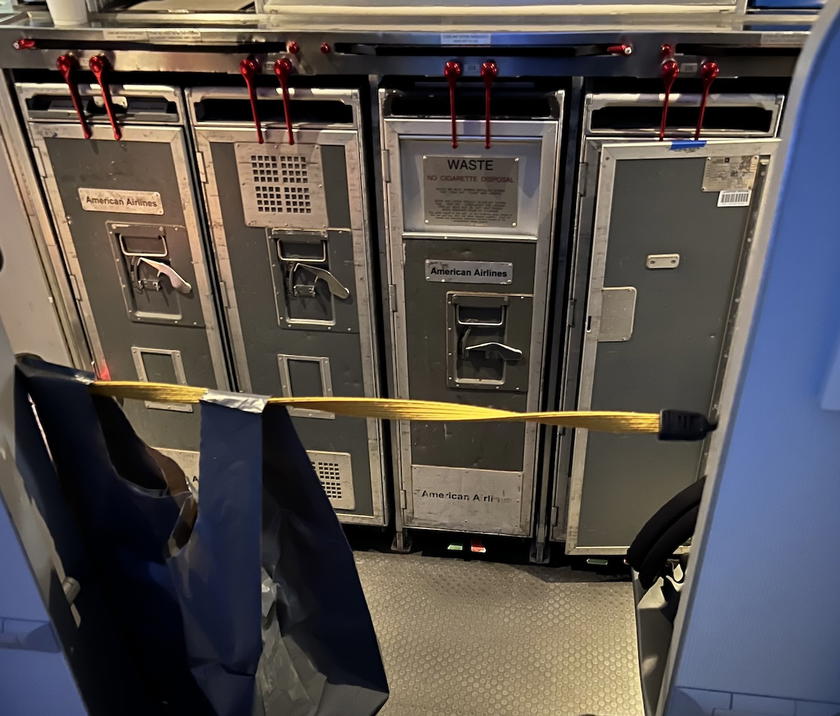
Well, on a flight that I took earlier this week, I had the crew do the same thing, just with a different device. The crew had a sort of elastic band that they stretched across the rear galley, so that passengers couldn’t enter it. There was a trash bag hanging on it.
Does this violate American Airlines’ policy? I assume so, but someone correct me if I’m wrong. Does this violate FAA regulations? Hopefully someone can chime in. I can’t imagine this poses an actual safety risk at cruising altitude, when these devices can easily be removed (it would be a different story if this were during the climb out or descent). Heck, some airlines set up literal barriers in front of exits during flight, to make the cabin look nicer (like Qatar Airways on the A380, at the bar).
Flight attendants aren’t doing this because they’re lazy
When this story was first covered by others bloggers several weeks ago, some claimed that this “selfish stunt could have lost lives,” and that flight attendants were trying to “find a new way to avoid serving passengers,” and that these are flight attendants “who do not like customers.”
Let me provide a different perspective, because I recently took two American 737 flights in economy (one of which I’m referencing above). To be honest, this was the first time in a long time that I was in American’s 737 economy on a flight long enough where I had to use the lavatory (ordinarily I’d try to hold it in, because airplane bathrooms are disgusting).
On the outbound flight there was no sort of device being used to block off the galley. When I approached the rear galley, the first thing I noticed was just how horribly tight it was back there. You have two lavatories that are right across from one another, right in front of the galley, and there’s no room to wait anywhere. On top of that, the galleys are tiny, yet that’s where two flight attendants are expected to be stationed after the service is complete. The flight attendants were within inches of other passengers — it was actually tighter back there than in the cabin, and that’s saying something.
Honestly, seeing that gave me a new appreciation for how unpleasant it is to work in an economy cabin on a narrow body aircraft when such little effort is put into making the space decent for the crew.
On the second flight, the crew blocked off the galley for maybe an hour after they performed the service. You know what’s interesting, though? The crew was actually friendly. They were happy to accommodate any requests in the rear galley, and you could easily see them or talk to them. They clearly just wanted an absolute minimal amount of personal space.
Let me be clear — I’m not excusing violating company policy. What I am saying, however, is that we have people making many millions of dollars per year signing off on cabin configurations that cram in as many seats possible, with absolutely no regard for how these configurations impact the people who have to spend their entire working hours in them.
Many would argue “well you’d never see something like this on Singapore Airlines.” Yes, that’s absolutely right. But you know what else happens at Singapore Airlines? Well, they design their cabins in such a way that takes into account the comfort of flight attendants, so that they’re set up to succeed.
Honestly, how much have so many of us (including me!) whined about how tiny American’s Boeing 737 lavatories are? And we just have to use those for a minute at a time. We blame American management for that, right? Yet when exactly the same approach is applied to the workspace of flight attendants (where they spend most of their working time), some suggest that they must be lazy and hate customers.
My point is simply that flight attendants doing this don’t necessarily hate customers and don’t necessarily want to not provide service. They probably just hate how their workspace is literally tighter than any other workspace out there, due to management’s disregard for their comfort.
That doesn’t excuse them violating the company’s policy, but there’s a difference between wanting a minimal amount of personal space and hating customers. If management wants flight attendants to provide good service, then set them up for success. Part of that includes a pleasant work environment.
Bottom line
Some number of flight attendants at American seem to be blocking off the galley space while inflight, using different makeshift techniques. This probably violates company policy, and if so, they shouldn’t do that.
However, it’s absurd to suggest that this is because they hate customers, or that it’s because they’re lazy. Rather it’s because US airline executives design airplanes with the pure goal of cramming in as much into a small space as possible, with no regard for passenger or crew comfort.
Again, I’m not excusing violating company policy. But on my outbound flight I was shocked by how unpleasant the rear galley is for flight attendants on American’s 737s, and I can understand why flight attendants would want to find some way to make their work environment less miserable.
What’s your take on this situation?


Membership is free and takes no more information than commenting as a guest. Earn status points for good contributions, and see fewer ads as your status grows.