

There’s a story that’s going viral about how a United Airlines flight that had diverted to Washington Dulles returned to its gate at 3AM after taxiing out to the runway, as the pilot had reportedly exceeded his maximum duty time for the day by just one minute. Obviously this is incredibly frustrating, but is there a little more to the story?
In this post:
United flight diverts, then cancels at 3AM after pilot times out
ESPN sports commentator Ian Darke and former soccer player Landon Donovan recently took to X to share their frustration over what happened on a recent United Airlines flight, in posts that have now collectively been viewed many millions of times. Specifically, this involves flight UA404, which was scheduled to operate from Houston (IAH) to Newark (EWR).
Darke took to social media to write the following:
Every passenger on @united 404 from Houston to Newark will think twice about using that airline again. Delayed , diverted , reboarded, then pilot says shift ‘ timed out’ as about to take off from Dulles. Still there 5 hours later. No hotel offer.
Meanwhile Donovan wrote the following:
I’ve been traveling 100k miles/year since I was 16 and this was easily the worst travel experience of my life. No transparency, no clarity and no respect for the passengers who were treated horribly all evening/morning. Absolutely shameful from @united
When someone else pointed out how the United States has rules limiting pilot duty hours, he responded as follows:
We were on the runway about to takeoff and the pilot was literally ONE minute past his time and decided to take us back to the gate at 3am
For some context, the 1,400-mile flight was blocked at 3hr42min, and was scheduled to depart at 6:17PM and arrive at 10:59PM, being operated by a Boeing 737 MAX 9 with the registration code N17589. The plane only ended up taking off from Houston at 8:17PM, and then made its way toward Newark.
However, due to bad weather at Newark, the plane ended up having to divert to Washington Dulles (IAD), where it landed at 1:04AM.
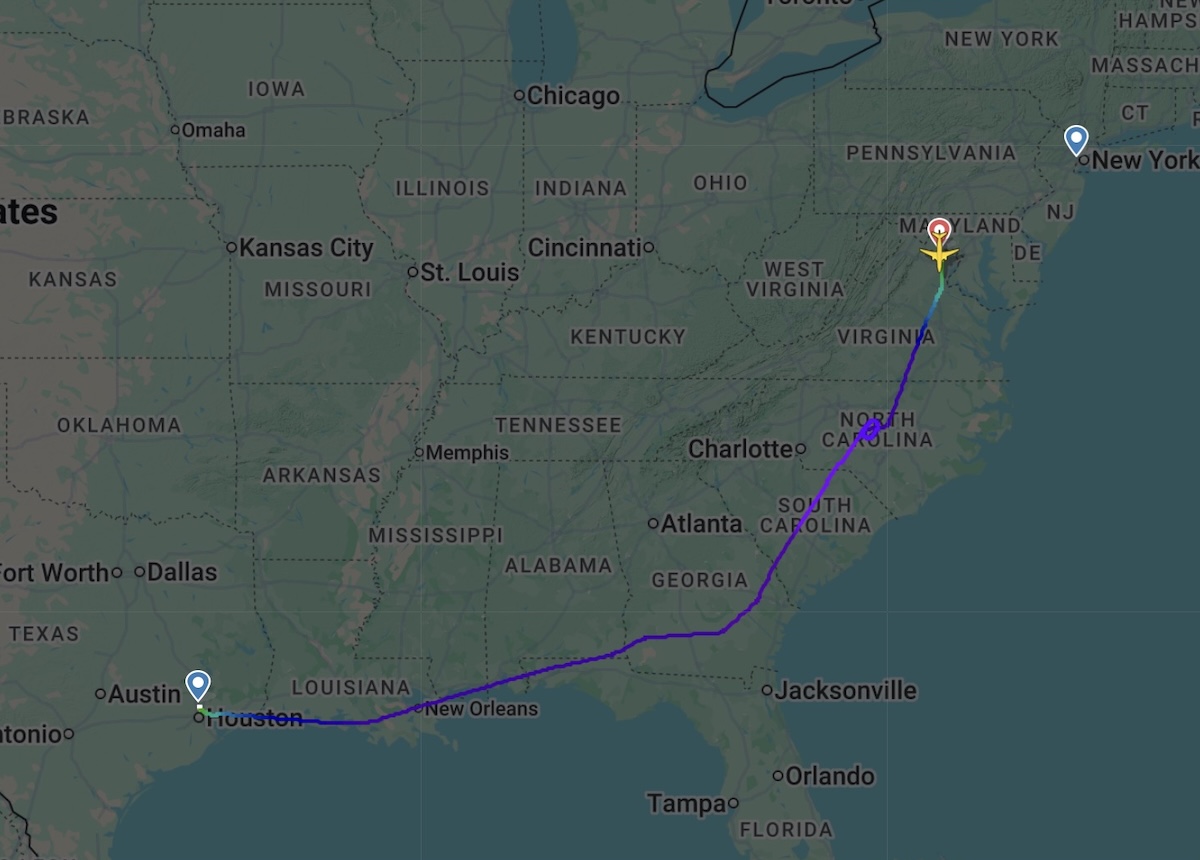
At that point the plane refueled, only for them to attempt to depart again. Based on what I can see, the plane left the gate at 2:48AM, only to then be back at the gate 28 minutes later, at 3:16AM. The plane indeed make it out as far as the runway (though I’m not sure it actually entered the runway), before turning around, with the claim being that the pilot was at that point one minute over the maximum duty period. The one minute claim is according to the passenger, but hasn’t been verified by the airline. I would guess this didn’t actually come down to one minute.
At that point the flight was canceled for the night, and then United operated a flight to Newark in the morning, departing at 9:23AM and arriving at 10:05AM. So for the passengers who ended up taking the replacement flight, they were over 11 hours late, and had a sleepless (or at least very short) night.
It’s hard to be too mad at the airline here… right?
Of course as a passenger, it’s incredibly frustrating to be on a flight that diverts, is seriously delayed, and then even gets canceled because the pilot times out. But at the same time, safety is paramount in aviation, and there’s a certain point at which crews will time out.
The Federal Aviation Administration (FAA) has strict rules around maximum duty days, which are covered in 14 CFR Part 117.
Here’s the part of the story that I find the most interesting, though. In my experience, if a flight cancels due to pilots exceeding their maximum duty period, it typically happens before the aircraft door closes. Over the years I’ve been on many flights where they rush to close the door, because there’s a certain cutoff after which the crew will time out, and closing the door typically solves that.
So what’s going on here? Let me start by stating that I absolutely support pilots only flying if they feel they’re capable of doing so safely, and have sufficient rest. Even if it’s inconvenient, I respect their rights to make operational decisions, including timing out.
That being said (not that it’s of any consequence), I think the interesting question is whether the pilot had no choice in the matter, or whether he opted not to continue. After all, the X post frames this as the pilot “deciding” to return to the gate.
One wonders, what happened between the time that the plane left the gate, and the time that it got to the runway, that caused something to be missed by one minute? The taxi didn’t take particularly long.
Ultimately there are many factors that determine maximum duty days for pilots — we don’t know where the pilot had come from that day, what his flying looked like in previous days, what his report time was, etc., as that all impacts maximum duty times.
It’s the timing I find curious here, so I looked at 14 CFR Part 117. As I understand it, risk of going over duty time is typically measured based on the time the door closes, plus the anticipated flight time. But what happens once the plane leaves the gate? Well, here’s the section that covers flight duty period extensions before takeoff:
For augmented and unaugmented operations, if unforeseen operational circumstances arise prior to takeoff:
(1) The pilot in command and the certificate holder may extend the maximum flight duty period permitted in Tables B or C of this part up to 2 hours. The pilot in command and the certificate holder may also extend the maximum combined flight duty period and reserve availability period limits specified in § 117.21(c)(3) and (4) of this part up to 2 hours.
(2) An extension in the flight duty period under paragraph (a)(1) of this section of more than 30 minutes may occur only once prior to receiving a rest period described in § 117.25(b).
(3) A flight duty period cannot be extended under paragraph (a)(1) of this section if it causes a flightcrew member to exceed the cumulative flight duty period limits specified in 117.23(c).
(4) Each certificate holder must report to the Administrator within 10 days any flight duty period that exceeded the maximum flight duty period permitted in Tables B or C of this part by more than 30 minutes.
As you can see, after the door closed, pilots can extend their duty period by up to two hours, with some limitations. Presumably if the door had been closed, that extension would’ve kicked in, if the pilots wanted it to.
It does seem like the pilots may not have been “feeling it” at that point, and just wanted to go back to the gate, unless I’m reading that wrong. Now, let me emphasize:
- I don’t think there’s anything wrong with that, and you want pilots who are ultimately well rested, and if they’re not comfortable flying, they’re making the right decision by taking everyone back to the gate
- The above is in reference to FAA regulations, though it’s possible that United’s pilot contract contains extra provisions
So anyway, at a minimum, I find this to be an unusual case of exceeding maximum duty limits.
Bottom line
Passengers on a United Airlines flight from Houston to Newark had quite the journey, when the plane diverted to Washington Dulles due to bad weather at the destination. The plane then refueled, and ended up taxiing out to the runway at 3AM… only for the plane to then return to the gate, as the pilot was reportedly one minute over the maximum duty period.
Pilot fatigue is a real issue, and pilots should absolutely prioritize safety over all else. I suspect the plane wasn’t actually on the runway, and I also suspect this didn’t just come down to one minute. Still, it’s definitely unusual to see a crew time out after leaving the gate, especially without a substantial initial delay. If anyone has any more insights into the technicalities of this, I’d love to hear them (just due to my own curiosity, and not because it’s actually consequential).
What do you make of this story of a United pilot timing out?




Oh thank you benevolent government bureaucracy for keeping us safe with arbitrary nonsense rules.
first, crew duty rules came as the result of the crash of a UA Express flight years ago. The problem w/ many of those rules is that they overlook commuting in an industry where huge numbers of pilots commute. The rules require airlines to give pilots a certain amount of rest but allow crews to commute across the country or across the ocean without counting that time.
and every rule is known and can be...
first, crew duty rules came as the result of the crash of a UA Express flight years ago. The problem w/ many of those rules is that they overlook commuting in an industry where huge numbers of pilots commute. The rules require airlines to give pilots a certain amount of rest but allow crews to commute across the country or across the ocean without counting that time.
and every rule is known and can be legally and logically followed.
UA simply was running a very late operation at the end of crew duty days and had to divert because of thunderstorms that were still delaying flights at 3 .am. Instead of realizing that the flight was going to cancel when it diverted - let alone at IAH when a fresh pilot crew could have ensured there was enough duty time to deal w/ the inevitable delays and diversions which didn't just happen w/ that flight, UA tried to push against a rope that collapsed against them.
Cancelling at a diversion point is always the worst outcome
Thanks captain pedantic
you took a swipe at regulators without knowing or acknowledging the source of these crew rest and duty time rules or how they have actually played out in real life.
There should be duty time rules and we all should shake our heads that it took so long to put them in place; the things that aren't covered by them and how those rules are handled in real life is what should still be concerning and the latter is the basis of this article.
Tim, recall that Mantis is based in Asia, and frequently spreads anti-government, anti-worker disinformation on this and other travel/card sites all the freakin’ time. Thanks for trying to counter his nonsense.
this is not unlike some of the stories that happen about airlines not being able to land at European airports because of hard times after which no flights are permitted.
As much as UA and the crew acted like they wanted to try to prevent a cancellation, if they also insist based on law - to follow the crew duty times - then you will tick people off.
If UA and its pilots can't realize...
this is not unlike some of the stories that happen about airlines not being able to land at European airports because of hard times after which no flights are permitted.
As much as UA and the crew acted like they wanted to try to prevent a cancellation, if they also insist based on law - to follow the crew duty times - then you will tick people off.
If UA and its pilots can't realize that there is a minimum amount of time necessary to do certain tasks and allow a cancellation before you get into a fight for minutes, there will be complaints. People can understand that pilots run out of duty time but they don't want to part of games to try to beat the system and then have the "gotcha card" pulled.
Summer weather and thunderstorms are making a mess out of travel and they seem to go back and forth between Texas esp. N. Texas, Chicago, the Northeast and Florida with occassional ATL, CLT and even BNA ground stops thrown in.
There is a point where cancellations before the flight ever departs are better than trying to run a flight and then having it so delayed or delayed and then diverted and cancelled.
I applaud United in their effort to keep us from having to listen to Landon Donovan but surely there were better ways than this.
Kind of ironic that it was flight 404, lol
I was on the flight. I sat 2 rows in front of Ian. There’s more to it. One other United flight left from Houston about an hour after us and was able to not divert to DC and made it to Newark.
When we landed at DC originally, we didn’t deplane for probably 15 min bc the pilots wanted to see if they could take off again right away and get to Newark. That...
I was on the flight. I sat 2 rows in front of Ian. There’s more to it. One other United flight left from Houston about an hour after us and was able to not divert to DC and made it to Newark.
When we landed at DC originally, we didn’t deplane for probably 15 min bc the pilots wanted to see if they could take off again right away and get to Newark. That wasn’t allowed and the crew then timed out. So the pilot deplaned us, but told us to hang around bc he was trying to get us a new crew. We were able to get a new crew eventually but then in the process of reboarding, United was in the middle of issuing new tickets for passengers to go from dc to EWR. This caused an issue of course with boarding as the United system didn’t recognize most people’s tickets and delayed our reboarding by 20 minutes. The pilot did say we were against the clock and he was going to timeout soon; will add when we diverted, he told us he was going to extend his clock to try and get us home. Eventually we all boarded and did a really quick taxi out. We were at the beginning of the runway and about to power up when the clock hit 3:01. The flight attendant told us we missed by 2 minutes. The communication once we deplaned again was awful. Some passengers got multiple notifications on their phones saying they would board again by 4, but the gate agent was telling people 7 a.m. Caused a lot of confusion. People started calling for Uber and booking Amtrak instead of waiting for updates from United at that point. I shared an Uber up with 3 others to EWR. Got there before the rescheduled flight took off.
James, sorry you had to deal with this; United clearly failed you and your fellow passengers here. Glad you made it. Ideally, the airline would reimburse you for your alternative transportation, but they probably won’t, because we have near-no consumer protections here. Wish we had an EU261 equivalent that included better Duty of Care for stranded passengers. (I know, originally weather, but, still their subsequent failures were partially staffing issues.) Hope you get some rest!
James, sorry you had to deal with this; United clearly failed you and your fellow passengers here. Glad you made it. Ideally, the airline would reimburse you for your alternative transportation, but they probably won’t, because we have near-no consumer protections here. Wish we had an EU261 equivalent that included better Duty of Care for stranded passengers. (I know, originally weather, but, still their subsequent failures were partially staffing issues.) Hope you get some rest!
One of the guys I shared the uber with was a Global Services member and so he was able to connect us with a rep and the rep cancelled the flight for us....we are supposed to get flight credit back, but will see if that happens!
Really was shocking though how United handled things. Also, the info I was getting on the flight came mostly from the flight attendants, an off clock pilot sitting...
One of the guys I shared the uber with was a Global Services member and so he was able to connect us with a rep and the rep cancelled the flight for us....we are supposed to get flight credit back, but will see if that happens!
Really was shocking though how United handled things. Also, the info I was getting on the flight came mostly from the flight attendants, an off clock pilot sitting next to me, and also the pilot himself (but not over intercom, just talking to the passengers in the first few rows). Otherwise the communication was pretty much none existent.
I was on the flight. Sat 2 rows in front of Ian. There’s more to it. One other United flight left from Houston about an hour after us and was able to not divert to DC and made it to Newark.
When we landed at DC originally, we didn’t deplane for prob 15 min bc the pilots wanted to see if they could take off again right away and get to Newark. That wasn’t...
I was on the flight. Sat 2 rows in front of Ian. There’s more to it. One other United flight left from Houston about an hour after us and was able to not divert to DC and made it to Newark.
When we landed at DC originally, we didn’t deplane for prob 15 min bc the pilots wanted to see if they could take off again right away and get to Newark. That wasn’t allowed and the crew then timed out. So the pilot deplaned us, but told us to hang around bc he was trying to get us a new crew. We were able to get a new crew eventually but then in the process of reboarding, united was in the middle of issuing new tickets for passengers to go from dc to ewr. This caused an issue of course with boarding as the united system didn’t recognize most people’s tickets and delayed our reboarding by 20 minutes. The pilot did say we were against the clock and he was going to timeout soon; will add when we diverted, he told us he was going to extend his clock to try and get us home. Eventually we all boarded and did a really quick taxi out. Was at the beginning of the runway and about to power up when the clock hit 3:01. The flight attendant told us we missed by 2 minutes. The communication once we deplaned again was awful. Some passengers got multiple notifications on their phones saying they would board again by 4, but the gate agent was telling people 7 am. Caused a lot of confusion. People started calling for uber and booking Amtrak instead of waiting for updates from united at that point. I shared an uber up with 3 others to ewr. Got there before the rescheduled flight took off.
Can someone compare the difference the crew would make stuck at IAD and if they arrived at EWR.
These affected passengers should be upset.
For a weather-related disruption, the Duty of Care is mandatory in the EU and UK (including overnight accommodation, meals, etc.), but only voluntary and airline-dependent in the USA. Clearly, here, United basically told these poor folks to ‘pound sand’ and ‘kick rocks.’
So, rules like EU/UK 261 aren’t just about ‘compensation’ (here, that likely isn’t eligible, because ‘extraordinary circumstance’ defense), it’s also about how passengers are treated...
These affected passengers should be upset.
For a weather-related disruption, the Duty of Care is mandatory in the EU and UK (including overnight accommodation, meals, etc.), but only voluntary and airline-dependent in the USA. Clearly, here, United basically told these poor folks to ‘pound sand’ and ‘kick rocks.’
So, rules like EU/UK 261 aren’t just about ‘compensation’ (here, that likely isn’t eligible, because ‘extraordinary circumstance’ defense), it’s also about how passengers are treated after weather-related disruptions. We deserve better in the US. Someday, hopefully, we’ll finally ‘get-it.’ Remember this the next time it happens to you. Vote for representation that isn’t beholden to the airline lobby.
I assume they thought they could just barely make it to Newark and so wanted to do so, then taxiing took slightly longer than expected, so the pilot then realized he would be 1 min over upon landing?
I assume they thought they could just barely make it to Newark and so wanted to do so, then taxiing took slightly longer than expected, so the pilot then realized he would be 1 min over upon landing?
28 minutes to taxi from the terminal to a runway at 3:00 am? I doubt IAD was that busy at that time of the night and they certainly could have been airborne before the crew timed out. Smells fishy to me... more likely the crew dragged their feet so they could time out and head for a hotel.
Sounds like it. Yeah, crew gets a hotel (which they should). But, passengers certainly did not. (They would if we had rules like in UK/EU.)
They were back at the gate 28 minutes later, so it's maximum 14 minutes one-way to the runway.
UA404 IAH-EWR on 06/14/2026 operates a 737 MAX9.
That's easy right. Your turn.
@ Tim Dunn -- We're waiting to learn which EWR-LAX frequencies UA operates with 737-900ERs, please!! These are the important details!
Legality to operate the flight isn't locked in at the time the door is closed. It's not legal to takeoff if, at the time of takeoff, the pilot can't compete the flight within the flight and duty time limits of FAR 117. To determine this, one has to consider the planned flight time, as well as the time planned to taxi in at the destination.
My airline publishes what's known as the MOT, or...
Legality to operate the flight isn't locked in at the time the door is closed. It's not legal to takeoff if, at the time of takeoff, the pilot can't compete the flight within the flight and duty time limits of FAR 117. To determine this, one has to consider the planned flight time, as well as the time planned to taxi in at the destination.
My airline publishes what's known as the MOT, or Mandatory Off Time, for each pilot on each flight. If we're not cleared for takeoff before that time, then we're not legal to complete the takeoff and must return to the gate.
Also, there are multiple reasons why a pilot can time out. We tend to think most often of duty time limits, but there are also flight time limits to consider. There are flight and duty time limits that apply not only daily, but also over longer periods, such as a limit of 100 hours of flight time in 28 days. If one is close to any of the limits, a taxi out being extended by a minute or two beyond what's expected could be the difference in being legal or not.
The fact that the flight left the gate and taxiied out is a good indicator that the pilots were actually doing their best to complete the flight, but were unfortunately unable to get off the ground in time. If they weren't making an effort to do so, they could have simply timed out before leaving the gate.
I can't imagine any pilot discretionarily deciding to return to gate in this circumstance. That said, there's lots of unknowns - for example, was the extension already invoked? Was the lack of a qualifying rest period a salient factor? Were there ATC delays in to Newark? Etc.
Insofar as there's fault, it's that airlines - not just UA, but all the majors - don't build for resilience (meaning, for example reserve crews on hand). As...
I can't imagine any pilot discretionarily deciding to return to gate in this circumstance. That said, there's lots of unknowns - for example, was the extension already invoked? Was the lack of a qualifying rest period a salient factor? Were there ATC delays in to Newark? Etc.
Insofar as there's fault, it's that airlines - not just UA, but all the majors - don't build for resilience (meaning, for example reserve crews on hand). As much as people grumble, it's more profitable to cancel flights, even on those rare occasions that they begrudgingly pay nominal compensation, than to be prepared for contingencies.
If you search for the flight on ADSB Exchange, you can clearly see that it landed at IAD, taxied to the gate, then went to the runway, then returned to the gate. Passenger descriptions on X are accurate.
https://globe.adsbexchange.com/?icao=a12f52&lat=38.942&lon=-77.452&zoom=13.5&showTrace=2026-06-15
Per that ADSB Exchange log, the aircraft did pull out onto the runway, then taxi back to the gate. Passenger complaints are accurate.
In the spring and summer I do everything I possibly can to fly before noon to mitigate the disturbance from thunderstorms that build up across the country every day in the late afternoon and evening. Because thunderstorms are the most disruptive event in all of air travel and often the airlines are powerless. These types of stories happen virtually every day this time of year.