Alaska Airlines Eliminates Plastic Cups

Alaska Airlines has just become the first US airline to eliminate plastic cups onboard flights…

Alaska transitions from plastic to paper cups

Alaska Airlines has just completed its transition to paper cups for inflight beverages. This move will eliminate more than 55 million plastic cups annually, equal to the weight of 24 Boeing 737s (that’s a lot of weight!). All inflight beverages are now served in Forest Stewardship Council (FSC) certified paper cups in economy, and in reusable glassware in first class.


Alaska Airlines has switched to paper cups

This is part of what has been a larger goal for the airline. In 2018, Alaska Airlines set out to eliminate its five largest sources of plastic waste. This initially started with removing plastic straws and stir sticks from inflight service, which was also a first for any US airline at the time. Then in 2021, Alaska eliminated bottled water onboard, instead replacing it with boxed water. That move alone eliminated 32 million plastic bottles per year.

By 2025, Alaska is hoping to replace its top five waste-producing items from onboard service, by pursuing product innovations and supply chain advancements.
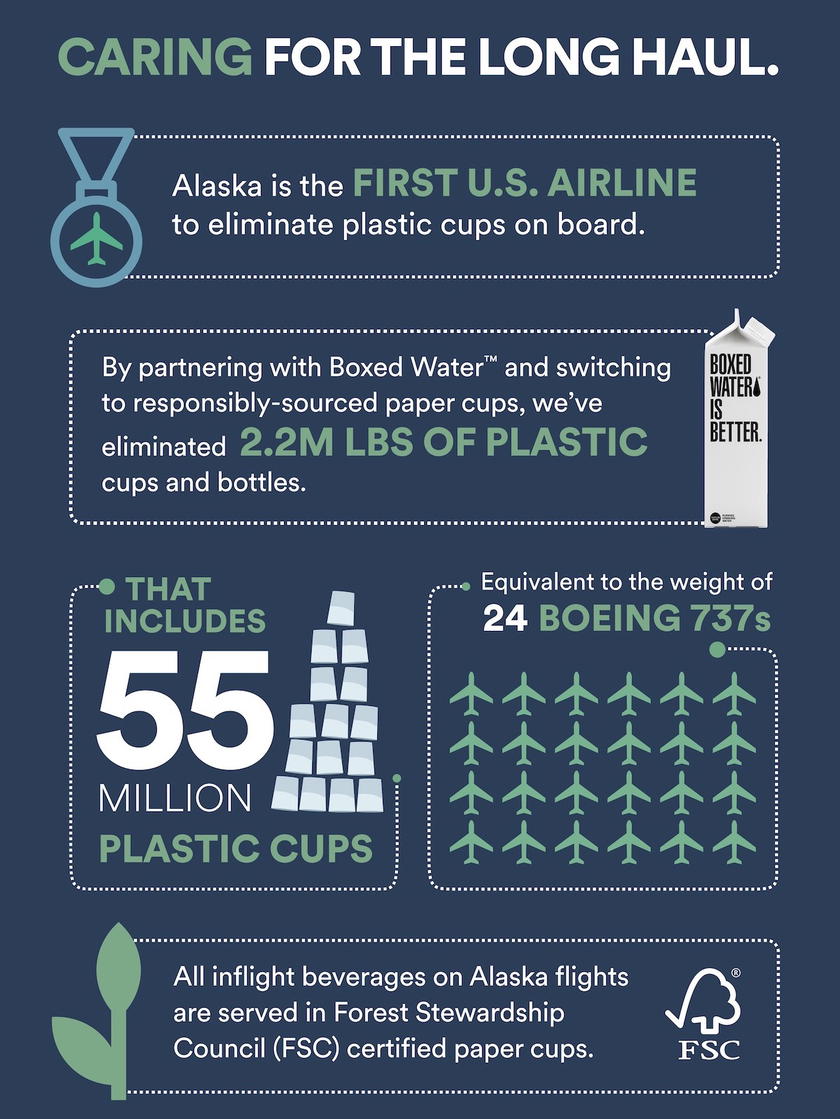
Alaska Airlines plastic infographic

Bottom line

In its latest environmental move, Alaska Airlines is eliminating plastic cups, instead replacing them with paper cups. Assuming the paper cups are of decent quality, I’d say that’s a great development, as it will save a lot of plastic.

Admittedly there’s never a perfect solution with this stuff, it’s just trying to find the best combination of what’s less terrible for the environment to begin with, combined with what’s easiest to recycle, all while not negatively impacting the customer experience as much as possible.

What do you make of Alaska transitioning from plastic to paper cups?

Conversations (19)
The comments on this page have not been provided, reviewed, approved or otherwise endorsed by any advertiser, and it is not an advertiser's responsibility to ensure posts and/or questions are answered.
Comment as a member

Membership is free and takes no more information than commenting as a guest. Earn status points for good contributions, and see fewer ads as your status grows.

Type your response here.

If you'd like to participate in the discussion, please adhere to our commenting guidelines. Anyone can comment, and your email address will not be published. Register to save your unique username and earn special OMAAT reputation perks!

  1. Loading comments…
Recent Comments
The latest from the OMAAT community.

The comments on this page have not been provided, reviewed, approved or otherwise endorsed by any advertiser, and it is not an advertiser's responsibility to ensure posts and/or questions are answered.

Timo Diamond

Or, maybe when insecure non-white men can't handle a rebuttal... see how effin' racist that sounds? Why don't you reword your original comment, bud.

1
‼ 0
Sir Digby Chicken Caesar Guest

Less plastic cups on fold-down tables, more doors on seats. Win-win for everyone.

0
‼ 0
Robert D Guest

I can’t wait to enjoy a cocktail in a paper cup…..said no one ever.

0
‼ 0
Dominick Vietor Guest

While I agree with everything said earlier in this thread, I think one important point is missed: paper cups (let alone glasswere) are heavier than plastic cups, and therfore lead to more fuel burnt. So all in all a dumb move and a classic example of greenwashing unfortunately.

0
‼ 0
Matt Guest

Part of my job is doing life cycle assessments (LCA) to evaluate the environmental impacts of new building products and the like. As a practitioner of LCA studies, I know that it's fairly easy to have an LCA study give the results that one wants. And comparing LCA studies to one another can lead to erroneous comparisons since there may be temporal, geographical, or temporal uncertainties in the studies. It's critical that the scope of the LCA study, its limitations, and assumptions are well understood before making direct comparisons among competing products/alternatives. That said, the best thing to do would be to find the original studies that any give "environmental superiority" claim is based on. Of course, it's important to know who also funded the studies.

1
‼ 0

Save posts to read later

Saving posts is a member feature. Become an OMAAT member to build a reading list you can come back to from any device.

Become a member
Meet Ben Schlappig, OMAAT Founder
5,883,136 Miles Traveled

43,914,800 Words Written

47,187 Posts Published