

Airlines take a complex approach to inventory and revenue management, regardless of whether you’re paying cash for a ticket or redeeming points. Nowadays we frequently see airlines use married segment logic for award tickets, so in this post, I’d like to discuss that in a bit more detail. What exactly is married segment logic, and why should you care?
What are married segments when redeeming miles?
Many airlines use married segment logic for award tickets. This means that airlines are often willing to make a different number of award seats available depending on whether you’re connecting or not. This is probably easiest explained in the form of an example.
Take the below example of trying to redeem Air Canada Aeroplan points online. You can book a business class award on SWISS from New York to Berlin via Zurich.
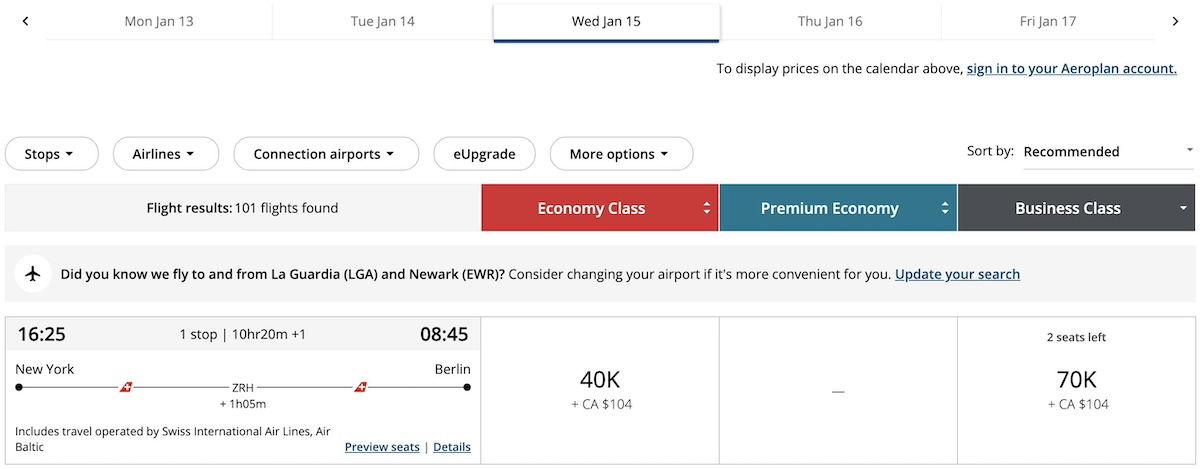
Want to book an award just on that New York to Zurich flight, without a connection to Berlin? Well, it’s not available.
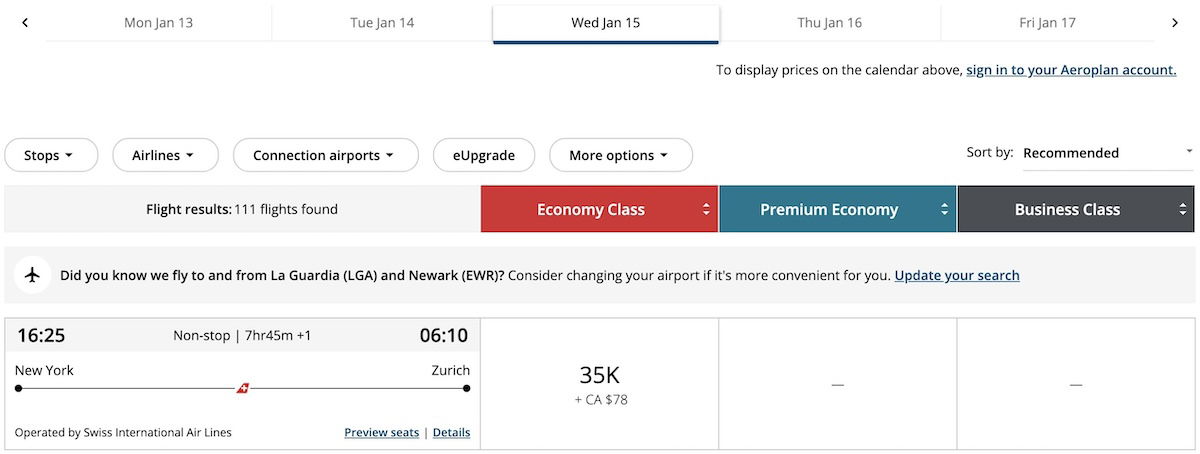
As you can see, the airline is only making award seats available on that New York to Zurich flight if it’s “married” with another segment. This happens all the time nowadays, where you might not see award availability when searching a route nonstop, but do see it when searching a connecting itinerary.
Why do airlines use married segment logic?
Why would an airline make award seats available if you’re on a connecting itinerary, but not if you’re trying to book just one segment? Airlines use a variety of techniques to maximize revenue and minimize the opportunity cost of allowing people to redeem points.
Many consumers think airline pricing isn’t rational, in the sense that the cost of a ticket doesn’t reflect the cost of operating a flight. That comes down to airlines trying to maximize how much they can get consumers to pay based on their travel patterns.
In the case of married segment logic, the idea is that airlines know that consumers are willing to pay a premium for a nonstop flight. You’ll generally pay more for a nonstop flight than one with a connection, and that’s because airlines know that people value the convenience. This is the whole reason that hidden city ticketing exists for flights.
The same logic applies with awards. Just as an airline might decide it wants to charge more for a nonstop flight if paying cash, an airline might also decide it only wants to make award seats available if you’re connecting and not flying nonstop.
Note that if you’re redeeming points for travel on a partner airline, the restrictions are imposed by the airline operating the flight, rather than by the frequent flyer program through which you’re booking. I find married segment logic to be common on airlines like Cathay Pacific, Lufthansa, Qatar Airways, and many more.
Can you “divorce” flight segments?
If you find yourself in a situation where there’s award availability with married segments but not on only one of the flights, is there a way to “divorce” those flights? Can you ticket an award that has both segments, and then call the airline and remove the segment you don’t want?
The answer is almost always no. Airline systems are pretty savvy, and if an agent tries to manually break up married segments, that flight will likely no longer show as available, and there will be an error message if they try to delete just one segment.
Why should you care about married segment logic?
While it’s worth being aware of married segments (since it might explain some quirks with award availability), why should you actually care in practice? After all, you can’t separate out the segments, so there’s not really a trick here to using this in order to create your own award availability.
There are a few considerations with married segments, as I see it:
- Many people search award space by first trying to find availability on the long haul segment individually, and then adding on other segments; this can work against you when there’s married segment award availability
- While I wouldn’t recommend this, I know some will book a married segment itinerary and then skip the last segment; note that this generally violates the airline contract of carriage, and this also won’t work if you have to check a bag, since that will be going to your final destination
- Many might assume it requires more miles to travel further, so you might be pleasantly surprised to see that adding a connection makes a flight cheaper
If you’ve ever tried to redeem American AAdvantage miles for travel on American flights (rather than for flights on partner airlines), you’ve probably noticed the extent to which your origin and destination impacts award pricing, just like on revenue tickets.
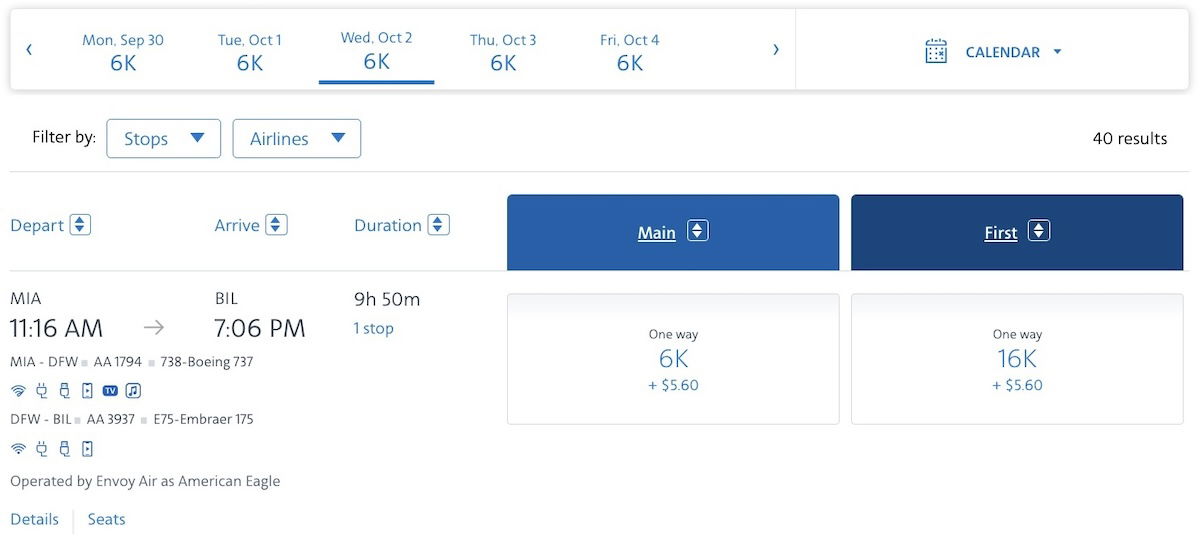
Want to fly from Miami to Dallas to Billings? That’s bookable for just 6,000 AAdvantage miles in economy or 16,000 AAdvantage miles in first class.
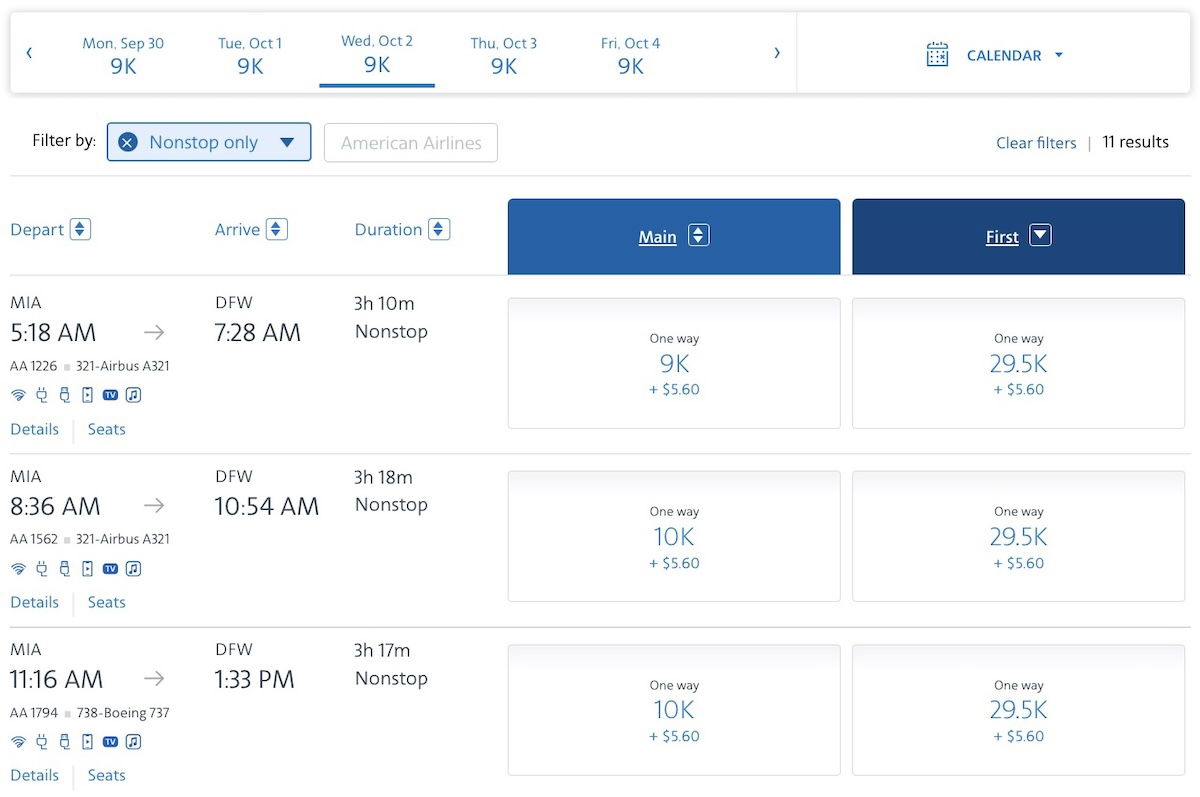
Want to fly just that first segment from Miami to Dallas? That’ll cost you 10,000 AAdvantage miles in economy or 29,500 AAdvantage miles in first class.
Bottom line
Airlines frequently use married segment logic with itineraries. In the case of award flights, this means that there might sometimes be award availability if you book a connecting itinerary, while there’s not availability if booking a nonstop flight.
This has become an increasingly common practice in recent years, and it’s worth being aware of. Not only does this explain some oddities you may notice when searching award availability, but it should also change how you go about searching availability.
What has your experience been with airline married segment itineraries?




@Ben I used to work in Amadeus (now working for an airline) and I feel like there are a few inaccuracies here:
- The first intended purpose of married segments is to only offer a short haul segment (e.g. NCE-CDG) in conjunction with a high value long haul segment (e.g. CDG-JFK). Of course a travel agent could then subsequently cancel the CDG-JFK and this is why the very concept of marriage was invented, which...
@Ben I used to work in Amadeus (now working for an airline) and I feel like there are a few inaccuracies here:
- The first intended purpose of married segments is to only offer a short haul segment (e.g. NCE-CDG) in conjunction with a high value long haul segment (e.g. CDG-JFK). Of course a travel agent could then subsequently cancel the CDG-JFK and this is why the very concept of marriage was invented, which leads me to the second point
- It is ALWAYS permitted to cancel a segment (in my example CDG-JFK). However, what marriage does is that, it will incidentally also cancel NCE-CDG (the agent would be aware of that because there is a marriage segment indicator)
- When we say "we see more and more airlines using marriage segments", maybe it's true when it comes to award bookings. For revenue bookings however, this is a very old concept and as you can see from my example above, based on the assumption that the long haul segment is more valuable than the short haul (which isn't always true). With airlines now moving towards Offer-Order Native systems, the intention would be to always offer the short haul (NCE-CDG in my example), but at the right price (i.e. price it as a long haul if that's what Revenue Management says)
Hope that helps!
Once an airline adopts a schedule, a majority of their costs are locked in. The incremental cost of adding a pax is low (a bit more fuel, snacks/food, and taxes/fees). And, for reward tickets you pay the taxes/fees. So, in essence, their goal is to maximize revenue. This causes confusion for some, as they imagine an airline should sell an AAA-BBB nonstop for less than a AAA-BBB-CCC connection since it must cost them less.
Another strategy is to book the married segment early, and then hope for a schedule change that will/may allow you to get around the married segment when rebooking.
My recent example--wanted to book an itinerary from Honolulu to a smaller Midwest city via Chicago for this coming March. United wanted 120k+ miles to book directly HNL-ORD-destination in Premium Economy. However, they wanted only 30k each to route via Maui in PE--HNL-Maui-ORD-destination. We booked the flight...
Another strategy is to book the married segment early, and then hope for a schedule change that will/may allow you to get around the married segment when rebooking.
My recent example--wanted to book an itinerary from Honolulu to a smaller Midwest city via Chicago for this coming March. United wanted 120k+ miles to book directly HNL-ORD-destination in Premium Economy. However, they wanted only 30k each to route via Maui in PE--HNL-Maui-ORD-destination. We booked the flight via Maui and were prepared to fly that route for the big savings in miles, but a couple of months later UA notified us of a schedule change in the departing time of the Honolulu to Maui flight of about 30 minutes. Rather than accept the offered computer generated reschedule, I called and asked the agent if we could instead take the direct Honolulu to Chicago flight instead of going via Maui, and she said sure, and did it with no questions asked and kept the 30K miles price in PE
A major issue in the current day which has made it a lot more difficult to book itins because when searching for award availability, it becomes a question of "Is it not showing the availability because of married segment logic or is it because there is literally no award availability?" And to test it, it requires plugging in various itins to city pairings that you would deem "acceptable." It's annoying and hateful. If anything in...
A major issue in the current day which has made it a lot more difficult to book itins because when searching for award availability, it becomes a question of "Is it not showing the availability because of married segment logic or is it because there is literally no award availability?" And to test it, it requires plugging in various itins to city pairings that you would deem "acceptable." It's annoying and hateful. If anything in my experience it has been Delta Skymiles that has made a bad name for "married segment logic."
I think the logic breaks when you consider award tickets though, because the airline isn't really "preventing" revenue loss in the same sense if it were a $ ticket. The traveler presumably isn't really forgoing the convenience and willingness to pay for the nonstop flight. The paying behavior of the award leisure traveler is different. And the award miles rate isn't higher for the nonstop, it's simply unavailable.
So, all it does is make...
I think the logic breaks when you consider award tickets though, because the airline isn't really "preventing" revenue loss in the same sense if it were a $ ticket. The traveler presumably isn't really forgoing the convenience and willingness to pay for the nonstop flight. The paying behavior of the award leisure traveler is different. And the award miles rate isn't higher for the nonstop, it's simply unavailable.
So, all it does is make the airline allow an extra segment for the same miles cost. Unless you believe that married segments make it more fair for people who live in the markets served by the connection flights?
The idea presumably is that people will spend cash on the direct flight instead of redeeming miles with a connection.
Quite the creative metaphors… married, divorced, etc. Is that a Ben-ism, or like something people actually say IRL when referring to these itineraries?
Yes "married segments" is the actual term
This is a comfort for me, when I want to fly to Toronto from Japan in business class, using AAdvantage points. When you can't get to New York or Chicago, try putting YYZ as your destination, just for giggles. I was pleasantly surprised at the AAdvantage this gave me. You might be forgiven for arriving at ORD, checking YYZ weather and deciding, on the spot, not to proceed to Canada after all. By the way, never check bags.
I’ve flown up to YYZ and YUL from NYC for trips to Europe and Asia just to get those ‘deals’ on ‘affordable’ business class tickets. And, why not stay a night before or after. The new Nobu hotel in Toronto is excellent as is the Four Seasons in Montreal.
I wouldn't check the weather, I'd discover I'm feeling ill. Can't risk the health of other pax. If I'd skip lag, which I won't.
Hidden city ticketing works better with partner awards than with revenue tickets. Swiss won't be breathing down AC's neck because you skipped a 22-hour connection and didn't come back to Kloten for it- and no airline will refuse access to your bags for a connection of that length.
Thanks for the simple explanation.
Note on that topic a ruling by Germany’s highest court from a few weeks ago (only relevant/applicable to German citizens - who are in the majority here but there are a few):
If travel plans change after a booking is made (should be irrelevant if based on cash or miles), the airline cannot request a compensation - and shall still let you fly. Will be interesting to see...
Thanks for the simple explanation.
Note on that topic a ruling by Germany’s highest court from a few weeks ago (only relevant/applicable to German citizens - who are in the majority here but there are a few):
If travel plans change after a booking is made (should be irrelevant if based on cash or miles), the airline cannot request a compensation - and shall still let you fly. Will be interesting to see what is needed (for further court ruling) to proof the required “intention at the time of booking to indeed fly the booked route/order of segments”.
German (sorry) source: https://www.handelsblatt.com/dpa/lufthansa-unterliegt-bgh-fluggast-muss-bei-ausgelassenem-teilflug-nicht-zahlen/100181082.html
@NB - It isn't that LX believes there is enough demand to fill the JFK-ZRH without connecting traffic, it is that in the case of the nonstop, they can charge a premium for the convenience and lack of competition. If I am traveling from JFK-BER, the routing through ZRH must compete with similar one-stop options via AMS, CDG, LHR, and more.
Re skipping last segment: The bag will most definitely not go to the final destination. If customer no-shows, the baggage must be unloaded too. The best course of action is to contact the baggage services right upon arrival at the transfer airport and inform them that you're not going to travel. It's a low priority task so it will take time, but usually your bag comes out within half an hour or so, maybe an...
Re skipping last segment: The bag will most definitely not go to the final destination. If customer no-shows, the baggage must be unloaded too. The best course of action is to contact the baggage services right upon arrival at the transfer airport and inform them that you're not going to travel. It's a low priority task so it will take time, but usually your bag comes out within half an hour or so, maybe an hour. Still faster (and cheaper) than flying to the ticketed destination and back.
As for skipping segments being illegal, while virtually all airlines put it in their T&Cs, the actual enforceability of such clauses varies widely by jurisdiction. Pretty much every attempt to enforce it in the EU has failed once it reached courts (nowadays we even have precedent that skipping a segment can't even lead to cancellation of the remaining segments in some instances). Airline will occasionally try their luck and send threatening letters but that's where it normally ends.
Flying into the US and onward (domestic and international) you will ALWAYS get your checked bag at the point of entry, since this is where your baggage must go through customs, regardless of whether you connect to the US or to another country. This, by the way, is the only advantage of such a nuisance in the event you plan to use Hidden City ticketing. Remains the risk of your onward reservations being cancelled, but...
Flying into the US and onward (domestic and international) you will ALWAYS get your checked bag at the point of entry, since this is where your baggage must go through customs, regardless of whether you connect to the US or to another country. This, by the way, is the only advantage of such a nuisance in the event you plan to use Hidden City ticketing. Remains the risk of your onward reservations being cancelled, but in the case of RETURNING to the US with a cheaper onward connection Canada, you are perfectly safe.
Also, and not as well known, Canada does not interline bags transferring to an airline different from that of the incoming flight. There again, you are safe.
Sorry, but your explanation doesn’t work. If LX really believes there is enough demand on NYC–ZRH, why would they make cheap NYC–ZRH–BER tickets available, risking a seat being taken away from a nonstop NYC–ZRH passenger who is willing to pay more?
The thing is they want all and then have this kind of annoying results. A loyal business class FQTV willing to redeem their miles look at this and just gets annoyed.
This...
Sorry, but your explanation doesn’t work. If LX really believes there is enough demand on NYC–ZRH, why would they make cheap NYC–ZRH–BER tickets available, risking a seat being taken away from a nonstop NYC–ZRH passenger who is willing to pay more?
The thing is they want all and then have this kind of annoying results. A loyal business class FQTV willing to redeem their miles look at this and just gets annoyed.
This case once again proves that airline systems are crazy and zero customer friendly because no one needs to know about married segment control.
@ Nb -- It's not about demand in terms of the number of seats, it's about willingness to pay. At low fares, you can fill seats in just about any market. The idea is that airlines want a higher average rate for those traveling nonstop, for the convenience factor.