
Airlines spend a lot of effort trying to optimize their boarding process, and at times I question their logic. Airlines all do a ton of research and trials, yet somehow they all arrive at different conclusions as to what kind of a concept is best. While there’s certain science to this, I don’t necessarily buy into the Mythbusters logic of there being a “best” boarding order, since these experiments don’t account for many of the real life challenges airlines face with boarding.
What makes a good airline boarding process, in my opinion?
- One that’s as simple as possible, given the distractions and noise in terminals, and that people often choose to ignore instructions anyway (in other words, I don’t love when there are eight boarding groups)
- One that’s likely to automatically lead to passengers seated next to one another being able to board at the same time (some airlines think it makes sense to board windows, then middles, then aisles, but this doesn’t account for the fact that those traveling with someone usually sit next to one another, and will end up in different zones)
On that note, Alaska Airlines has announced some updates to their boarding process as of July 18, 2018, and I really like these changes. Alaska’s new boarding process is one of the more straightforward ones out there.
For reference, currently Alaska Airlines boards in the following order:
- First class, pre-boarding for those who need extra time, and active duty military
- Million Milers, Alaska Mileage Plan MVP Gold 75Ks, and MVP Golds
- Alaska Mileage Plan MVPs and Premium Class passengers
- Those seated in the back half of the plane
- Those seated in the front half of the plane
Alaska Airlines is mostly maintaining that order, but instead they’re adding group boarding, where main cabin passengers will be in groups, A, B, C, or D. This makes perfect sense, since often it’s hard for people to hear announcements.
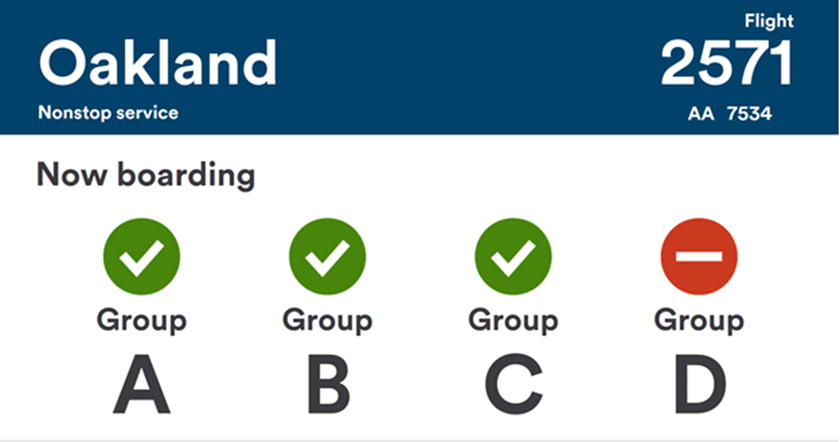
Alaska Airlines will be boarding in the following order:
- First class, pre-boarding for those who need extra time, and active duty military
- Group A: Million Milers, Alaska Mileage Plan MVP Gold 75Ks, and MVP Golds
- Group B: Alaska Mileage Plan MVPs and Premium Class passengers
- Group C: Those seated in the back half of the plane
- Group D: Those seated in the front half of the plane
The only change being made here is how they’re identifying the boarding order.
Here’s a comparison of the new and old boarding passes:
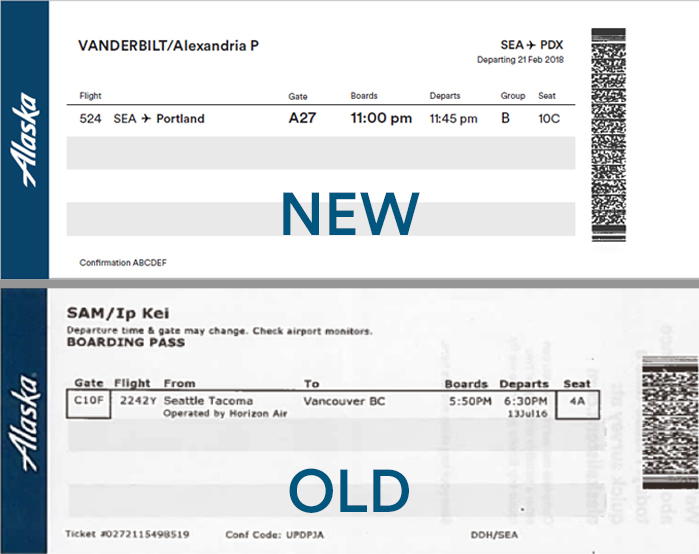
As you can see, previously boarding passes didn’t at all reference what boarding group someone was in, but rather passengers had to listen for their row numbers to be called. Under the new system, the boarding pass clearly indicates what group someone is in, as does the monitor (though oddly the above monitor doesn’t show first class boarding, which I find strange).
I like Alaska’s new boarding system. It’s straightforward, and adding boarding groups makes sense, since it makes it easier to identify what part of the boarding process they’re in.
All that being said, my biggest gripe with Alaska boarding is that I find they consistently start the process way too early. I’ve arrived at the gate over 30 minutes before departure, only to find that they were on the final boarding call. Alaska says that with this boarding system an announcement will be made 30-35 minutes out explaining the boarding process, and then the boarding process will begin, with groups being called in roughly five minute intervals. That sure doesn’t sound like the Alaska Airlines I know!
What do you make of Alaska Airlines’ new boarding process?


Membership is free and takes no more information than commenting as a guest. Earn status points for good contributions, and see fewer ads as your status grows.