
I’ve recently written about the Q2 2024 financial results of American, Delta, and United, which weren’t great, for the most part, and point to industry overcapacity (or at least that’s the narrative that airline executives like to tell).
JetBlue has today revealed its Q2 2024 financial results. The airline reported a modest profit of $25 million. While not great (given that this is the best quarter for most airlines), it’s still a big step in the right direction, as the airline has turned a quarterly profit for the first time in a long time.
In addition to revealing its financial results, JetBlue has also announced more about plans to return to sustained profitability, and this includes some pretty drastic action.
JetForward, JetBlue’s plan to return to profitability
JetForward is how JetBlue is referring to its evolved strategy of restoring profitability. The airline is focused on four priorities, targeting $800-900 million in incremental EBIT from 2025 to 2027.
So, what does JetForward entail? Some of the points are a little light on details, though let’s share what JetBlue claims as the four pillars of this strategy:
- Reliable and caring service, which includes improving on-time performance through investments in tools and technology, designed to enable better planning and recovery, and delivering outstanding and consistent customer service
- The best East Coast leisure network, focusing the network around leisure flying originating in New York, New England, Florida, and Latin America; this also includes pulling out of many markets that aren’t profitable
- Offering products and perks that customers value, including enhancing product offerings and loyalty perks to attract customers that value high quality and premium experiences, and optimizing product merchandising to maximize revenue potential
- Ensuring a secure financial future, by sustaining historical cost advantages, and restoring balance sheet health through balance sheet discipline
I’ve gotta give JetBlue credit here. While this is all easier said than done, these are exactly the things that JetBlue should be focused on. Interestingly there’s no announcement about JetBlue introducing first class throughout its fleet, though that’s expected soon.
JetBlue defers new aircraft to 2030 and beyond
Now I wanted to focus on what I’d consider to be the single biggest development from JetBlue today. The airline has announced that it’s deferring approximately $3 billion of capital expenditures through 2029, intended to improve the company’s cash flow outlook.
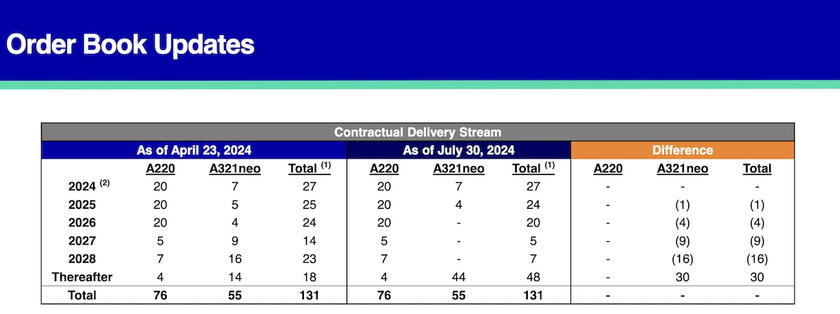
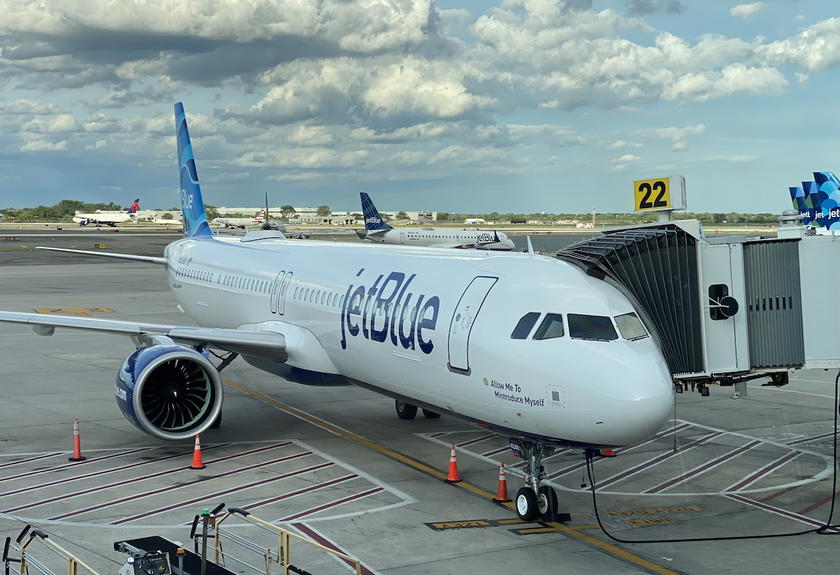
This includes deferring a total of 44 Airbus A321neo aircraft deliveries from 2025 to 2029, to 2030 and beyond.
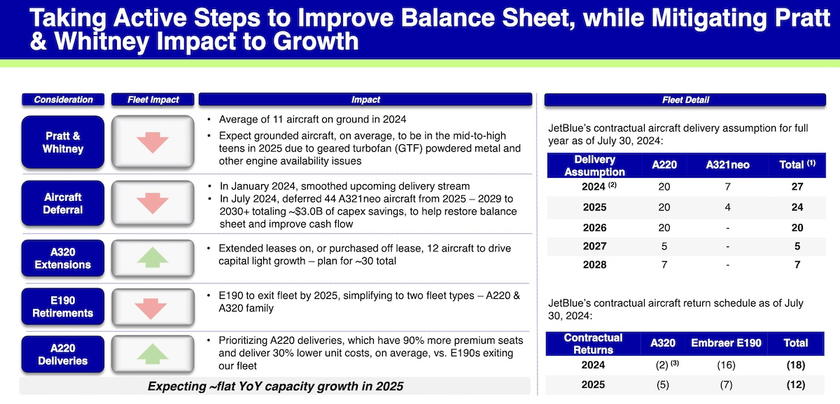
This has major implications for the airline. JetBlue will still take delivery of the Airbus A220-300s that it has on order, as previously planned. The airline has a total of 76 of these on order in 2024 and beyond. However, JetBlue doesn’t plan to take delivery of any new A321neos in 2026, 2027, 2028, and 2029.
JetBlue has A321neos, A321LRs, and A321XLRs on order, and many of those will be deferred (A321LRs and A321XLRs are a type of A321neo, so are presumably included with this change). Keep in mind that the A321LRs and A321XLRs were supposed to used for more long haul growth, so obviously we’re not going to see much expansion on that front anymore.
It remains to be seen how JetBlue’s overall capacity changes between now and the end of the decade:
- The airline is largely using A220s to replace E190s; the former are higher capacity, and also much more fuel efficient
- The airline is retiring some of its older A320s over time, so that will lead to a reduction in the “classic” fleet
- Some A320-family aircraft are also grounded due to Pratt & Whitney engine issues
This seems like a sensible development on JetBlue’s part. Airlines talk about overcapacity, but then still have very aggressive order books, which doesn’t seem like a great combination.
Bottom line
Along with revealing its Q2 2024 financial results, JetBlue has announced that it’s deferring the delivery of dozens of new planes. Specifically, the carrier doesn’t plan on taking delivery of any A320-family aircraft in 2026 through 2029, as these planes have been deferred to 2030 and beyond.
This has huge implications for JetBlue’s growth, and in particular impacts long haul growth. These changes seem logical enough, given the current state of the industry.
What do you make of JetBlue’s aircraft deferral?


Membership is free and takes no more information than commenting as a guest. Earn status points for good contributions, and see fewer ads as your status grows.