
Alaska Air Group has just made a major announcement when it comes to the future of Hawaiian Airlines’ inter-island service. Specifically, starting in 2028, Hawaiian will be taking over some Alaska Boeing 737-800s, and using them to replace Boeing 717s. This isn’t a surprising outcome, though it could’ve (in theory) also played out differently.
Hawaiian will take over some Alaska Boeing 737-800s
While Alaska and Hawaiian both belong to Alaska Air Group and are on a single operating certificate, the two brands maintain their own identities. So each brand has its own fleet of aircraft in their respective liveries.
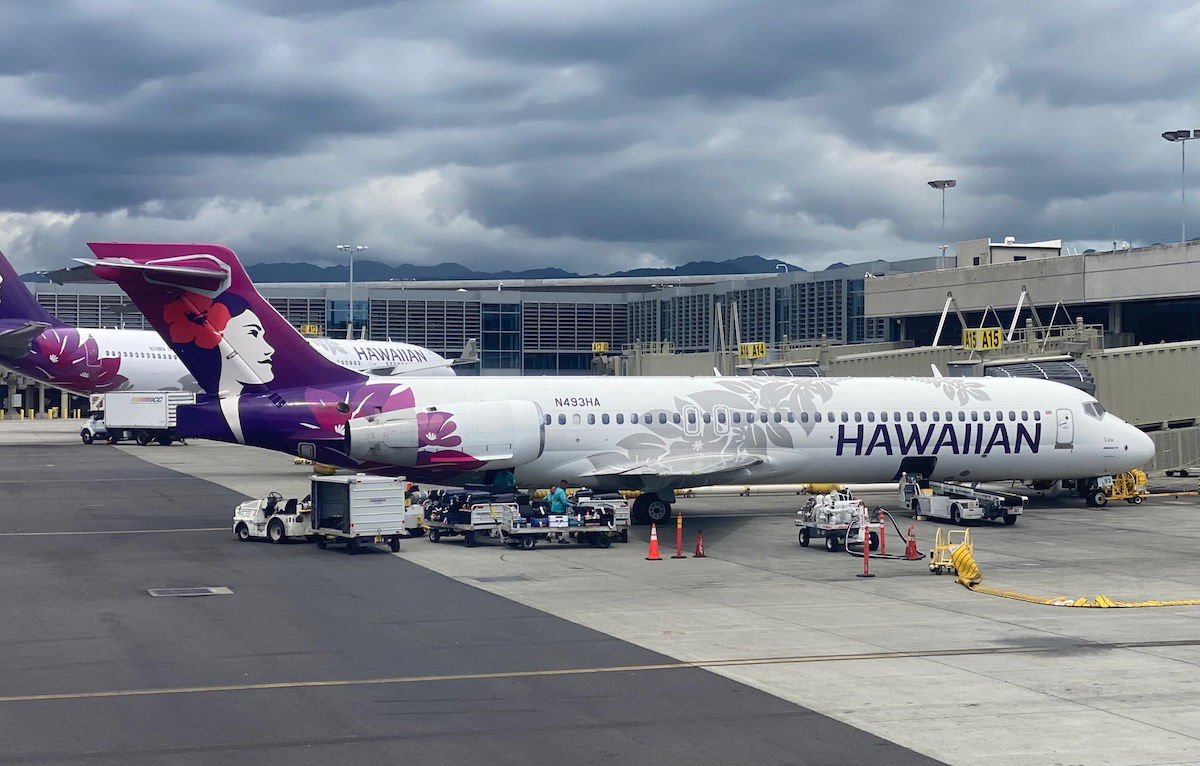
Currently, Hawaiian primarily uses Boeing 717s for its inter-island flying, as the airline has 19 of these planes in its fleet. While the airline also sometimes flies Airbus A321neos on inter-island flights (between longer sectors), the 717s are only used for these routes, and not any others.
We’ve known that the airline eventually planned to replace these, and we’ve now learned about the plan — Hawaiian will pick up some Alaska Boeing 737-800s, and they’ll be used for these flights. The goal is to begin the fleet transition in 2028, and move quickly to bring this additional capacity to Hawaii. As you’d expect, these planes will feature the Hawaiian livery, and will be flown by local crews.
Prior to that transition, as of October 2026, an Alaska branded Boeing 737 will already start flying between Honolulu (HNL) and Maui (OGG), with three daily roundtrip flights. This is described as being part of a plan to sustain frequencies while increasing capacity to meet the demands of the local community.
Alaska Air Group notes how this fleet transition will improve the passenger experience and expand capacity. Hawaiian’s 717s feature 128 seats, including eight first class seats and 120 economy seats. Meanwhile the Alaska 737s feature 161 seats, including 16 first class seats and 145 economy seats.
It’s noted how the 737s feature twice as many first class seats, plus 30 extra legroom economy seats, free Starlink Wi-Fi, more cargo room for surfboards, power outlets, seat back device holders, and more.

This was the obvious inter-island fleet renewal strategy
For quite some time, we’ve known that Alaska Air Group needed to make an inter-island fleet decision beyond the Boeing 717s. At one point, there was talk of whether the airline group could order new aircraft for these flights, whether that comes in the form of the Airbus A220, Embraer E190-E2, etc.
However, just using Alaska’s older 737-800s seems like the most obvious choice. Keep in mind that this kind of inter-island flying is really taxing on airplanes. These planes fly an insane number of cycles (takeoffs and landings, given the short length of the flights), plus the highly humid, salt-heavy environment is really tough on aircraft and engines.
So I would’ve been surprised to see the airline order purpose built aircraft for this mission, especially from a fleet complexity standpoint. With that in mind, just using 737-800s that would likely otherwise eventually be retired seems obvious enough.
Now, it goes without saying that the move from the 717 to the 737 will represent a significant per-aircraft capacity increase, as we’re talking about an extra 31 seats per flight. The economics of inter-island flying have become increasingly challenging over the years, with fares being down significantly, due to Southwest entering the market. Still, this is an important market for Hawaiian, and also for Alaska Air Group’s commitment to the state.
Bottom line
Alaska Air Group has made a fleet decision on the future of inter-island flying. As of 2028, Hawaiian Airlines will start to take over some Alaska Airlines Boeing 737-800s, and they’ll be used for inter-island flying, replacing Boeing 717s. Expect these planes to get the Hawaiian livery, and for this subfleet to be used exclusively for these routes.
This was the most obvious decision for Alaska Air Group to make, though there’s also a world where this could’ve played out differently, with a new aircraft order, or something.
What do you make of plans for a Hawaiian 737 fleet?




where are the 717s going? retired, or possibly leveraged for more west coast continental flying?
Delta baby! They just won't need those portable extended range fuel tanks Long Beach made for Hawaiian just for these models.
The 717s will be retired. They are 20+ years old, have been heavily used in very challenging conditions (high cycles, salt air, multiple short trips daily) although HA has done a formidable job of maintaining them.
I would assume retired. They're all 20+ years old and have been heavily used.
Delta, of course!
Perhaps some would be of interest for spare parts
More likely to the airplane knackery. The number of cycles they'd have racked-up is probably some kind of record.
There are no "longer sectors" in intra-island flying. Geographically, every single island route is <300 miles. When the 321s are deployed for intra-island it's for volume reasons, not distance
The 321neo inter-island flights are between layovers, not between longer distances within HI.
I've read that the 737Max isn't a good choice for their flying conditions, with earlier 737 models being better. If they had to buy something currently being made, what model would best serve their needs?
That is, actually a question. I also read newer 737s' engines do not like short frequent segments. That is also why Aloha kept their 200s for a very long time
ATR72. Except American pax hate them for some reason.
Didn't I read somewhere that Southwest is cutting a bunch of their flights to/from certain islands because the 737 isn't economical (more seats, but also means when less people fly in those, it's not worth it). I wonder if Alaska will continue the almost hourly departures if the planes aren't full? Guess only one way to find out.
Cranky extensively has covered intra-Hawaii both for HA and WN, most recently, WN is cutting frequencies and exiting some interisland markets.
Yes, it is obvious that AS/HA will use the 738; they have 5 dozen of them and they are the same sized - although different configured - than the 738s and now MAX 8s that WN has used for all Hawaii flying.
It is a given that AS/HA will reduce the number...
Cranky extensively has covered intra-Hawaii both for HA and WN, most recently, WN is cutting frequencies and exiting some interisland markets.
Yes, it is obvious that AS/HA will use the 738; they have 5 dozen of them and they are the same sized - although different configured - than the 738s and now MAX 8s that WN has used for all Hawaii flying.
It is a given that AS/HA will reduce the number of flights as they transition to larger aircraft.
the bigger story is that AS lost $76 million in the 2nd quarter and $269 million year to date; their guidance for the 3rd quarter is not enough to offset those losses so it is likely AS will lose money for the year.
Their domestic capacity is flat and will likely remain that way with their only capacity growth coming from longhaul widebody capacity growth.
Yield was up 10% (below DL and UA) and LF was down a percent and a half which means they will not likely grow capacity.
They have to get costs out and growth will slow. retiring the 717s will get costs out and simply the joint labor agreements which will increase their costs further.
That was a great article that Cranky wrote. I agree, Tim
The bigger story here is that nobody cares….
Actually, Roberto, others do care, even if you do not. As much as some like to give Tim a hard time about his Delta sycophancy, Tim is right to promote Cranky Flyer's post on this topic. Brett's take there was insightful.
you may not but lots of people do whether they spend time on aviation chat forums or not.
ALK is a weaker carrier as a result of their most recent merger and the runup of fuel prices. Mirrored a similar thing that happened with the Virgin America acquisition.
2027 might look better for AS or it might not.
@ben 717 has 128 seats, 8 first class and 20 economy seats?
Seems like the 737-700's of AS would be a better replacement to avoid such a big capacity bump (and associated downward fare pressure).
But I know AS doesn't have enough of those to do a 1:1 replacement of all 717's, and it may need the shorter field takeoff performance for certain airports in Alaska/mainland.
AS already converted most of their 737-700s to freight aircraft for freight services to remote Alaskan towns.
I was wondering the same thing about the 737-700.
I certainly prefer a 2-3 seat chart over 3-3, but I get that brand new a220s are unlikely to replace the 717, because the high-cycle and salt-air on those quick interisland flights would degrade those assets way too fast. As long as they keep serving that delicious guava juice, all will be well!
To me this reads as a stop gap measure. Alaska's 737-800 are already old and beat up and probably "paid for" by now. Its like buying an old used car you don't mind running into the ground.
The real question is what is Alaska's long term plan for interisland flights. The 737 seems like overkill. The E175 which Alaska uses seems too small. The E190 or the A220 seem to be better fits. Since...
To me this reads as a stop gap measure. Alaska's 737-800 are already old and beat up and probably "paid for" by now. Its like buying an old used car you don't mind running into the ground.
The real question is what is Alaska's long term plan for interisland flights. The 737 seems like overkill. The E175 which Alaska uses seems too small. The E190 or the A220 seem to be better fits. Since Alaska has experience with the E175 my bet is on the E190.
The 737 is just a placeholder.
There's something liminal about inter-island HA - particularly the mid-evening runs out of Honolulu. The older (and smaller) aircraft lend something to that, but aren't the critical feature. The ideal time is just late enough that it's starting to quieten down in the terminals but you're in the air in time to catch the sunset and red spectrum colors in the sky. It feels like a glimpse into an world similar but somewhat alien to...
There's something liminal about inter-island HA - particularly the mid-evening runs out of Honolulu. The older (and smaller) aircraft lend something to that, but aren't the critical feature. The ideal time is just late enough that it's starting to quieten down in the terminals but you're in the air in time to catch the sunset and red spectrum colors in the sky. It feels like a glimpse into an world similar but somewhat alien to ours. Beautiful and familiar but stubbornly out of phase with the robust pace of change today.