

Many airlines around the globe are currently struggling due to high jet fuel prices. Airline margins are razor thin under the best of circumstances (if they aren’t negative in the first place), and essentially doubling one of the largest operating expenses isn’t exactly easy to absorb.
So the Canadian government has created a program to help airlines, and it seems relatively fair. However, perhaps what stands out to me most here is WestJet’s stance — the airline is telling the government to stop helping airlines, and not screw over Canadian taxpayers. Say what now?!
WestJet blasts Canadian government airline loans
On Monday, June 8, 2026, the Canadian government introduced what’s described as “targeted support to help Canada’s airline sector weather global fuel market volatility.” This primarily consists of two things:
- The Canadian government had already announced that between April 20 and September 7, 2026, the federal excise tax on jet fuel has been removed, reducing the cost by four cents per liter
- On top of that, we’ve seen the launch of the “Liquidity for Airline Sector Resilience” facility, a loan program whereby eligible Canadian airlines experiencing financial pressures due to high jet fuel costs can get up to $150 million in repayable liquidity support, on an as-needed basis
I think the most interesting thing about this is how airlines are responding to this support from the government. In particular, WestJet is tearing into the government here, and I think the whole statement is worth sharing:
WestJet strongly opposes the government’s proposal to issue loans to airlines amid the rising fuel costs. The government faces a choice: continue with costly and market distorting subsidies or build a sustainable future for Canadian aviation.
We’ve seen where this path leads. In 2025 alone, taxpayers lost around $400 million in COVID-related airline loans that were forgiven by the federal government. With this, they have been turned into direct taxpayer subsidies to some airlines.
This time is no different as it is unlikely that they can ever be repaid by the airlines that might accept them, so they will easily result in further hundreds of millions of taxpayer dollars that could have been used for other more meaningful purposes.
The United States, our direct competitor, have deliberately stayed away from bailing out airlines in the spirit of fair and level playing field competition. Their airlines face the same oil prices as ours and Canada should stay away from distorting markets, both within our country and across the border to the US, especially at this sensitive time between our nations.
WestJet has proven a different path is possible to be a viable competitor in the Canadian market. We do not take government loans and instead advocate for a competitive environment where airlines can succeed based on their own strength.
We ask the government to abandon the cycle of corporate charity and focus on long-term stability by fixing the overdue foundational cost issues that hold our entire industry back.
An airline looking out for taxpayers, and opposing corporate charity? Say what now? Is this WestJet’s latest April Fools prank? 😉
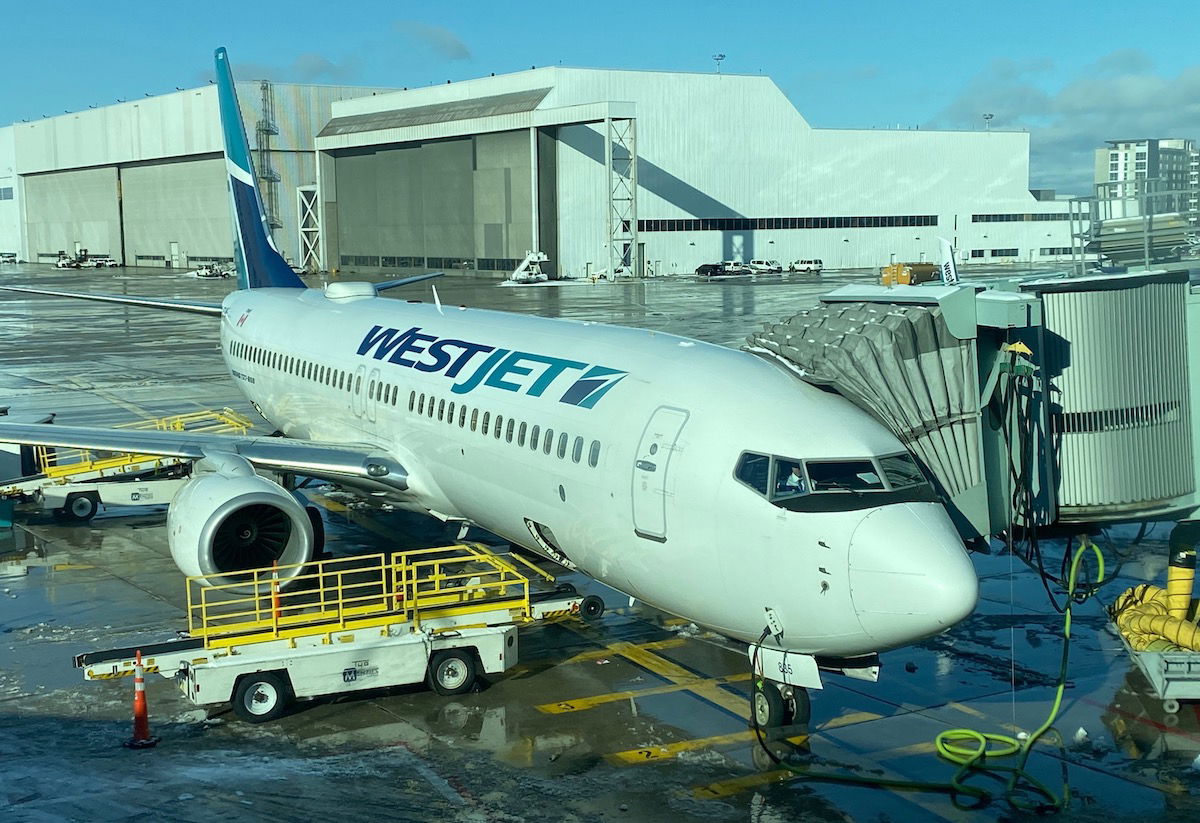
Why is WestJet looking out for taxpayers, exactly?
In fairness, it can be hard for governments to strike the right balance when it comes to providing support to airlines during tough times. The goal is to preserve competition without distorting the competitive landscape.
So that’s why I was super opposed to the concept we saw in the United States, where the government wanted to take over Spirit Airlines, as it would totally distort competition. However, in theory, the concept of giving loans to airlines in as fair of a way as possible strikes me as being less unreasonable.
Obviously airlines all have different financial strength and market positions, so they won’t all have the same perspective when it comes to what kind of support is appropriate. However, the extent to which WestJet is condemning the government is quite something here.
It seems pretty clear what’s going on here — WestJet thinks that at least one of its competitors may be on the verge of going out of business and can’t weather the storm. You have to look no further than the airlines that are thanking the government for the support, and saying they’re reviewing the loan offers — Air Transat and Porter Airlines.
Now, Air Transat has actually had a bit of a turnaround, and turned a profit in 2025, so I don’t assume that’s the primary target here. Instead, it’s Porter that’s the mystery — the airline isn’t publicly traded, so it’s hard to know the company’s financial situation. However, let me just say that there’s a lot of skepticism out there about the profitability of the company’s flying, especially given the pace at which it has grown.
I get WestJet’s perspective — while WestJet also isn’t publicly traded, the company’s management team has done a stellar job carving out a strategy that works. And their lack of desire for any government support even during tough times makes it clear that the airline can weather this storm.
I will say, the one thing that makes the Canadian government’s plan a bit unfair is that a $150 million loan will go a lot further for an airline like Porter than an airline like Air Canada, given their vastly different sizes.
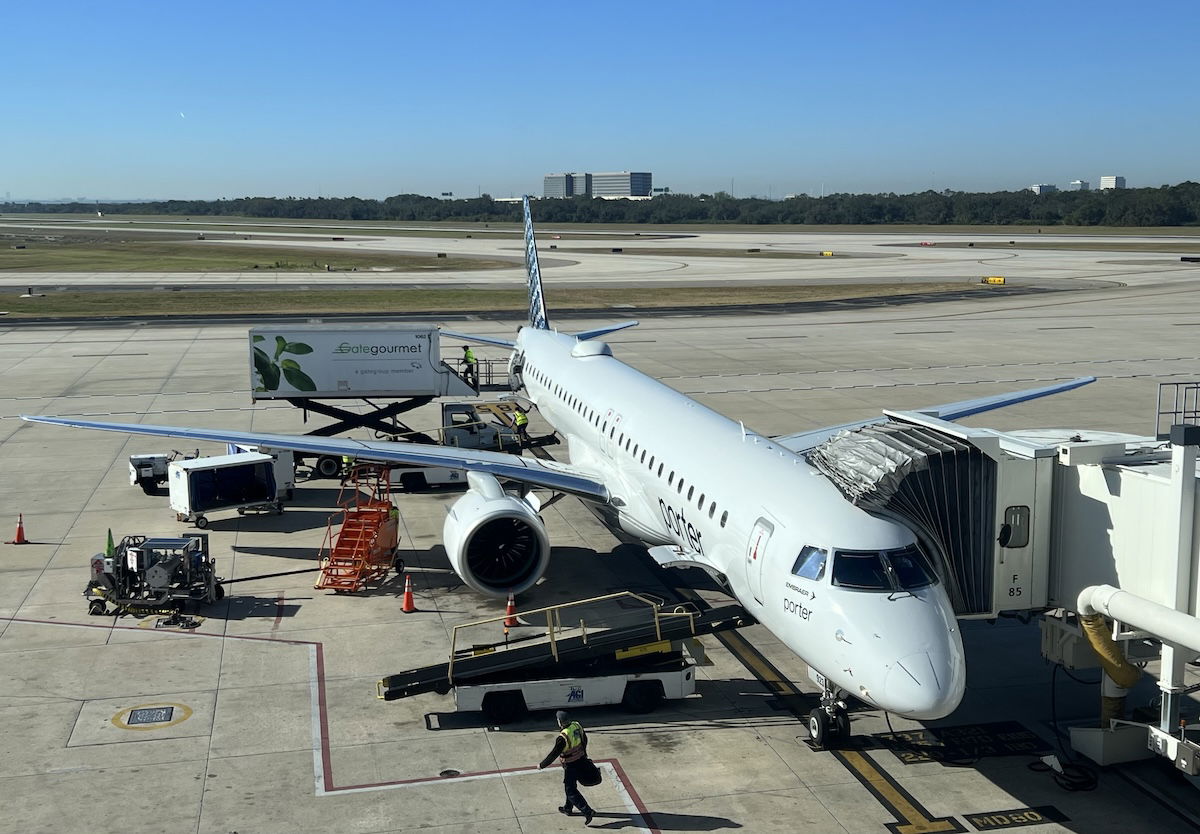
Bottom line
The Canadian government is trying to support airlines when it comes to the high cost of jet fuel. In addition to pausing the federal excise tax on jet fuel, the government is also offering up to $150 million in loans to offset higher jet fuel costs.
What’s interesting is how strongly WestJet opposes this — the airline claims this is a direct taxpayer subsidy to airlines, and it will result in hundreds of millions in taxpayer dollars being wasted. Admittedly airlines will have different takes on this, since not everyone has the same financial strength. However, this has to be one of the firmest oppositions we’ve seen from an airline when it comes to government support.
I certainly commend airlines that have been able to build their businesses to the point that they actually plan for bad times, and can sustain operations for an extended period of time, rather than relying on government support the second things go wrong.
What do you make of Canada’s program to support airlines, and WestJet’s response?




I'm going to guess that Westjet fully hedged its fuel prices for the year and they're trying to screw over their competition that didn't...
Porter finally started flying into YLW giving us an alternative to AC and WS. AS is an alternative but has decreased service to one a day and ATMOS long haul offers have dropped in value.
Certainly hope Porter succeeds as the last flight I had let me compare Porter to AC Rouge. Absolutely no comparison. Rouge is a nightmare. Perter great and half the price. (A Porter economy seat is as good as a Rouge Business).
Everyone basically detests West Jet.
Better yet, use those spare Alaska points on Porter! Have actually found some good deals that way, especially for PorterReserve. Wild!
Funny, no mention of Air Canada, but they bear the brunt of having to serve remote communities, especially in the North. I can’t help but wonder if part of the cut in fuel tax/offer of loans is to ensure AC doesn’t cut any service to remote areas, even though I believe they get some compensation for these routes to begin with.
I really enjoy flying with Porter. Every flight I've flown with them has been on time, love the 2x2 seats, I'm a fan of the city centre airport, they have frequent discounts and the service has always been fantastic. It would be a shame if they went out of business. OTOH I can't stand WestJet and try to avoid them at all costs.
Agreed! (And, sometimes, Alaska points are great redemptions on Porter's premium economy!)
Is it me or just a coincidence? After picking up my iPad again and asking Walter Mitty Dunn a question or two, he goes dark. I can only infer from his silence that he is not prepared to provide honest answers to pertinent questions.
Come along now Walter what has trucking got to do with the subject of this thread. You post gobbledygook to avoid answering questions and by doing so diminishing your credibility.
@DenB
It's all the same person.
It's fake Eskimo, and some other alter ego regulars.
Aboot me Eh? Too busy making fun fake of Canadians being offended for not speaking fake French to care about unions or decree, LOL.
Then there's Katy Perry.
And you'd think Tim Dunn is going to give me a well said compliment and I'm not even poking anything at Tim?
We still don't know when did UA flew 737 on EWR-LAX. My contacts in Flightaware is looking up "facts".
Too many fakes and alter egos roaming today.
And AeroB13a gibbers about the gibbering, "which bear[s] no relevance whatsoever to the published article"
Den, please be advised that the AeroB13a Guest post above is not of my doing. One suspects a disgruntled ex-Delta darlink perhaps?
No, I’ve been out for a glide around the shires on this fine June afternoon. Some fine thermals rising today, just perfect.
I will not hold your rebuttal against you as I will report the incident, not that anything will ever be done to curtail the nuisance. Notwithstanding, Ben will benefit from your click …. :-)
Aero (Diamond), do you actually think it's Tim impersonating you? Oof. Tim. Do better.
1990: Ben, if he had the inclination could easily put a stop to the practice. It may be coincidence, but when it happened before it was under similar circumstances. Your guess is as good as mine old mucker.
I thought it was the guy behind several aliases (Penile, Unintimidated, Greenburg Taurig, etc.)
1990, I do believe that the text has been cut and pasted from one of my previous posts. If you notice, I have hardly mentioned “The proletariat” for a while. Furthermore, when the post was added to the thread, I was probably at about 1000ft gliding above the Hampshire [the real one :-)] countryside. As for the flatterer, in truth, perhaps only Ben, can find out or get any idea.
They say that imitation is...
1990, I do believe that the text has been cut and pasted from one of my previous posts. If you notice, I have hardly mentioned “The proletariat” for a while. Furthermore, when the post was added to the thread, I was probably at about 1000ft gliding above the Hampshire [the real one :-)] countryside. As for the flatterer, in truth, perhaps only Ben, can find out or get any idea.
They say that imitation is the highest form of flattery, so, at my age I perhaps should soak it all up …. :-)
The "real one" bah! (So, not New Hampshire, I take it!)
No 1990, there is only one Hampshire and that is a county in England, again the real one! …. :-)
Uh oh… Guest Aero! ;-)
Where to begin @Eskimo? I don't see an "LOL" in your post so I'm assuming you actually advocate:
- eliminating unions, in Canada, by government decree
- closing operating airlines by government decree
- preventing Air Canada buying from two of Boeing, Airbus or Embraer
- government auditing private, family-owned companies
Um, yeah, so the "burden" is already on flyers, who pay very high taxes and fees on flying, and on airlines,...
Where to begin @Eskimo? I don't see an "LOL" in your post so I'm assuming you actually advocate:
- eliminating unions, in Canada, by government decree
- closing operating airlines by government decree
- preventing Air Canada buying from two of Boeing, Airbus or Embraer
- government auditing private, family-owned companies
Um, yeah, so the "burden" is already on flyers, who pay very high taxes and fees on flying, and on airlines, which pay the highest airport fees in the world to serve Canadian airports, which are owned by the federal government. If the government stops paying for essential air services, they'll still collect the taxes and fees. Essential air services are operated because people vote people out who kill them, and they vote in people who will restore them. They have to operate (looked at a map recently? how could they not?) and the government has to have a scheme to make it so. Eliminating them is not a political option.
porter doesn't open their books to the kind of people who show up for merger due diligence, so not sure on the Transat idea.
Air Canada keeps good relations with more than one aircraft manufacturer. It's sound policy and if it costs money not to have an ultra-simple fleet, they think it's worth it. I don't know about you, @Eskimo, but I don't know as much as they do, so I don't have an opinion on this approach.
The portion of Canada's population holding as hostile a view as yours towards unions is in the low 30 percentile. Since we're talking about actions a government might take, I'll leave it there.
"airline market is in critical need of consolidation"? Says who? What's the problem? What lawful, politically viable measures would alleviate the problem? Many say that the market needs exactly the opposite of consolidation.
"government...prop them all up"? In Canada, government collects vastly more money from air travellers in direct charges than in USA. it's refreshing when they use a little of that money for a useful, aviation-related purpose. If airlines hanging on by a thread, I'm not sure my response is "kill the weak ones!".
You know-nothing!
I know-fake!
There’s a recurring issue in these kinds of “simple consolidation fixes everything” arguments - they treat aviation like it’s a spreadsheet problem rather than a geographically constrained, capital-intensive, heavily regulated, labour-dependent network industry operating in one of the most challenging domestic geographies in the world.
Let’s go point by point.
On “critical need for consolidation”
The claim that Canada is “obviously” over-supplied with carriers ignores why those carriers exist in the first place. Canada is...
There’s a recurring issue in these kinds of “simple consolidation fixes everything” arguments - they treat aviation like it’s a spreadsheet problem rather than a geographically constrained, capital-intensive, heavily regulated, labour-dependent network industry operating in one of the most challenging domestic geographies in the world.
Let’s go point by point.
On “critical need for consolidation”
The claim that Canada is “obviously” over-supplied with carriers ignores why those carriers exist in the first place. Canada is not a dense European-style short-haul market. It is a long-distance, thin-density, seasonally volatile network with a handful of trunk routes and a large number of marginal or regionally dependent routes.
Consolidation does not magically remove the economic constraints of geography. It often simply results in higher fares, reduced frequency, and thinner route coverage outside major city pairs. The assumption that fewer airlines automatically equals a healthier system is not supported by airline economics in markets of this structure.
On proposed “closures” and forced mergers
Suggesting closure of carriers like Flair or forced mergers such as Air Transat with Porter ignores the basic reality that low-cost and leisure carriers often serve distinct demand segments that legacy carriers either do not serve efficiently or choose not to serve at all.
Removing them does not “clean up inefficiency”—it typically transfers their traffic into higher-yield networks or eliminates it entirely. That is not the same thing as efficiency; it is capacity contraction.
Similarly, mergers are not administrative exercises. They involve fleet overlap, AOC integration, labour negotiations, fleet harmonisation, and often multi-year disruption before any theoretical synergies are realised.
On regional airlines and “Essential Air Services”
This is where the argument diverges most sharply from operational reality. Regional aviation in Canada is not an artificial construct; it is the backbone of connectivity for remote and semi-remote communities.
Calling it a “burden on taxpayers” ignores that the alternative is not efficiency—it is isolation or dramatically higher per-seat costs borne directly by consumers rather than subsidised through structured programs. Many jurisdictions explicitly accept this trade-off because aviation is not just a commercial product; it is a connectivity infrastructure layer.
On fleet simplification at Air Canada
In theory, fleet simplification reduces complexity. In practice, airlines already optimise fleets within operational constraints.
Air Canada’s current fleet structure is a product of route diversity: transborder, domestic trunk, long-haul widebody, and regional feed all require different aircraft economics. A forced “one aircraft per category” model sounds neat but ignores real-world issues like:
* Stage length variation
* Airport performance constraints
* Seasonal demand swings
* Cargo uplift requirements
* Aircraft availability cycles
Airlines already push toward simplification where feasible; the remaining complexity is not inefficiency—it is operational necessity.
On unions and fare pricing
This is where the argument becomes least aligned with observable data.
Airline pricing is primarily driven by:
* demand elasticity
* yield management systems
* capacity discipline
* fuel costs
* airport and navigation fees
* currency effects
Labour is a component of cost structure, but it is not a direct, linear determinant of fare levels. The comparison to specific US domestic fares is also not meaningful without controlling for network structure, competition density, and subsidy environments.
Labour relations in aviation are not a distortion of the system—they are part of how safety-critical, highly trained workforces are sustained over long operational cycles.
On “government oversight of airline P&L and revenue management”
This is the point where the proposal effectively moves from industrial policy into direct state control of commercial decision-making.
Airline revenue management is not a corruption vector; it is the core mechanism by which airlines allocate scarce inventory across time, demand curves, and network constraints. Government micromanagement of this would not reduce inefficiency—it would dismantle the pricing mechanisms that allow capacity to be allocated dynamically.
The historical record on state-directed airline commercial operations is not particularly supportive of improved efficiency or consumer outcomes.
Final assessment
The underlying assumption running through all of this is that complexity in aviation is self-inflicted and can be “cleaned up” through consolidation, labour suppression, and administrative control.
In reality, most of what is being labelled as inefficiency is actually the structural outcome of geography, demand distribution, safety regulation, and capital intensity.
Consolidation can play a role in certain markets. But treating it as a universal corrective force—and layering on top-down operational control—does not simplify aviation. It typically replaces market complexity with systemic rigidity, which tends to show up later as reduced connectivity, higher barriers to entry, and less resilient networks.
very well said; airlines worldwide are the product of geography.
and consolidation has allowed AC to grow into parts of the country where it has not been as strong.
The Canadian market covers very similar amounts of geography as other large countries and yet, without consolidation of one form or the other, Canadians pay a premium for lots of competition that expresses itself in market strength in various parts of the country.
WestJet could...
very well said; airlines worldwide are the product of geography.
and consolidation has allowed AC to grow into parts of the country where it has not been as strong.
The Canadian market covers very similar amounts of geography as other large countries and yet, without consolidation of one form or the other, Canadians pay a premium for lots of competition that expresses itself in market strength in various parts of the country.
WestJet could very likely be a stronger nationwide competitor if some of the financially weaker airlines in eastern Canada failed and WestJet was able to grow.
and I believe that WestJet is arguing for allowing the natural process of business failure reduce the number of airlines far less than consolidation through mergers.
The US has taken a pretty similar stance regarding airlines in trying to preserve competition which leads to inefficiency. NK is gone, the first airline failure in years even though data has said for years that there are too many economy seats chasing too little revenue for all those seats.
Well said, Darryl. Tim doesn't actually care about anything but Delta's quarterly profits. He'd burn everything down if it mean 'line go up' for another round. Psh.
Does WestJet have it's own interests it's looking out for? Of course. The bigger question is why does government constantly bail out private business? There are other lines of business suffering from either higher fuel prices or slack demand or both. Where's their bailout?
thank you.
Trucking is suffering far more than airlines due to high reliance on diesel and trucking and ground transportation is a much larger part of just about every country's economy than airlines.
Whenever George and Tim agree, I'm automatically skeptical, since they're usually pro-industry, anti-consumer, anti-worker (and in Tim's case, pro-Delta, anti-United, at all costs).
So, I suspected Tim would support WestJet here given Delta’s 15% equity stake. His goal is to see WestJet starve out Porter and Air Transat, mirroring his desire for a simplified DL-UA oligopoly in the US. A consolidated Canadian market gives Delta exactly what it wants...
1990, thank you for providing more background information on the Walter Mitty Donn character. His inability to provide a coherent explanation for his missives and misgivings is starting to make sense now. Do you think that these shortcomings are part of the reason why Delta sacked him?
Walter Mitty Dunn posts: “Trucking is suffering far more than airlines due to high reliance on diesel and trucking and ground transportation is a much larger part of just about every country's economy than airlines”. I say prove it Walter, post some facts to sustain your narrative.
According to the Government of Canada websites, trucking dependence is approximately half that of those dependent upon the Canadian aviation industry.
Aviation: 1m
Trucking: 450k
I...
Walter Mitty Dunn posts: “Trucking is suffering far more than airlines due to high reliance on diesel and trucking and ground transportation is a much larger part of just about every country's economy than airlines”. I say prove it Walter, post some facts to sustain your narrative.
According to the Government of Canada websites, trucking dependence is approximately half that of those dependent upon the Canadian aviation industry.
Aviation: 1m
Trucking: 450k
I encourage you to attempt to provide data to support your opinion Walter, yes?
Is that why Delta sacked you, for publishing unsubstantiated information?
Aero, if Tim has to bring up 'trucking' on an aviation post... that tells you he's pivoting away from what's really at stake here. It's a sign of desperation. Bah!
The excise tax on fuel has also been waived for the same time period, so it isn't just the airlines, it was just the airlines that were still going to be paying it
Westjet should focus on their own customer screwing like the recent switch planes and then cancel without recourse
visibility is the reason. government does what they can't get away with not doing.
of course gov't does what is in their best interests and, as noted, aviation, not just airlines, employ lots of people. The article doesn't say it is reducing taxes on other forms of aviation including general aviation.
but trucking ALWAYS has a bigger consumer impact than air travel except in small island countries. air fares are a much smaller part of the cost of living than all of the goods that are carried by truck.
...of course gov't does what is in their best interests and, as noted, aviation, not just airlines, employ lots of people. The article doesn't say it is reducing taxes on other forms of aviation including general aviation.
but trucking ALWAYS has a bigger consumer impact than air travel except in small island countries. air fares are a much smaller part of the cost of living than all of the goods that are carried by truck.
because some people don't underestimate basic economic principles doesn't make them right with their cherrypicked statistics.
and 1990,
George and I understand that distortion of markets only hurts consumers while you, like a good liberal, thinks consumers should always benefit - but can never explain who is supposed to pay the bill - or get them to.
looks like even San Francisco voters are smart enough not to target highly paid execs; they might have more sense than leaders of Seattle and NYC
No, Tim, like usual, you're just advocating for your preferred business (Delta and its investments). The truth remains that WestJet (and Delta) have anticompetitive motives here, and that's bad for the whole market and consumers alike. Everything else you mention (trucking, partisan ideologies, SEA/NYC is mere distraction.)
(Aero, if you must know 'the game' here... Tim is resorting to his ole playbook: pivot to macro-level patronizing, weaponize "basic economics," and take personal swipes at other...
No, Tim, like usual, you're just advocating for your preferred business (Delta and its investments). The truth remains that WestJet (and Delta) have anticompetitive motives here, and that's bad for the whole market and consumers alike. Everything else you mention (trucking, partisan ideologies, SEA/NYC is mere distraction.)
(Aero, if you must know 'the game' here... Tim is resorting to his ole playbook: pivot to macro-level patronizing, weaponize "basic economics," and take personal swipes at other frequent commenters. It's a dance! Enjoy!)
Again, smoke and mirrors Walter, smoke and mirrors. Absolutely nothing substantial to back up any of your ramblings, is that why Delta shoved you out of their door Walter?
Hey, y'all, see the "Iran War Fuels Skyrocketing Airfare" post from June 10 (a day after this one), wherein George and Tim argue the polar opposite points on that post. Buncha jokers...
well said.
and while WestJet's focus is not AC as some think, AC has way too much of the market for a single carrier.
THAT is part of why airfares in Canada are so insanely high - but it will not likely ever be corrected.
Westjet can't help ranting about this, because it's a Government of Canada initiative, so it must be bad.
It's an Alberta thing.
"It's an Alberta thing" comment clearly indicates that you are not an Albertan and knows next to nothing about Alberta. WestJet does not represent Alberta, despite the fact that Alberta government extended a well generous offer to establish its quarter in the province. It did not and does not receive federal government bailout while sending the most tax receipts from its oil rich reserve, among the top three provinces, to the federal treasury. Its contribution...
"It's an Alberta thing" comment clearly indicates that you are not an Albertan and knows next to nothing about Alberta. WestJet does not represent Alberta, despite the fact that Alberta government extended a well generous offer to establish its quarter in the province. It did not and does not receive federal government bailout while sending the most tax receipts from its oil rich reserve, among the top three provinces, to the federal treasury. Its contribution to the Canada far exceeds the rest of the country. I gather you are Ontario resident.
Ontario taxpayers paid just over $92 billion in income taxes and,
Alberta residents paid just under $30 billion according to the latest CRA data so about 32% of what Ontario oays into Federal coffers.
Alberta also has 1/3 the number lf residents as ontario….so on a per capita basis
The federal government is liberal and they do anything to support anything Quebec! So since this is "hush hush" it's got to be Air Transat, that needs the money.
Naturally as always it will never be paid back.
"paid back"? It's a tiny opportunity for a small fraction of our flight taxes to be put to some aviation use. Westjet is turning it into an Alberta rant about Libs and Ottawa, throwing red meat Alberta resentments and petulance. "Government offers to help with wasy loans if you need it" is bad if it comes from Liberals in Ottawa.
Nice conspiracy theory... let's see if it's true before getting out the pitchforks.
If so, it reminds me a bit of all that PPP money in the US that went to 'small business owners' buying second homes and jet-skies? (Sorry, a bit off topic, but that was a mess... socialism for the rich, rugged individualism for everyone else, is a very Republican concept, down south.)
Rather than Porter Airlines, I'd be surprised if it's ULCC Flair Airlines that WestJet is hoping to see as the next Canadian airline to go under. It's based out of nearby Edmonton (out of which WestJet operates more and more flights), but also flies a lot of routes out of WestJet's main hub, Calgary. Plus, Flair's planes have "fixed recline" seats aka ones that don't recline — the same type of seats that WestJet installed...
Rather than Porter Airlines, I'd be surprised if it's ULCC Flair Airlines that WestJet is hoping to see as the next Canadian airline to go under. It's based out of nearby Edmonton (out of which WestJet operates more and more flights), but also flies a lot of routes out of WestJet's main hub, Calgary. Plus, Flair's planes have "fixed recline" seats aka ones that don't recline — the same type of seats that WestJet installed but later had to backtrack on due to public outcry.
This was honestly my immediate thought as opposed to Porter and AT both of whom sorta fills different niches than WestJet. Flair is the Spirit of Canada, it wouldn’t surprise me if they have the same financial woes that Spirit did and are closer to the brink of insolvency than folks realize.
Interesting to see how they are "playing the game" and accusing the government of Communism. The government, of course, is vehemently opposed to being ruled as communistic and therefore will cancel this program based on a calculation of balance of probabilities. This will result WestJet getting the full amount of what's been divvied up for the Big Five as "hush money". Smart strategy, and I am betting we'll see this initiative cancelled with a under-the-table...
Interesting to see how they are "playing the game" and accusing the government of Communism. The government, of course, is vehemently opposed to being ruled as communistic and therefore will cancel this program based on a calculation of balance of probabilities. This will result WestJet getting the full amount of what's been divvied up for the Big Five as "hush money". Smart strategy, and I am betting we'll see this initiative cancelled with a under-the-table remittance to WJ by end of week!
WestJet thinks it’s playing 4D chess, but it’s just gaslighting if it thinks repayable loans are 'communism.' What next? Is a 30-year fixed rate mortgage the new Soviet Union? Quick, someone call the politburo, I mean, Wall Street!
The Canadian airline industry is still rather fractured for a market as small as Canada's is; WestJet would love to consolidate its strength by the failure of a couple of those smaller airlines - its focus is not Air Canada.
and a whole lot of other countries around the world are going to be doing similar things in the coming months as the mess in the Middle East drags on. The good news is that...
The Canadian airline industry is still rather fractured for a market as small as Canada's is; WestJet would love to consolidate its strength by the failure of a couple of those smaller airlines - its focus is not Air Canada.
and a whole lot of other countries around the world are going to be doing similar things in the coming months as the mess in the Middle East drags on. The good news is that global economies are not on the verge of collapse due to high fuel prices or even the rapid rise of them and there has been a lot of fuel demand worldwide that has been eliminated as a result of the war - which should make environmentalists happy.
Major economies will figure out how to live with high fuel prices; they aren't the highest the world has ever seen in historic terms but make a lot of transportation unprofitable.
and as much as we love to talk about airlines here, diesel fuel is as high as jet fuel in many parts of the world and a far higher percentage of economies are dependent on diesel fuel rather than jet fuel.
specific to aviation, a whole lot of capacity will be coming out of airline networks in the fall and winter.
Somebody took a shit in your brain???
in contrast, of course, to your complete inability to engage in the discussion so you attack other people.
do you think you could at least post a SINGLE sentence on the topic?
NO! I refuse to engage or respond to such meaningless drivel and your poorly thought-out, moronic and imbecilic fantasies!
but you waste time trashing other users even as you call someone else moronic.
Eskimo doesn't always hit homeruns but he did in his post above. Think you could at least aim for the outfield even if you strike out?
Bull! I don't waste time at all. I correct people who are blatantly WRONG!
(Pretty sure Tim just impersonated Eskimo to repeat his own biased arguments to himself...)
Jessica, no need to taunt Tim, personally. What he said on-topic was bonkers enough.
I suspected Tim would support WestJet, at all costs, since Delta owns a major 15% equity stake in WestJet. Tim can't call them out, even when they're acting absurd, because he actually wants WestJet to starve out Porter and Air Transat. Very similar to how Tim wants the US market to become a simplified DL-UA oligopoly of two.
A consolidated...
Jessica, no need to taunt Tim, personally. What he said on-topic was bonkers enough.
I suspected Tim would support WestJet, at all costs, since Delta owns a major 15% equity stake in WestJet. Tim can't call them out, even when they're acting absurd, because he actually wants WestJet to starve out Porter and Air Transat. Very similar to how Tim wants the US market to become a simplified DL-UA oligopoly of two.
A consolidated Canadian market where WestJet dominates the domestic space is exactly what Delta wants. It gives Delta a clean, powerful, and unbothered feeder network north of the border to funnel transborder premium traffic into its hubs.
It is the exact same playbook he advocates for in the US: squeeze out the low-cost disrupters, let the majors divide the spoils, and keep the oligopoly running smoothly. Tim isn't looking at this as a neutral observer; he's looking at it as a Delta shareholder protecting the northern flank.
Watch out, WestJet. The RCMP’s elite tactical moose unit is rolling out, and those maple-syrup darts are locked and loaded. /s
It's a repayable loan, not a subsidy (although Westjet is suggesting that the recipients would not be able to repay). It is conditioned on limits on executive compensation and shareholder distributions - maybe that's why Westjet isn't interested in partaking.
To me, the tone of that letter really goes against their friendly and caring brand. I'm not sure who the intended audience is. If they are marketing to people who want to travel, surely...
It's a repayable loan, not a subsidy (although Westjet is suggesting that the recipients would not be able to repay). It is conditioned on limits on executive compensation and shareholder distributions - maybe that's why Westjet isn't interested in partaking.
To me, the tone of that letter really goes against their friendly and caring brand. I'm not sure who the intended audience is. If they are marketing to people who want to travel, surely those people would prefer the lower prices when there are more competing airlines. If they are targeting people who don't travel a lot and don't what the government to spend in this way, what does Westjet gain if those people aren't travelling?
I've never experienced any friendliness or care from any brand. Although some brands happen to have some friendly and caring staff.
I haven't flown either yet but I constantly hear from people I know many good things about Porter and many bad things about Air Transat. It'd be...
I haven't flown either yet but I constantly hear from people I know many good things about Porter and many bad things about Air Transat. It'd be sad to see Porter going belly up as they have really created new routes that the two big airlines would never consider :(
Just wanna echo praise for Porter. I've flown them mostly between NYC and Toronto. It's an awesome smaller airline. If going to/from the city, YTZ is far better than YYZ. PD has all smaller aircraft, so no middle seats; specifically, their newer E2s are impressive. (Also, kinda silly, but their cute racoon mascot is worth signing up for their emails, just to see the creative clip-art!)
Yeah, the racoon has friends and everything. They're all lovely.
Mr. Porter and his friends are the best! His various outfits and accoutrements are hilarious.
Just got one this morning: "Enjoy a warm welcome to Winnipeg!" Mr. Porter is gardening!
oh yeah, really cute!
Got another one! "This sale is off the chain..." *Mr. Porter on a tandem bike with his duck friend wearing helmets of course, because safety first*
Got one more today... "Flights to Turks & Caicos start this winter" ... Mr. Porter is riding a horse on the beach! Oooh lala!
WestJet appears to have some integrity , unlike the rest of the airlines .
Oh, please do share your definition of "integrity"... I'll wait.
WestJet's sudden pivot to fiscal conservatism is just a convenient excuse to protect their own turf.
1990 ... Honesty and uprightness , as was Fiorello LaGuardia .
Mayor LaGuardia built public infrastructure to connect people; WestJet is just trying to clear the runway of its rivals.
I notice that there was no concern expressed by WestJet in regard to the fuel tax holiday, which benefits them, only the loan program which might benefit a competitor and is on terms they do not want. You can bet that they would be happy to take tax payer money if there were no strings attached.
Exactly, Farmorthtrader. WestJet is disingenuous at best here. Delta fanboys like Tim are jumping on the bandwagon because it helps Delta’s 15% equity stake. Don't take the bait.
Maybe Westjet has some integrity... certainly not a lot: https://www.cbc.ca/news/gopublic/go-public-westjet-flight-cancellations-9.7191542. Swapping planes out to avoid paying compensation isn't ethical.
It is estimated that the Canadian commercial airlines industry employs somewhere between 800,000 and one million people. What this effectively means is that approximately 1 in 50 people are reliant upon the Canadian aviation industry.
Due to the population size in comparison to the land mass of Canada, for the majority of the population, air travel is vitally important. The Canadian government could be said to be well aware of the importance of loans...
It is estimated that the Canadian commercial airlines industry employs somewhere between 800,000 and one million people. What this effectively means is that approximately 1 in 50 people are reliant upon the Canadian aviation industry.
Due to the population size in comparison to the land mass of Canada, for the majority of the population, air travel is vitally important. The Canadian government could be said to be well aware of the importance of loans to sustain both the airline industry and the public sector too.
And to sustain the excessive airline executive compensation .
Alert, I am not certain that I understood your comment, would you add some meat to the ‘snack’?
What you also forget is that WestJet is now deeply entrenched in YYC. Which is the oil capital of Canada, likely the execs there are unhappy.
And, apparently, some US far-wing oligarchs are still pumping millions into secessionist propaganda over there... real Albertans and all Canadians should reject that astroturf'd nonsense.
According to WestJet, offering loans is some sort of ‘communism,’ now? Buncha jokers…
Ironically, among the regular commenters, you're as close to a Communist as it gets.
Oh, with a capital-C, eh? Buncha jokers…
If only...