

Latvian flag carrier airBaltic has been in a rough financial spot for some time, and in recent weeks there has been talk of the airline potentially needing to suspend operations due to running out of cash.
The airline has now unveiled a new business plan, intended to strengthen its long term sustainability. This is actually a pretty radical transformation, so expect a lot of things at the airline to change… particularly, its network! First let’s talk about what’s changing, and then we’ll talk about how airBaltic got into this situation in the first place.
airBaltic unveils updated, long term business plan
airBaltic’s supervisory board has just approved the carrier’s updated business plan, which is intended to strengthen the company’s long term competitiveness, establish a sustainable capital structure, support future development, and maintain reliable connectivity for Latvia and the wider region.
Here’s what will be changing, summarized as succinctly as possible:
- airBaltic currently has a fleet of 54 Airbus A220-300s, and was planning on growing that fleet to 100 planes; however, the airline now plans to shrink instead, decreasing its fleet to just 36 planes by the end of 2026, before eventually increasing the fleet to around 40 planes by 2031
- The airline plans to largely maintain its scheduled capacity (since the airline does a lot of leasing out of aircraft — more on that below); available seat kilometers are expected to decline from 9.6 billion in 2026 to 8.7 billion in 2027, before gradually increasing to 10.5 billion by 2031
- airBaltic will continue to have a network heavily focused on Latvia, but rather than pursuing broad expansion, the airline will focus on deepening its presence in existing markets by increasing frequencies where demand and profitability are strongest
- airBaltic largely leasing out its aircraft to other airlines under a wet lease model (particularly Lufthansa Group carriers), but the airline plans to increasingly focus on year-round deployment with this strategy, to mitigate the seasonal issue
To fund these changes, airBaltic is seeking 225 million EUR in interim financing, intended to bridge the company to a permanent financing solution. The company is also seeking 100 million EUR of new capital. Here’s how Erno Hildén, airBaltic’s CEO, describes this updated strategy:
“Every successful airline must continuously adapt to a changing market. Thus, this business plan is about making disciplined choices that strengthen airBaltic’s long-term competitiveness while preserving what matters most – reliable connectivity and operations, together with financial sustainability. It provides a stronger foundation for the company’s future and positions us to create long-term value for our customers, partners and Latvia.”
How airBaltic has found itself in such a tough spot
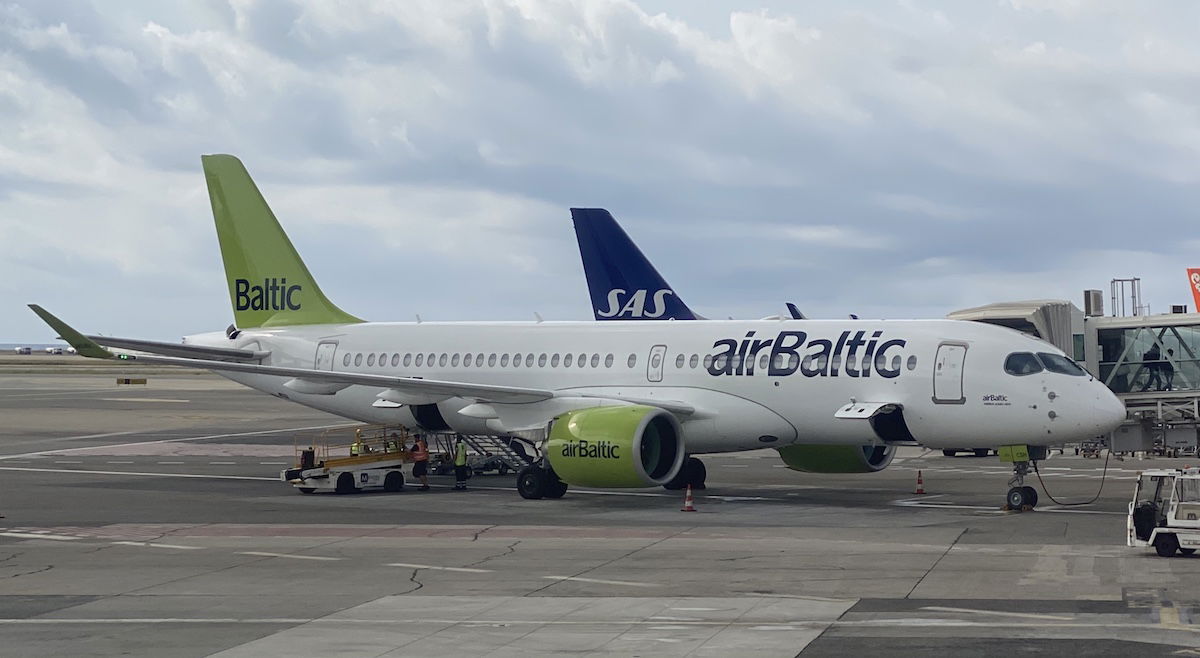
airBaltic has historically been an incredibly well run airline. The CEO used to be Martin Gauss, but he was fired (which I found to be an odd decision), and he’s now CEO of Gulf Air. airBaltic operates an all-Airbus A220 fleet, and the airline had huge growth plans, and intended to acquire 100 of these aircraft.
For a long time, the idea was as follows:
- Latvia has convenient geography for connections in Northern Europe, as well as to Russia, etc.
- Latvia is part of the European Union, but airBaltic has a major cost advantage, given that Latvia is a bit cheaper than some other countries in the EU, so there was merit to the airline wet leasing its aircraft to other airlines
However, as you’d expect, the situation has evolved over time. With Russian airspace closed to airlines from the European Union, that has massively limited airBaltic’s potential route network, and particularly has limited the number of connecting itineraries the airline can sell. If the current conflict with Russia didn’t apply, it would be a totally different story at airBaltic.
While airBaltic continues have a robust wet leasing business, the issue is that most airlines looking to lease planes only need them in summer, and not winter, given that it’s when demand is highest. In early 2025, Lufthansa Group even bought a small stake in airBaltic, in part because of how much it values the wet lease agreements for subsidiaries like Lufthansa, SWISS, Brussels Airlines, etc.
But the issue is that summer-only wet leases need to be able to cover costs not just for summer, but also winter, since it’s not like airBaltic has anywhere to profitably fly those excess planes in winter.
What has really caused issues for airBaltic in recent times is the increase in fuel costs. Not only have fuel costs increases been particularly bad in Northern Europe, but it’s also tough to be a full service(ish) airline that exclusively has a regional network, given how robust ultra low cost carrier competition is in the region.
Unfortunately for airBaltic, shrinking probably is the right choice here. That way the airline can focus its network on routes that are actually profitable, and on top of that, can be more selective about wet leasing, to airlines that actually value having planes on a year-round basis.
Bottom line
airBaltic has been on the brink of collapse in recent months, and the company’s board has approved a new business plan, which will include some major changes. The most significant change is that the carrier’s fleet will go from 54 planes to 36 planes by the end of the year. Then by 2031 the fleet will grow to 40 planes, compared to the planned 100 planes.
With this downsizing, airBaltic also plans to increasingly focus on its most profitable routes, so expect some network cuts. We’ll also see reductions to the carrier’s wet leasing operations, as the airline tries to secure year-round deals, rather than just seasonal deals.
What do you make of these airBaltic updates?




Where are all those planes they have in their reduction going?
They've also got hubs at Vilnius and Tallinn, right? Since their point-to-point traffic isn't generating them much profits, I wonder if they might find more luck by becoming more premium? Or even pivoting to long haul flights eventually a la Finnair?
Hope the best for them. I've always enjoyed my flights on Air Baltic.
Air Baltic is a nice airline, but facing many issues:
(1) Huge dependency on LH-Group wetleases which are mostly seasonal;
(2) A high maintenance fleet of which always a part is grounded due to engine shortage;
(3) Loss of connecting traffic to/from Russia/Belarus and Ukraine on their own network;
(4) Small home market.
In this context, shrinking is probably the only option.
I love flying these A220s when they wet lease for LX, and the crews are awesome, less professional but much more genuin than CH based crews in my opinion.
Latvia is great. They should try wet leasing the A220s to United to fly EWR-RIX
BT is one of my favourite European carriers so I will be sad to see it go, but at the same time I understand that their current business model is not sustainable. The concept of connecting the west and the east just doesn't work in the current geopolitical climate.
What I like is that they're focusing more on the network than on their general customer proposition - keep doing what works, but only at...
BT is one of my favourite European carriers so I will be sad to see it go, but at the same time I understand that their current business model is not sustainable. The concept of connecting the west and the east just doesn't work in the current geopolitical climate.
What I like is that they're focusing more on the network than on their general customer proposition - keep doing what works, but only at routes where it can be sustained. What I don't like is that there isn't more push towards diversification. There's nothing stopping BT from opening bases in locations that would make more sense in terms of routes - being an airline of Baltics is their main issue today since the network effect just isn't there anymore, but it's not a hard limit. There are so many underserved airports in Europe (think PRG or BUD) where they could execute their product while also being able to create a network that makes sense.
Air Baltic a full service carrier? Not at all. They've been acting like a low cost carrier, charging full service prices for over a decade. They're trying to get the best of both worlds: Ryanair service for Lufthansa prices. Only sometimes, when they have a sale going on (prices marked by a red cherry), are their prices somewhat competitive. Ryanair has a huge base there at RIX, so there is tough competition in the low...
Air Baltic a full service carrier? Not at all. They've been acting like a low cost carrier, charging full service prices for over a decade. They're trying to get the best of both worlds: Ryanair service for Lufthansa prices. Only sometimes, when they have a sale going on (prices marked by a red cherry), are their prices somewhat competitive. Ryanair has a huge base there at RIX, so there is tough competition in the low cost carrier market.
You mention their network, but not really their 'strength' there. They used to offer a relatively big amount of connections to CIS states, former Soviet countries that are underserved by the rest of the European carriers. And they're geographically located in a spot where that makes sense. That model is now completely blocked. Flights to Yerevan and Tbilisi take almost twice as much time now, and thus burn a lot of extra fuel too. It makes no sense to fly those routes anymore. They used to have flights to the Stans in Central Asia, but those are completely gone now.
What you haven't mentioned, though, is the trouble they've had with their A220 fleet, caused by the Pratt & Whitney engine issues. AirBaltic went completely all in on that aircraft type and they found themselves in dire straits for quite a while. That also contributed a lot to their current troubles.
So, offering a low cost product at legacy prices, long term trouble with the backbone of the fleet and strong geographical restrictions basically sum up why they are where they are now.
ps. "airBaltic has historically been an incredibly well run airline. The CEO used to be Martin Gauss, but he was fired (which I found to be an odd decision)," is a chef kiss statement, it's so well run that they make odd decisions for key positions. :D
Interestingly, I perceive BT as being the opposite. Rather than being an expensive lowcost, I see them as a cheap legacy carrier (or as Ben put it, "full service(ish)"). BT can't quite compete with Ryanair in terms of how cheap it is, but it can deliver value for money that LHG or AFKL can't (I'm gonna ignore IAG because their bases at edges of the continent make them kinda pointless for intra-European trips).
Basically, they...
Interestingly, I perceive BT as being the opposite. Rather than being an expensive lowcost, I see them as a cheap legacy carrier (or as Ben put it, "full service(ish)"). BT can't quite compete with Ryanair in terms of how cheap it is, but it can deliver value for money that LHG or AFKL can't (I'm gonna ignore IAG because their bases at edges of the continent make them kinda pointless for intra-European trips).
Basically, they let me book a flight at a reasonable price without having to suffer through the full LCC experience (poor airports, poor schedule, P2P only, being herded in a bus or a "gate cage"), and they also have very attractive proposition for those of us who want some extras in flight - such as having excellent BOB and fantastic pre-order meals. Kinda what the LHG's (and now KL's) marketing team wants to sell, but actually delivering on it.
Frankly, most European airlines have become low cost carriers, at least in short haul economy class. The only notable exceptions are TK and Aegean.
@Andy - And LOT.
Flew them very recently from CDG to RIX. Nifty little airline. Nice planes. Great WIFI. Problem is, they serve countries with small populations and so the growth is limited. As a feeder to a larger partner or partners, it would work better.
They are not limited to serving those countries with small populations though. They could grow across the entire continent, but that requires an investment which won't happen while they're underperforming. If they decided to go pan-European a decade ago, they would stand a good chance of making it work, but then the pandemic restrictions shoot them in the head, followed by Russian war shooting them in the head from the other side, and now it's...
They are not limited to serving those countries with small populations though. They could grow across the entire continent, but that requires an investment which won't happen while they're underperforming. If they decided to go pan-European a decade ago, they would stand a good chance of making it work, but then the pandemic restrictions shoot them in the head, followed by Russian war shooting them in the head from the other side, and now it's not really feasible anymore.
I wonder if we will see SAS or Finnair grabbing a stake in airBaltic eventually...geographically, it could make sense, and I suspect a lot of folks would rather fly airBaltic's A220s rather than the SAS and Finnair old 320s (though the former's Neos are decent) and the Norra fleet...
Isn't Finnair a state owned carrier? SAS is in no position to take a stake. I suspect if anyone does, it will be Lufthansa.
Occasionally I fly Air Baltic from ZRH on behalf of Swiss and I must say that the crew are in general nicer/more natural than Swiss crew.
The aircraft seem to be quite new as well.
Ideas suggested below (@roger - partnership with Finnair or @Felix - proper business class) seem interesting, would fly with them this way.
It would be sad to see AirBaltic go, but looks like it will go. Cute and formerly very solid airline, plus seemingly the only major company in modern Latvia that was working well. Ryanair's O'Leary called this months ago.
Russian airspace restrictions are not likely going away. Winter comes every year.
Sending your planes and crews all over Europe doesn't solve the basic structural issues that Air Baltic faces.
Wow, Hewhomustnotbenamed was raving about the partnership at the time with the world’s most premium airline…. #ThEa220PaRtNeRsHiP
you do realize that SK won this contest and by a wide margin?
and you can bet that Airbus will be trying to sell a chunk of A220s that airBaltic has on order.
And yet, Tim, has the audacity to accuse others of "loving to argue just for the sake of arguing" (see the recent LH post 'meltdown'). Don't worry, if the facts aren't on your side, make it personal and bring up the Gospel of Delta...
and yet I replied to someone else's swipe against me and DL.
and Ben is the one that accurately noted that LH thought it could lock in air Baltic's low labor costs and it has massively backfired.
“ and you can bet that Airbus will be trying to sell a chunk of A220s that airBaltic has on order.”
You heard it here folks!!!!! My Jack Russell Terrier could have made this prediction…
Tim we loved your meltdown on the LH post.
Maybe try a newish business model.
The all A220 fleet is perfect to introduce a proper business class on European flights.
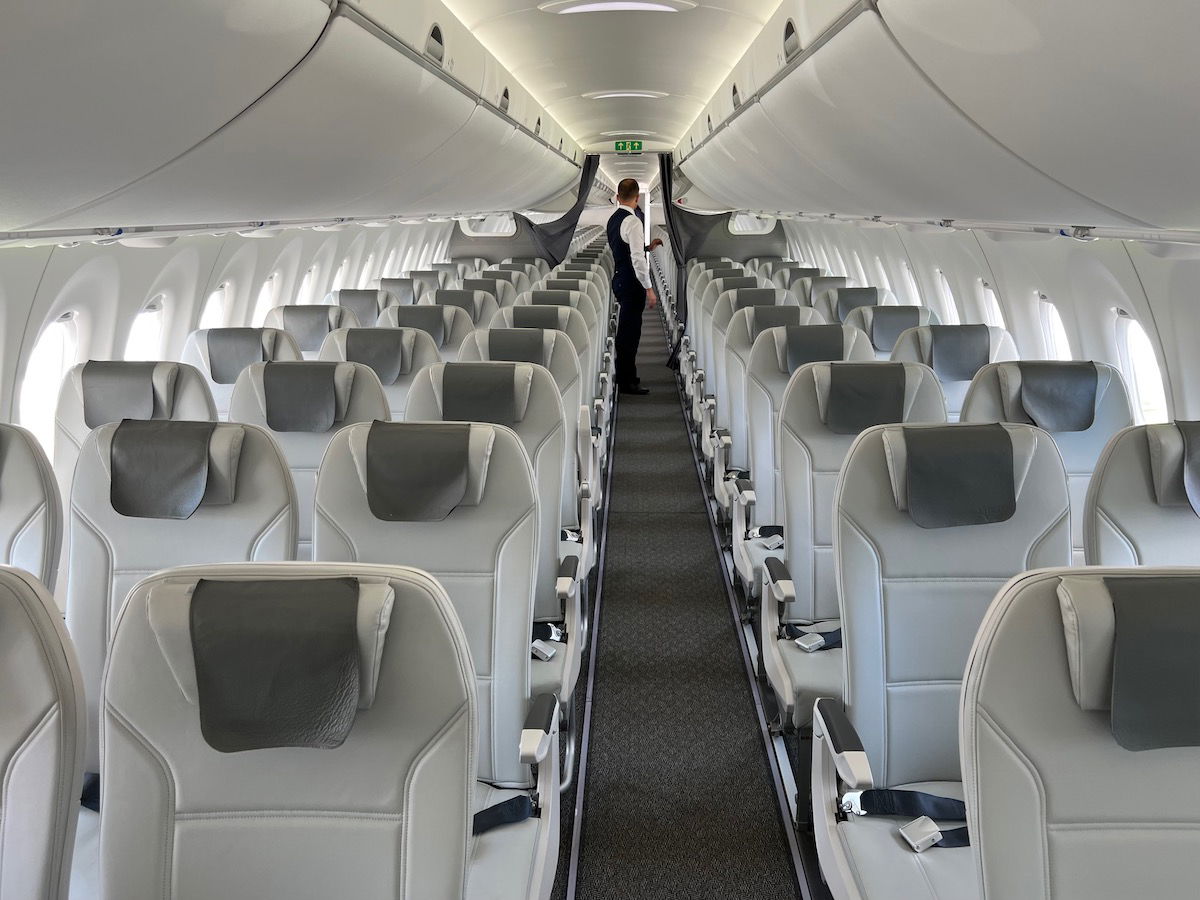
The A220 can be equipped with a very space efficient 2-2 configuration. So you only sacrifice 1 seat per row instead of 2 seats per row with the A320/B737.
Then focus on business/ premium leisure routes. Especially in winter long flights to the canary islands are not served with a proper business class from...
Maybe try a newish business model.
The all A220 fleet is perfect to introduce a proper business class on European flights.
The A220 can be equipped with a very space efficient 2-2 configuration. So you only sacrifice 1 seat per row instead of 2 seats per row with the A320/B737.
Then focus on business/ premium leisure routes. Especially in winter long flights to the canary islands are not served with a proper business class from Germany, UK, France, Netherlands etc.
Would love to see airBaltic making it work!
I think the issue with introducing proper Business Class cabins on intra-Europe flights is the matter of flexibility. Some routes definitely have more premium demand than others, and as with any European airline, being able to adjust the size of the cabin at any time is too beneficial to lose.
airBaltic seems like it should have pursued a Business Partnership with FINNAIR to capture more of that Northern/Central Europe flow than hitch its wagon to LH Group who would more than likely dismember it. Another choice would have been LOT to capture the Central/Eastern Europe flows of traffic.
Never flown them, but those neon green planes are hard to miss in Europe. Between the P&W engine nightmare a220, offloading fleet to Lufthansa/Swiss, geopolitical fallout, and fuel prices; bad luck.
Sorta related, another a220 operator, Breeze, literally has an old EgyptAir a220 parked at CHS that they cannibalize for parts, just sitting out there (no paint, no engines).