The state of the miles & points "industry"

For all the lame animal videos and (awesome) reader photos I post, I try to once in a while put some thought into a post. This is one of those posts where I had that intention. Well, at least about two weeks ago, when the idea for the post first came up. It was actually…
Continue reading: The state of the miles & points “industry”
Share your questions, experiences, and thoughts below.


"Why the future of hotel programs looks better than airline programs" is the headline on one section. But at the end you say, "if I had to invest in either an airline or hotel currency, I’d invest in the former." I'm not sure I understand how both of these can be true. Is the future of hotel programs better because they have already devalued so much that they are likely to stay more stable? Or perhaps there's a typo here or a use of "former" when you mean "latter"?
@ Andy -- Whoops, mixed up the titles and fixed them now. Should have said "Why the future of airline programs looks better than hotel programs."
While the rules of the game have shifted, it has not "ended" nor will it end. The travel industry and affiliated companies are way too invested and have too many people clamoring for an "aspiration".
I am not as savvy as you Lucky, but I have seen a massive shift from "free/complimentary nights/trips" to a subsidized model. Pay a little(more) get a lot.
Lifemiles is a good example. While they have devalued slightly, the LM Directors see a benefit to selling cheap miles with poor odds at 4 RTW seats in F. However they do offer a method to "protect" one against high fares.
e.g. YVR-IAH is generally $700 RT, but through an LM investment, I can pay roughly half of that for Y, or $750 for Domestic F.
In my mind it is a war of arbitrators. If the enthusiasts find a way to fly RTW J via AC for $1000, the airline will find a way to sell to you, at whatever the market will stomach. When the economics impact the bottom line for either player, there will be a shift (as we have seen) AC has hemorrhaged cash and thus sold Aeroplan, and in turn raised rates.
The Canadian market has the points business model working extremely well. Tease the market with 10-20k miles on a CC with lower earning options than in the US. Tons of participants dream big, but it hooks you into 3-5 years of earning for any kind of exciting award.
Don't worry Ben, you will have your job as long as you care to have it, just be willing to adapt as the landscape changes.
The only thing to lament the loss of is; a lifetime supply of Yogurt Cups.
@lucky, It's all relative, I suppose. I've been in this about as long as you have, and even when I started, people were lamenting opportunities that had dried up. Sure, there were some especially good times during the worst of the recession but this "hobby" will always be something of a cat-and-mouse game, with great opportunities coming and going. Even with the inexorable slide to revenue-based programs, there will be opportunities to find and use until they too dry up and we move on to something else.
As an aside... three reader comments so far: Andy, Andrew, and Andrew C... glad to see we're well represented.
I think the next benefit on the chopping block is free domestic upgrades. I just don't see the U.S. airlines continuing to offer this for free, at some point they will want to be paid. As American is doing with the A319, they will probably start reducing F capacity and just jamming more coach seats into the cabin.
And for systemwides, with the cost to the airlines of lie flat seats and the revenue generated from them, i suspect that elite benefit will erode over time. Once again, at some point they will want to be paid.
Miles and points better be treated as a commodity than currency. The best and worst of a commodity depends on how it translates to a $ value (CPM in this space). 6 Years Ago Gas prices were $1.60/gal and now at least 220% hiked. Should the govt be blamed for that entirely? The answer is a Yes and a NO as well. Same applies everywhere. Bloggers alone cannot be blamed every time. It is the industries' approach that drives the bloggers not the other way. I personally feel that a valuable commodity that entitles you to enjoy luxury travel should not be given away easily. Let everyone spend some money on claiming ownership, be sensible about the speculation, take responsibility for learning things the hard way.
I think there's a lot of great perspective here and I agree with most of your conclusions. What it boils down to for me is that some of the things we were most comfortable with (great examples with LH/LX) are getting harder while other opportunities (EY, EK ... again good examples) are born. The fact that SOME things are getting more difficult doesn't mean actually traveling is getting more difficult--just means you need to keep up with what's happening.
Just the natural order of things and business as usual in a market economy.
I think connecting the state of the global economy with how it affects business travel and thus award space available makes a lot of sense.
I would not be surprised at all if we continue to see space dry up as the economy continues to improve with shale oil/gas production keeping inflation in check and the Fed doubling down with QE Infinity.
But there are bubbles forming, and economic dogma will once again stop government from taking a proactive approach, as supposedly "the market knows best". These bubbles will pop, and the economy will crash yet again. Award space will thus be plentiful like in the late 2000s...
In sum, it's too early to draw any meaningful conclusions. In the meantime, all we can do is speculate, which is not very productive. Accordingly, blog/travel on!
Ben, I think this is your best post of yours in the 6-8 months I've been religiously reading the blogs. I agree with lots of points made by you, Robert, and Joe. I definitely think most of the negatives that are coming about are due to a stronger economy than a few years ago, and due to inflation when comparing to 15-20 years ago.
Interesting point regarding why you think hotel programs are less "investable" than airline programs for the future. That definitely makes sense, especially for the fact that hotels are owned by third parties whereas airlines in general own the product they offer a reward on (not counting partner award flights).
I hope that I didn't miss out all that much by only getting seriously into the game about a year ago but am having fun so far and definitely wouldn't be where I am without your (and other bloggers) help.
Keep up the good posts like this. It was great hearing your insights at FTU and this post adds to that.
I'd also add eventually market forces will take effect. We've already seen a shift in the demand curve for travel and its only a matter of time that a shift in the supply curve (increase in supply) occurs to match suit. This will come about as a result of new suppliers coming about or the more likely scenario, current suppliers adding more capacity/building more hotels.
Lucky,
Does SQ release two suites class saver awards between Asia an the US? If so, which routes?
What are the three points currency you use to obtain emirates miles? Great article Lucky!
@AndrewC, don't forget Andrew B that is competing to go to HEL.
I suppose I should change my Handle to Andrew R for clarity. or Andrew yvR.
I think the reason that 5-10 years ago looked like the golden age was because it was a critical point of immaturity of airline alliances -- the alliances had largely formed and all of the key airlines had signed up, but the members hadn't yet come to resent each other as it now seems like they might (with developments like AF offering virtually zero award space to DL and SQ offering virtually zero award space to anyone, for example). It will be interesting to see if the trend toward re-shaping alliances and closer partnerships (JVs, ownership stakes, etc.) changes that dynamic.
It also doesn't help that awards are, as Lucky notes, directly against the best interests of the airlines and hotels. It is not a coincidence that Virgin Australia has the best award space between the US and Australia and also has perhaps the weakest revenue performance of the airlines flying that route. Airlines are doing vastly better now than they were 10 years ago and that means fewer free tickets, but at the same time it also means better in-flight and ground products. Likewise in the hotel space, redemptions are getting stingier, but benefits like Starwood Platinum's free breakfast and Internet are a huge improvement over what was offered 5 years ago.
Finally, some of the cutting-edge airlines have realized that the old system is too easily gamed. Younger carriers like Emirates, Etihad, Virgin America, Virgin Australia and JetBlue all have revenue-based redemption programs. Other airlines would surely love to go that way but are worried about alienating their existing customer base. How long before that fear gives out? Oddly, the one area of hope is that airlines typically slash and burn during downturns and bankruptcies, but are always wary of tinkering too much with their loyalty programs during such times for fear of scaring away skittish customers. During good times there's less pressure to make changes. So there's no clear trigger event or circumstance that would necessarily push airlines to gut their loyalty programs, but as we've seen with raising domestic change fees recently, once one does it, others will quickly follow. Hopefully they are not just all waiting for AA and US to merge before reshaping the industry...
As always this was a excellent analysis by Lucky. However, I'd like to point out that the one major hotel program which DOES use capacity control, Priority Club (soon to be IHG Rewards) just went through a massive devaluation this year. Yes, like any airline program they need to devalue to account for the fact that people earned points when rates were lower in the past but can redeem them now when rates are higher.
As for times still being good, I couldn't agree more. I enjoy AAdvantage awards to Sri Lanka as they are priced in the same zone as Hong Kong due to the fact that CX was the only OneWorld airline that flew to CMB when the current AAdvantage All Airline Award Chart was released. However, once Sri Lankan and Qatar join OneWorld, you'll have service to CMB provided by four five OneWorld carriers and American will no doubt increase the number of miles require to go to Sri Lanka. You know what, I don't care because I'll be able to route over the Atlantic and have a choice of a multitude of carriers instead of one. Exactly what Lucky pointed out!

"...the mid-2000s were great for points addicts. The economy sucked, and the unique things about airlines and hotels is that the marginal cost of an additional guest is next to nothing."
In the mid-2000s the economy as measured by GDP growth was doing okay, actually ( 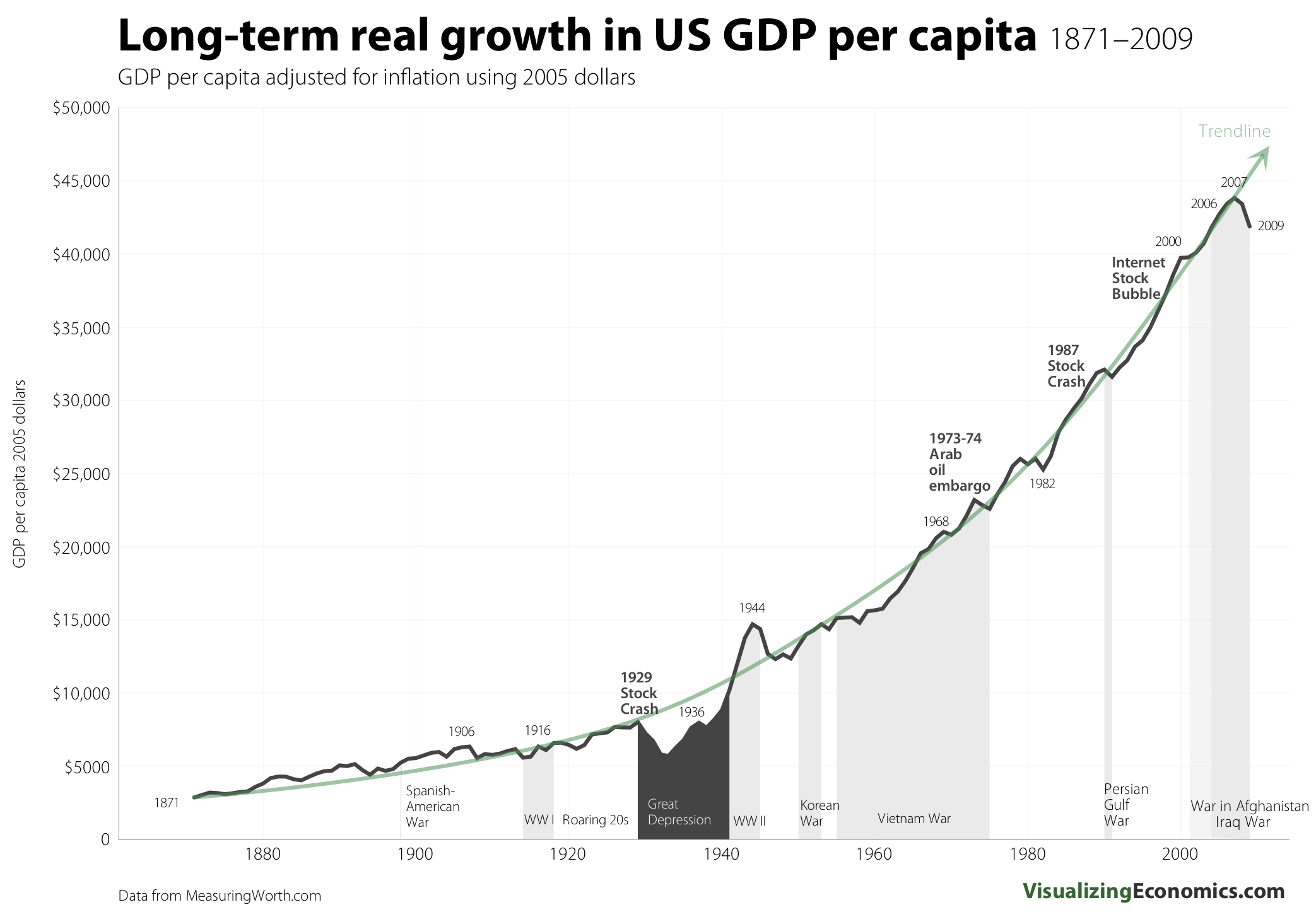 Yes, this is only one measurement and we have zillions from which to choose, but I’m trying to be quick here). And those really were banquet years in terms of award redemptions. I suspect that the awards were so plentiful because the airlines hadn't figured out how to nimbly shrink supply when there were, perhaps, at the time many strong business cases to be made for doing so. But I don’t have time to research load factors at the moment (Can someone go do that? 🙂 ).
I completely agree with your reader Robert that “…it’s less because of ‘too many people with too many miles’ [although that is a factor as well], and more because there are simply fewer seats and rooms unsold, and especially fewer premium seats even being flown.”
@German Expat, completely agree. This game is great if you have the kind of flexibility that Lucky has. Unless you just can't travel in anything but business of first class, collecting cash rather than points is often a better option for the average joe and more and more addicts. I have ~250k Delta points that I have been unable to use for anything useful since 2011. I'ld be better off with cash. If you are about going from A to B, go for cash. If it's about how you go from A to B (and you have flexibility) go for points.
The good old days were the 1980's. I remember being able to spend 5,000 Continental miles on *any* discounted coach seat and get an upgrade to First. Easy. Cheap. So few people knew about it.
Then in the 1990's I remember US Airways, and Alaska, having miles-for-50% discount awards, another great way of getting into the forward cabin for a reasonable price.
The result of my flying so much in First, combined with the continued deterioration of Coach, is that I became addicted to the forward cabin. I will now pay for First or Business, rather than risk having to fly long-haul in sardine-class. So maybe the airlines' loss leader use of First Class upgrades has benefited them in the long term.
I too am curious of what AA/US has in store. If the combined program matches UA MP it wouldn't be so bad save the loss of meaningful SWUs. I received the survey from AA several weeks ago asking about double cabin SWUs (Y to 3-cabin F), super SWU that had last seat availability, etc so I wonder what they have in store.
You wrote...
Do I think we’re better off than “X” years ago in our little hobby? Maybe not. But I also don’t think we’re worse off, necessarily. So while I wouldn’t mind going back to 2008 or so in some ways, I don’t think I’d trade it for what we have today.
The problem is your memory just isn't long enough. For those of us who remember the mid 1980's those were the golden year.
50,000 miles got me F anywhere in the world AND a second ticket upgraded to F from the least expensive most restrictive Y plus every seat on the plane was available. Airlines gave out confirmed F upgrades like candy and I had so many I just threw them out because I couldn't use them all. International F awards included a car for a week anywhere in the world. Hotel awards cost a quarter of what they do now.
Of course it was all completely unsustainable but for those of us who thought nothing of picking up the phone and expecting that if we had the miles we got the seats...however many we needed and to where ever we wanted to go because we had earned those miles the hard way it was a very, very different world.
Kids. What are you gonna do? 2008 isn't the gold old days. Try 1988.
@ Steve -- I wasn't around in 1988, so out of curiosity, how did you earn miles back then?
flying - and using a Continental credit card. With upgrades at 5K a pop, it didn't take much
Ben, what's changing is the credit card miles landscape. Even a year or two, things were better than they are now. Smaller bonuses, higher spend, etc. AmEx is starting to get on my nerves -- it's now impossible to hold two cards in the same program, for example.
There is a business cycle to points and miles just like any economy. It will ebb and flow again; I'm not worried about that. Plus on the positive side (at least from our perspective), the game is becoming vastly more complex, creating a learning curve that benefits incumbents.
The only thing I really worry about is the long-term viability of the credit card industry. The payments space is evolving rapidly on every level from mobile payments to even currencies themselves (take a look at Bitcoin and Ripple). Nowhere is it written that in this brave new world banks will continue to earn the interchange fees that fund the miles they offer us.
Lucky you wrote...
@ Steve — I wasn’t around in 1988, so out of curiosity, how did you earn miles back then?
Here is how the serious people did it.
There was no ID check in those days nor did the COC's or FF rules require one to actually be the passenger named on the ticket. I know hard to believe but you could buy a ticket, give it to anyone you wanted and they flew on it.
Well one of the airlines decided to do a short term promotion...double miles. The other matched. Then one extended it to triple miles. Everyone matched. Finally somebody made it triple miles for the whole year.
Then they started a fare war.
So for almost a year one could buy a ticket from one coast to the other for $198 round trip. It would earn over 15,000 miles which as I've noted was enough for an F ticket anywhere in the world plus a second ticket upgraded from the most deeply discounted ticket to F. All for the $600.
But for those who really wanted to go places in F the holy grail was to become a courier. DHL would give you a free ticket to HKG or SYD or wherever because they wanted to get 20 or 30 gigantic sacks filled with express packages there fast and this was the only way to do it that guaranteed the stuff wouldn't languish in air freight customs. But baggage requires a passenger so they need a warm body to "own" the baggage. Your job was therefore to basically sit in the airline seat, enjoy your trip and do the same on the way back.
Of course you got to keep the miles. On Pan Am. It didn't take too many trip to earn an F ticket to South Africa.
And when you flew F in those days everyone and I mean everyone else had paid full freight. You met some very interesting folks just about every single trip.
There is a lot more but suffice to say that the key point was that the airlines though of these programs as a way to get rid of something that was going to waste anyway (the value of an empty seat the second they close the door to the airplane is pretty close to zero) so the economic underpinnings the award charts were based on were extremely advantageous to anyone who could rack up a lot of miles for very little cost. That was extremely easy to do and because virtually no one was doing it there were infinite seats whenever you wanted it.
For a taste of how really good it was check out the old BA chart and look up round trip on the Concorde. I could have taken that as much as I wanted anytime I wanted just by picking up the phone.
Those were the days.
If you want to hear some of the things that went on that are not be appropriate for publication drop me a line. That flight with Priscilla Presley's to Johannesburg comes to mind...
In 1998? Collecting miles? No, I worked for AA and the 80/90s were the golden years for airline employees. I flew first class pretty much for peanuts. Would fly on a Friday to Paris and back on Sunday night. And I would plan this...on a Thursday. Or I would go to the airport with friends, would look at the screens and decide, lets party in Chicago tonight, just waitlist and show your Id and you are set to go. Like having a private fleet of jets. It all changed after 9/11 and that is the reason I do not work for an airline. No longer fun or I guess I got tired of all that travel. Now I read Lucky's travel !
So I guess opportunities come and go, but one thing is for sure, more opportunities are on the way.
I view the people who run loyalty travel programs just like oil companies/gas station owners. They can raise and lower the prices, daily and without notice. As long as they're allowed to make and change the rules in the game we have agreed to participate in, there is nothing we can do but roll with the punches and take the advice of the expert bloggers who inform us how to adjust.
To be fair though take a look at the first class hard product from back then. If F you got a seat. It was only slightly better than what you get in domestic F now. Beds? No way. Hadn't been invented yet so that flight to HKG from SFO was long (although the aircraft, a 747SP was short).
Africa was really a long haul. SF to NY to Monrovia (the only place they would let a plane headed to South Africa land to refuel) then JNB. When you got their you felt like you were on Mars you were so dog tired.
But the food was amazing. They cooked the filet mignon on board and it was darn good, even by terrestrial standards. If there is one thing I miss it would be that. They would come down the aisle with this long piece of of filet on a cutting board and slice off what you wanted just like a real steak house.
I mean why can't they do that these days?
Ah to be young again.
Steve, Lucky - yes, the 1980's were the "golden age" in a lot of ways (I jumped on the mileage bandwagon in 1982, when UA offered a "fly 7 segments/7000 miles, get an award ticket" promotion which I used (getting my 7th segment by having someone else fly in my name) to fly "free" from SFO-JFK-PDX-Maui-SFO in first class). But some things we take for granted were missing. UA, AA, and DL were purely domestic airlines, and there were no alliances, so, if you wanted to fly internationally, you had to have miles with the right international carrier. And the award issuance process was entirely paper-based, so it could take a few weeks from the time you requested an award until the time you could actually travel. (How many of you remember stapling the little paper coupons to your paper tickets so the airline would know your FF account number?? You could get credit for award flights about 80% of the time. 🙂
The negative correlation between how financially strong an airline is and how rewarding its loyalty program is, is really interesting and makes a lot of sense. If demand is so high that the airline can fill seats without providing extra rewards, then why should they?
For now the airline industry is doing well, so they feel free to reduce benefits (remember, we're just "over-entitled" elites) and reduce the value of flying on their alliance partners. But the industry is, and probably always will be, unstable. The next oil crisis, the next economic downturn, the next (God forbid, but it can't be ruled out) 9/11 - and wham, they'll be reeling again and the loyalty programs will suddenly become more generous. It's a question of when, not if.
I heard Jeff Smisek speak recently. His mind set is "I'm running a business", not "I'm running an airline". He is focused on maintaining the "capacity discipline" he and his competitors have achieved. So we may never again see the overcapacity/fare wars/empty seats we used to see.
On the positive side - in the past, many seats went out empty because airline yield management systems did not offer them as award seats. Now, most airlines manage their inventory much more dynamically than before, so the odds of an empty seat becoming an award seat are much higher. (Lucky has advised me there are a few airlines that deliberately hold back premium cabin seats, preferring to use them for operational upgrades instead of awards.)
I might be in the minority here but I think the rapid inflation of the pts/miles needed or the lack of low level redemption is due to the explosion of pts/miles accumulated. The programs can see how many miles are outstanding and raise the miles needed accordingly. I think this is so they can lower their financial liability on their balance sheet. Its a rapid form of inflation where they raise the points needed (or add catagories) every 2-3 yrs. This in turn reduces the value of each mile flown or earned.