
Many people will shop for luxury goods when traveling abroad (especially if going to places like Milan or Paris), and love to point out how it’s “such a good value” compared to shopping in the US. That’s perhaps true, if part of that math includes requesting a tax refund in the foreign country, and then not declaring it upon your return to the United States, in violation of customs laws.
A reader asked me an interesting question about this topic, and I didn’t have a good answer, so I think it makes for a good discussion. First let’s talk about the background, and then I’ll pose the specific question a reader asked me.
How travelers try to avoid import taxes on luxury goods
To keep this example specific to the United States, when you return to the country from abroad, you’re typically asked by a Customs and Border Protection (CBP) officer if you have anything to declare.
Travelers have to declare all kinds of things (meat, produce, drugs, etc.), including any purchases above the $800 standard personal exemption, which is the limit of merchandise acquired abroad that can be imported without paying taxes (tangent — it really is time that limit is raised, since it has been the same for over two decades, and there has been quite some inflation in that time!).
In other words, if you made $2,000 worth of personal purchases abroad, you’re supposed to declare that, and you’d have to pay import taxes on $1,200 worth of those purchases.
The idea is that travelers make purchases abroad and pay the local sales tax, but then upon departure, foreigners can request a refund of those sales taxes. This typically has to be done at the airport, assuming the country allows tax free shopping.
The way people often mentally process this is that they’re able to shop “tax free.” That’s even how many stories will market things. What that of course conveniently overlooks is that you’re supposed to then declare these items when you return to the United States, and pay taxes there.
With some frequency, you’ll see people posting online about the huge issues they have with this, and it tends to fall into one of two categories:
- People claim they had no clue they had to declare these kinds of items (whether they actually believe that or are just feigning ignorance comes down to the person)
- People deliberately do what they can to avoid detection, by taking tags off items, throwing away receipts, etc.
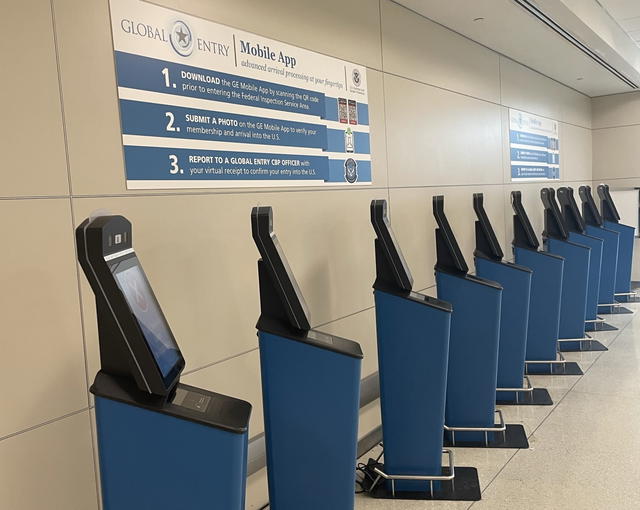
You’ll see stories all the time of people having their Global Entry revoked over things like this, along with facing other punishment. And that brings us to the question a reader posed…

Questions about a $250K luxury goods seizure
Several weeks ago, CBP put out a press release about how it seized more than $250K in undeclared jewelry from a Global Entry member at Philadelphia International Airport (PHL). Okay, I’m not surprised stuff like this happens, but here’s the part of the story that is most interesting:
The traveler, a Pennsylvania resident, was referred for a secondary baggage examination after arriving on a flight from Amsterdam. During the inspection, the traveler initially told CBP officers that she had purchased only a few thousand dollars’ worth of souvenirs.
Prior to the traveler’s arrival, CBP officers obtained information indicating the traveler had purchased a Cartier bracelet valued at $183,818 and a Cartier ring valued at $67,811.
CBP officers provided the traveler multiple opportunities to declare the jewelry, but she did not. The traveler declared the items only after officers informed her that they were aware of the purchases. The traveler later admitted she had discarded the jewelry boxes and receipts.
Obviously two jewelry items worth over $250K is a major “haul,” but the part of the story that a reader asked me is the claim that CBP obtained information about this prior to the traveler’s arrival.
Is that actually true, or were they bluffing? Do various customs authorities share details with one another, where one country will say “oh, this person just received a tax refund on a $250K purchase and is now boarding a flight to the US?” I can’t find any credible information online suggesting that information is shared in this way.
Obviously agencies of various countries do coordinate on some important things, but this seems different than having someone on the “most wanted” list board a flight. But what is the alternative explanation? Is the claim here that a private citizen somehow made CBP aware of this?
Was this person somehow bragging on social media about their purchase while abroad, and CBP came across it, and then confronted her? I otherwise have a hard time imagining a tip from a citizen would get “processed” that quickly by CBP, given the timeline we’re talking about.

Bottom line
Many people like to shop while abroad, and view it as a great deal, since they can often claim a tax refund in that country. That conveniently overlooks that the personal tax exemption when entering the United States is $800, so anything above that amount is supposed to be declared, with import taxes having to be paid.
Of course the thing is that many people try to get away with not disclosing their purchases abroad — some people just don’t even think to do so, while others will intentionally throw away boxes and receipts, etc.
CBP recently reported how it seized $250K+ in jewelry at Philadelphia Airport, claiming they were already tipped off to this before the traveler arrived in the US. The traveler just had two small (but very expensive) Cartier pieces, so that raises an interesting question that a reader asked me about.
I assume that when you make a tax free declaration in one country, they’re not immediately turning around and sharing that with another country, but obviously I can’t say that authoritatively. But what other explanation is there? Was someone just stupid and bragging on social media, and somehow CBP came across it, or what?
Can anyone answer this question better than I can? Because now that I’ve been asked it, I’m curious as well!


Membership is free and takes no more information than commenting as a guest. Earn status points for good contributions, and see fewer ads as your status grows.
There are currently no responses to this story.
Be the first to respond.