

Before I get into this post, I’m curious what initial impressions people have — is a small, thin garment bag considered a personal item or a full size carry-on when flying? The answer tends to surprise people, so let me explain. This also relates to a question that a reader asked me, which I’ll address below.
Garment bags typically have a carry-on classification
Most airlines in the United States will let passengers bring both a full size carry-on, as well as a personal item, into the cabin of a plane. The full size carry-on typically includes something like a rollaboard bag, while the personal item includes something like a purse, backpack, etc.
Virtually all airlines have size dimension limits for carry-ons, and some airlines also have weight limits, but that’s not as consistent. What’s interesting is how garment bags are often classified. Logically, one would assume that garment bags would be classified by their size — in other words, if they’re small enough to fit into a personal item sizer, they should be able to count as a personal item. However, that’s often not how they’re actually categorized.
Instead, every US airline that explicitly references garment bags in its carry-on policy, notes how they are considered carry-on items, and not personal items, regardless of their size.
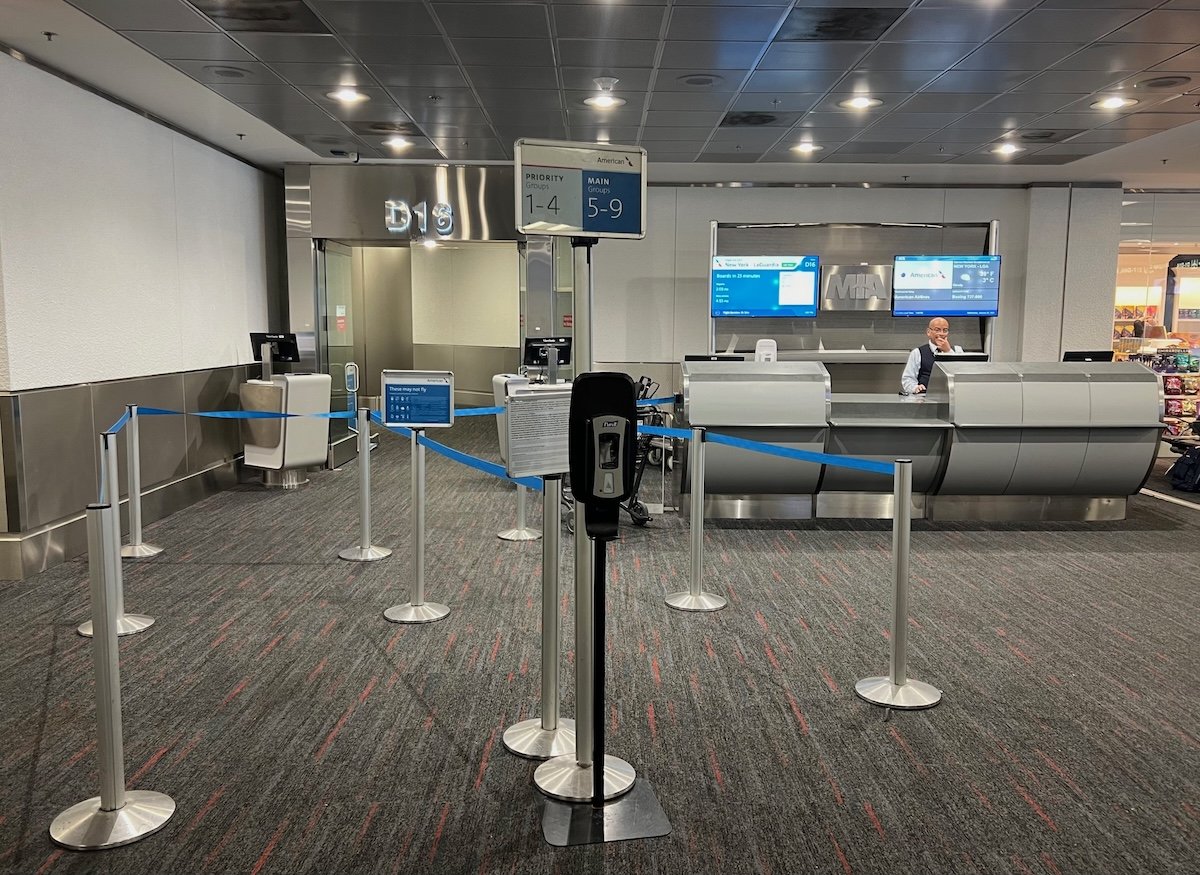
For example, if you look at American’s page for carry-ons, you’ll see garment bag specifically listed under the “carry-on items” section, and not the “personal items” section (and that’s not a mistake — I’ve had American gate agents confirm that is in fact the policy).

If you go to Southwest’s page for optional fees, you’ll see a garment bag specifically described as a carry-on and not personal item:
Southwest allows all ticketed Passengers to carry on the following for free: (a) one carryon bag (e.g., roller bag, garment bag, tote bag) that does not exceed external dimensions of 10 x 16 x 24 ; and (b) one smaller, personal type item (e.g., purse, briefcase, laptop computer case, backpack, small camera), provided that such items can be stowed under a seat or in an overhead compartment.
Garment bag carry-on rules aren’t always enforced, though
I do think it’s worth emphasizing that enforcement of garment bags being counted as full size carry-ons is inconsistent. That’s especially true if we’re just talking about a small garment bag with one suit, vs. a garment bag that’s the size of a rollaboard.
That inconsistency is fair enough, given that:
- There is generally some confusion among passengers around how garment bags are classified, since the rules aren’t terribly logical
- Many employees just don’t want to unnecessarily pick a fight with customers
- In general, carry-on enforcement in the US is really inconsistent, and several airlines have even eliminated bag sizers
My point is to say that you shouldn’t be surprised if you board a flight with a carry-on and a garment bag, and manage to get away with it. At the same time, don’t be surprised or shocked if you’re stopped, and certainly don’t hold it against the frontline employee for doing their job.
A reader’s garment bag carry-on confrontation
Longtime OMAAT reader Sam shared the following experience with me, related to traveling with a garment bag:
I recently flew Delta Connection in First Class from BOS-PIT for a conference, carrying a Briggs & Riley carry-on, backpack, and garment bag (item linked below). Before boarding, the gate agent repeatedly emphasized Delta’s two-item carry-on policy and the limited overhead-bin capacity of the ERJ-175. I was seated in 1A and boarded first in Group One. The gate agent did not question my bags, and the flight attendant accommodated my request to hang the garment bag in the coat closet.
The return flight was a very different experience. Before boarding in PIT, the gate agent made similar announcements. Again, I was seated in 1A and boarded first in Group One without being questioned about my bags. When I asked the flight attendant to hang my garment bag, she refused, citing the two-item policy. When I mentioned that the BOS flight attendant had accommodated the same request, she reiterated the policy, referenced FAA audits and additional training, and questioned me about the gate agent’s training.
I found the interaction unnecessarily confrontational. We were standing near the galley, holding up boarding, and I ultimately asked her to gate-check my carry-on so other passengers could board. In retrospect, I recognize that my response might have come across as confrontational as well, although my intention was to de-escalate the situation.
The flight attendant then suggested combining my backpack and garment bag. After an unsuccessful initial attempt, she managed to fit the backpack inside the garment bag, placed both in the coat closet, and allowed me to put the carry-on in the overhead bin. I was surprised by this outcome because I had understood the coat closet to be intended primarily for coats, crew luggage, or airline items, not combined garment bag-backpacks.
The interaction left me uncomfortable, particularly because other passengers were watching and boarding was delayed. The flight attendant seemed unfriendly toward me for the remainder of the flight, although she otherwise provided normal service. Near deplaning at the gate, a couple who had pre-boarded before me asked what had happened and questioned why the garment bag had been an issue.
I explained that I believed the flight attendant was technically correct about the policy, but that I thought garment bags warranted some consideration. The flight attendant then addressed the First Class cabin, reiterating that she was following policy and referencing FAA audits. I acknowledged her position, and there was no further interaction.
During the flight, I researched Delta’s and the FAA’s policies. My understanding is that Delta’s two-item limit applies here, and that its coat-closet provisions do not necessarily create an exception for garment bags. I therefore don’t believe the flight attendant was necessarily wrong to enforce the policy. However, friends and I have previously used coat closets for garment bags without issue, so the experience highlighted what seems to be an inconsistency in how passengers perceive and experience enforcement.
I’m also curious about the FAA reference. Does the FAA specifically audit compliance with carry-on limits, or was this more likely Delta training and enforcement intended to ensure consistent application of its own policy? I may be missing relevant context, and you may have more insight into Delta’s current practices.
My broader theory is that Delta may be emphasizing the two-item limit more consistently to reduce boarding delays and move more bags to gate check. That is speculation on my part, however.
I think there is also a reasonable discussion to be had about whether small garment bags should receive an explicit exception, perhaps based on dimensions. I appreciate that “garment bag” can mean anything from a compact folding bag to a full-sized piece of luggage, and I understand why airlines need clear, consistently applied rules.
Ultimately, my concern is less about the policy itself than how the interaction was handled. I have flown Delta for years and have never experienced a similar confrontation over carry-on luggage. I’m not looking to identify or punish the flight attendant, and I have no intention of filing a complaint with Delta. I simply thought the experience might be relevant to your coverage of the airline.
My practical takeaway is to check a carry-on-sized bag if necessary, rather than assume a garment bag can be accommodated in the coat closet as a third item.
I think Sam mostly answered his own questions, so let me just share a few thoughts here:
- Yes, as Sam found out, there is no carry-on exception for garment bags not counting toward the carry-on limit, and quite to the contrary, they often even count toward the primary carry-on limit
- Frontline employees aren’t all aligned on the extent to which they enforce rules, which is why Sam experienced such inconsistency; but of course just because one person doesn’t enforce the rules, doesn’t mean they don’t exist
- Regarding the FAA compliance issue, it’s tricky; yes, sometimes there are FAA auditors, but more than that, frontline employees are often trained to enforce rules as if there are auditors watching, are warned that the airline could be fined for not enforcing the rules, and will often also use that messaging with passengers
- The FAA doesn’t actually care what the carry-on rules as such are, but instead, the FAA requires airlines to publish their rules and then enforce whatever rules the airline decides on
- A lot of flight attendants just aren’t great at dealing with curveballs, so holding up boarding to handle this sounds less than optimal; ironically, it does sound like the flight attendant did end up being helpful in terms of consolidating items (which is of course a reminder of how random some of these rules are)
- Sam is a good guy, and I know he had no bad intentions here, so I’m sorry he dealt with this awkward situation
Bottom line
Carry-on rules around garment bags can be confusing. At most airlines, garment bags are considered a full size carry-on, and not a personal item, regardless of the size. Why? Well, I’m not sure there’s necessarily terribly good logic, other than trying to create a consistent rule that factors in the variability of the size of these items.
The thing is, enforcement is rather inconsistent, with many gate agents and flight attendants letting travelers still take these, without batting an eyelid. So don’t be surprised if you don’t have issues with this, but also, don’t be surprised if you do have issues.
What has your experience been with traveling with a garment bag as a carry-on?




A soft garment bag containing a suit and a shirt or two should be considered more like a coat. It folds up very compactly, and in the overhead it will fit on top of your roller bag, without taking up space that someone would need for their bag. That being said, I do see why airlines would restrict it, because there’s wide variance in how much people try to stuff inside garment bags, and the...
A soft garment bag containing a suit and a shirt or two should be considered more like a coat. It folds up very compactly, and in the overhead it will fit on top of your roller bag, without taking up space that someone would need for their bag. That being said, I do see why airlines would restrict it, because there’s wide variance in how much people try to stuff inside garment bags, and the gate agent shouldn’t have to police it. I’ve flown many times with a roller bag, a backpack, and a garment bag, and never have had a problem, but I know it’s against the rules and I wouldn’t push back if asked by a gate agent to check my roller bag.
@Lucky, I don't think Sam's issue is whether airlines consider garment bags carry-ons or personal items. Sam boarded with three items, which is one too many. The fact that one item was a garment bag that would be put in a closet is irrelevant. Just because enforcement varies doesn't mean that he wasn't wrong. Heck, airline enforcement varies for EVERYTHING, and not just garment bags.
Now, if he had a carry-on, a backpack, a cane,...
@Lucky, I don't think Sam's issue is whether airlines consider garment bags carry-ons or personal items. Sam boarded with three items, which is one too many. The fact that one item was a garment bag that would be put in a closet is irrelevant. Just because enforcement varies doesn't mean that he wasn't wrong. Heck, airline enforcement varies for EVERYTHING, and not just garment bags.
Now, if he had a carry-on, a backpack, a cane, and a medical device, it would be different. This combination would've been ok.
Some here may not like the rules; but, you did accurately cite the general rules (currently, for US carriers, at least). People also dislike getting fines for speeding; there can be selective (even ‘aggressive’) enforcement there, too. Each is a human construct. Not naturally occurring. Can be changed, too.
“I found the interaction unnecessarily confrontational.” - sounds like an average interaction with a flight attendant on a US airline…
So the DL FA on the return was just following the rules, even if she could have executed it a bit better?
Its a carryon.
Tired of OPMs taking up bin space of actual paying pax up front.
Are you suggesting that a person who paid for a FC ticket with cash out of their own pocket should be treated differently than a person who paid cash for a FC ticket with a client's or someone else's money?
(I'm concluding that "OPM" in this case = "Other People's Money," though it's not completely clear from the context of the comment)
Willy gets it. Alan’s just scapegoating.
It depends on whether or not you’re flying AA. Those ******* at AA will chase Exec Platinums down the jet bridge to ding us for supposedly inappropriate carryons.