

Nowadays it’s common for airlines to award miles based on dollars spent rather than based on distance flown. While it eliminates some gamification, the incentive is obvious — airlines want to encourage passengers to book expensive tickets, especially when they’re on someone else’s dime.
Understandably airlines have the philosophy that they want you to spend as much as possible, though one airline is unique in drawing a line, and saying it won’t reward people above a certain level of spending. I’d like to take a look at that in this post, because there’s no denying this policy should be updated, and at a minimum, the cap should increase.
The United MileagePlus 75K miles per ticket cap
Generally American AAdvantage, Delta SkyMiles, and United MileagePlus, award you a certain number of miles per dollar spent, based on a combination of your elite status and whether you have a co-branded credit card.
What’s interesting is the restriction that you’ll find at United, but not at American or Delta. For example, below is the MileagePlus mileage earning chart.
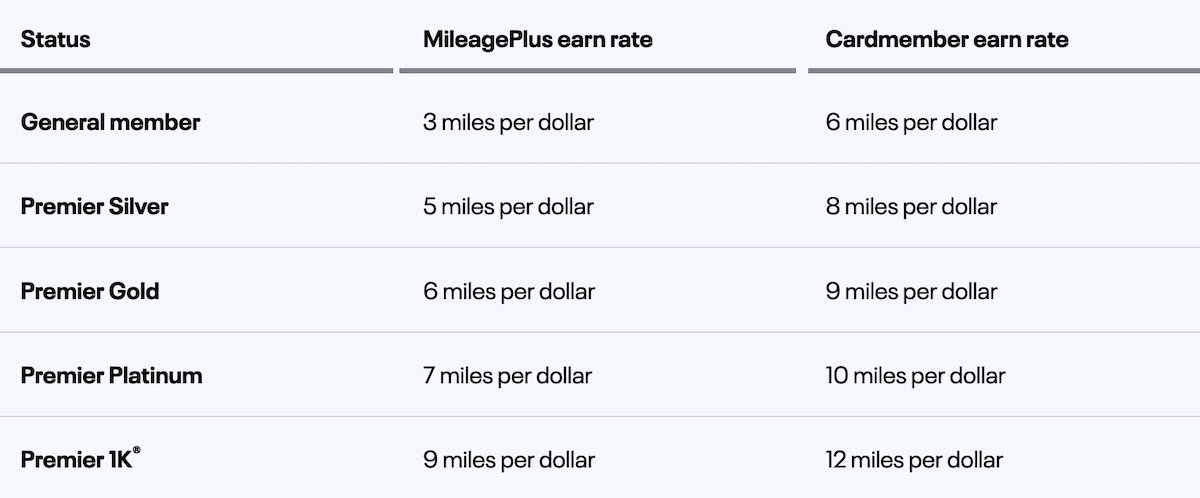
What’s unique is that United MileagePlus will award a maximum of 75,000 miles per person per ticket, regardless of how much you actually spend. So if you’re a Premier 1K member, any spending above $6,250 on a ticket wouldn’t earn you any incremental rewards.
For what it’s worth, American AAdvantage and Delta SkyMiles used to have similar policies, but abandoned them years back. They now have no cap on how many miles you can earn per ticket. So if you’d like to spend $25,000 on an American first class ticket to Australia and have AAdvantage Executive Platinum status, that would earn you 275,000 miles (11x miles).
That brings us to a message I received from a friend, who is a United Global Services member (and far too loyal to the airline, in my opinion, but that’s a different story). He raises an interesting point, and of course acknowledges that this is a first world problem:
As fares have risen sharply in the last few months — for those of us who travel internationally, hitting that sort of ticket price is not uncommon. Roundtrip to Tokyo can be up to $9,000, roundtrip to Johannesburg can be up to $12,000.
The maximum mileage per ticket has not risen for years, whilst ticket prices most certainly have gone up with inflation.
He points out how he’s about to buy his third ticket of the year where mileage earning is capped, which is rather frustrating.
Is there any merit to United’s ticket mileage cap?
As I see it, there are two topics here — should there be a cap on mileage earning at all, and if so, should it at least be raised? Let’s address that second point first.
United started awarding miles based on dollars spent rather than distance flown in 2015, with that same cap of 75,000 miles. Between 2015 and 2026, we’ve seen roughly 40% inflation, so airfare is obviously more expensive than it was back then. Even just keeping up with inflation, it seems reasonable that this cap should be increased considerably. United’s lack of updates there is downright cheap, but it seems the airline feels it can get away with that.
But then there’s the bigger question of whether the cap should exist at all, or whether American and Delta have the right idea. Logically, you’d think there wouldn’t be a cap:
- Airlines have increasingly made it clear that they only care about how much we spend (on tickets or credit cards), and not how much we fly, so shouldn’t they be rewarding those who are dropping five figures on a ticket?
- Logically an airline’s margins are better on a ticket that costs $10,000 than one that costs $1,000, so can’t they pass on some rewards for all that incremental spending as well? After all, generally speaking, with rewards programs the incremental return increases, rather than decreases, the more a customer spends
So what’s United’s logic for its current policy? I suspect the answer is simply that United is doing it “because they can.” In other words, United feels like it’s not losing sufficient high yield business by having this cap to warrant changing its policy:
- Most people booking really expensive tickets are doing so because they have a specific flight or schedule they need, and they’re making their decision based on that rather than mileage earning
- A lot of people dropping this much on a ticket have some sort of corporate contract with the airline they’re flying, so miles earned don’t make much of a difference
So like most things in the airline industry, their logic isn’t totally sound. They want to encourage you to spend as much as possible, and they want to reward you for that. But not too much. I do find it interesting how American and Delta have changed this policy, while United hasn’t.
Another aspect of this policy that I find questionable is that the hotel cap is the same regardless of your elite status, even though a top tier elite earns double as many miles as a non-elite. In other words, while a Premier 1K member gets rewarded for the first $6,250 in spending, a non-elite member with a co-branded credit card gets awarded for the first $12,500 in spending.
To me it seems like it would be more logical to make the cap around “base miles” earned, and then allow elite bonuses on top of that. It doesn’t make much sense that the cap is so much lower for elite members than non-elite members. I imagine their thinking is that an elite member is more likely to book that airline anyway when on an expensive ticket, so the incremental miles won’t make much of a difference.

Bottom line
United caps MileagePlus members at earning 75,000 miles per ticket, regardless of how much it costs, and regardless of elite status. While a vast majority of customers aren’t impacted by this limit (which is reached when spending $6,250, at an absolute minimum), the super high yield customers who are subsidizing airfare for the rest of us certainly are impacted.
Given that this policy was introduced over a decade ago, at a minimum, it feels like it’s time to update the cap, to reflect the roughly 40% inflation that we’ve seen since then. Personally, I’d argue that the cap should be lifted altogether, to match American and Delta. But obviously United feels it can get away with this, and not lose too many customers over this policy.
What do you make of United’s cap on mileage earning?




That is interesting. I had no idea about this cap (but I haven't engaged with United since they went to dynamic awards - there are better values from transferrable currencies outside UA for *A redemptions...
My guess is it’s a system limitation of some kind. A software issue that would be complex to resolve or some such, and the cost isn’t worth it.
-G
Thanks for putting this out there. I’m global services too and I actually never thought about this assuming all airlines did the same thing. It has really got me rethinking where I buy an expensive ticket.
I converted from BA/OneWorld to United/Star when I moved to the US. But I will literally still book OneWorld flights and credit back to BA (where I still have status) when I'd hit this cap. Costs united business!
This is my main gripe, and I have raised it continually with UA in focus groups and surveys - and the fact it hasn't been raised in years makes it even more egregious. If they want to be a premium airline, then this exact rule needs to be amended to reflect that -- this came in at a time when they were not focused on such.
Now that I'm gainfully unemployed, I find travel simple. I look up the flight I want and choose based on cost and schedule. I don't think for a second about miles, because they will do what they do. Do I get FF flights? Yes. I consider it like finding cash on the street. My life works great with that attitude. [To be honest, the one thing I do about FF miles is to make sure my AA miles don't expire...and, yes, fu AA for that stupid policy.]
While the cumulative inflation is 40% over the past 10 years, airfare is one of those things that do not go up or down based on inflation but rather based on seat availability and demand.
I agree with the fact that United does these stupid things because they can. If United actually cared they would have changed this when American and Delta did. I fly enough to keep it status on United and the rest of my money goes to Delta. Why, because like United I can. If you're spending $10,000 on a ticket, any airline will be interested in your business so change your loyalty.
I think you mean "total" rather than "hotel."
As much credit as one'd like to give UA, they remain the most bottom-line conscious (or flyer unfriendly) on a few policies. Remember the no refund of residuals in the early Covid days when AA and DL both offer refund and credits? UA might have a larger share of corporate accounts so it's their way to manager the cost. Like you said, just bc they can.
Having said that, I agree with others that...
As much credit as one'd like to give UA, they remain the most bottom-line conscious (or flyer unfriendly) on a few policies. Remember the no refund of residuals in the early Covid days when AA and DL both offer refund and credits? UA might have a larger share of corporate accounts so it's their way to manager the cost. Like you said, just bc they can.
Having said that, I agree with others that customers do compare and remain more rational these days. I also know of a few 1Ks and GSs who would book away from UA when they have requalified or simplify prefer more miles in another account (with no cap on long haul paid J tix).
People can always use an alternative account within the same alliance, particularly if they choose a programme with interesting non-alliance partners (e.g. Air Canada working with lots of different airlines, Flying Blue allowing redemptions on the likes of Gol and Bangkok Airways).
This policy is just another example of how United is trying hard to destroy the loyalty that programs like MileagePlus tried to create long ago
The cap is absolutely necessary
MileagePlus has been ruined by hyperinflation because of the obscene amount of miles given out to OPM flyers
It should be lower than 75k
That is more heavily impacted by things like their push for credit card usage - and giving bigger multiples to credit card purchased airfare - than it is by a cap (or lack thereof). The cap unfairly penalizes high spend and high status flyers, which makes no sense from a loyalty perspective.
I've been impacted by it on tickets I've purchased for myself - not OPM - so it doesn't just impact work travelers....
That is more heavily impacted by things like their push for credit card usage - and giving bigger multiples to credit card purchased airfare - than it is by a cap (or lack thereof). The cap unfairly penalizes high spend and high status flyers, which makes no sense from a loyalty perspective.
I've been impacted by it on tickets I've purchased for myself - not OPM - so it doesn't just impact work travelers.
This cap is not the difference between catastrophic and current hyperinflation - and it's not the difference between you affording and never being able to book lucrative award tickets. That is dictated by more structural changes that United makes to the program and redemptions.
The problem is the more miles in circulation, the less valuable they are. Delta might not have a cap, but skymiles are basically useless. See the person with 2 million skymiles who can't even book an award flight to france. Meanwhile i can still reliably book USA-Japan for 90k miles in coach.
I see plenty of availability on AF with DL miles, sometimes the number of miles is lower than the FB equivalent! If DL are blocking AF availability from the USA, they could always fly from MEX instead. 2 million DL miles are worth $25k any day of the week.
Waiting to see what Tim fluffs this time.
RASM or lost luggage?
Dont forget not access to any UA lounge when connecting to UA domestic flights from partner transcon.
This is not true - assuming you are talking about a partner transatlantic / transpacific (if you truly mean domestic transcon - the only partner I can think of is Jet Blue?). You can access United Clubs if you are Star Gold for connecting airports of an international itinerary including coming back to the US and connecting to UA domestic flights.
You are confusing that with the Polaris lounge access rule. Specifically if you are...
This is not true - assuming you are talking about a partner transatlantic / transpacific (if you truly mean domestic transcon - the only partner I can think of is Jet Blue?). You can access United Clubs if you are Star Gold for connecting airports of an international itinerary including coming back to the US and connecting to UA domestic flights.
You are confusing that with the Polaris lounge access rule. Specifically if you are flying to the US on a partner airline in Business class, you cannot access a POLARIS lounge when connecting to a domestic UA flight. But you can access regular United Club locations. You can only access a Polaris lounge in that situation if you are flying back to the US on a UA aircraft in Polaris.
That's incorrect if you don't have any status. *A rule is based on departure flight. If you are arriving in the US with a non-UA flight and connecting to a UA domestic flight, and if you don't have status, there is no access to United Club. This includes if you are arriving in ANA or LH F.
I've written to United multiple times about this and it's ridiculous. I was Global Services for a number of years and I would sometimes book one-ways if the cost wasn't significantly different, but usually for international flights it is many times more expensive to book individual one-ways vs. a roundtrip.
It is true that to some extent for loyal United fliers, they are often just going to accept it, but there are plenty of situations...
I've written to United multiple times about this and it's ridiculous. I was Global Services for a number of years and I would sometimes book one-ways if the cost wasn't significantly different, but usually for international flights it is many times more expensive to book individual one-ways vs. a roundtrip.
It is true that to some extent for loyal United fliers, they are often just going to accept it, but there are plenty of situations where I saw colleagues who had a lot of spend on both United and American book American when the fares were super expensive because they don't have a cap. So you're incentivizing certain travelers to book another airline on the most expensive fares. What a wild behavior to encourage. It's a very real scenario in Chicago where you have lots of international destinations from both carriers.
This feels like one of those policies that United has “forgotten about” that would go away if enough high-value customers complained.
The card is worth the Cat 1-4 night, for now anyway. The choices will probably be only sad Hyatt Places within 2-3 years and Hyatt will greedily raise the annual fee. Then, it will be time to re-evaluate.
(Think you meant to post this on the Hyatt credit card entry, not the United one)
I mean, the hope would be that the fee bump would come with a category bump (to 1-5, perhaps).
And if I put "just" $15k on the card, I get two free nights plus 15-30k points (depending on spend pattern), so that's not a bad deal.
The question is going to become whether to keep putting spend there or divert it elsewhere starting next year - I'm already over 60 night-credits, so I'm probably going...
I mean, the hope would be that the fee bump would come with a category bump (to 1-5, perhaps).
And if I put "just" $15k on the card, I get two free nights plus 15-30k points (depending on spend pattern), so that's not a bad deal.
The question is going to become whether to keep putting spend there or divert it elsewhere starting next year - I'm already over 60 night-credits, so I'm probably going to at least run out most of the 150-night runway. But for next year? TBD.
Is the 75k limit per segment or per ticket? I recently purchased a roundtrip ticket in J to Germany. LH outbound and UA inbound. Both segments ticketed as United flights. Got over 130k points on this ticket. One segment posted at 74k and another 64k. Again it was a round trip with both segments on the same ticket.
It is supposed to be per ticket. It sounds like there may have been a glitch in that case because of the mixed metal on that flight but who knows.
Normally the way it shows up is you get full credit on the outbound (74k in your case) and then on the return they implement the cap (so you'd only earn 1k for the return flight). I have had multiple flights impacted by this cap (as recently as January) so I can confirm they do normally implement the cap properly.
United's recent award ticket pricing changes have further devalued the program, as well. International economy award tickets that were 40k miles just a year ago are now "dynamically priced", but somehow the cheapest ones are often 85k miles each way. With the 75k mile cap, you used to be able spend $8-10k on a Polaris international flight and almost have enough miles to buy one international saver award round trip economy ticket (80k miles). Now...
United's recent award ticket pricing changes have further devalued the program, as well. International economy award tickets that were 40k miles just a year ago are now "dynamically priced", but somehow the cheapest ones are often 85k miles each way. With the 75k mile cap, you used to be able spend $8-10k on a Polaris international flight and almost have enough miles to buy one international saver award round trip economy ticket (80k miles). Now you are still 10k+ shy of a saver one-way economy ticket. They have increased how many miles you can earn on their branded credit cards, but it does not make up the difference. Doubling the 75k mileage accrual cap probably still wouldn't make up the difference. The devaluation is extreme and no one seems to be talking about it. As a Global Service member, it is making American look at lot more appealing. I shouldn't have to spend 850k miles to take my family to Tokyo IN ECONOMY when it used to only be 400k miles. Despite how much I spend on United tickets and on branded credit cards, I am ending up with a lot less spending power on how many award trips I can take my family on.
You also could have discussed United’s strict (and super limiting) policy about purchasing points.
Why would you buy Hyatt points nowadays? This was once a good deal, but now not really.
Sorry, I obviously was confused sbout which post I was reading. Sorry!