
Cathay Pacific will be making changes to the layout of its Airbus A321neos, to make the plane more comfortable for both passengers and crew, which is a pretty rare thing in the industry nowadays, eh? While we first learned that these changes were coming at the beginning of the year, we’ve now learned more about what all this will entail.
Cathay Pacific plans Airbus A321neo cabin changes
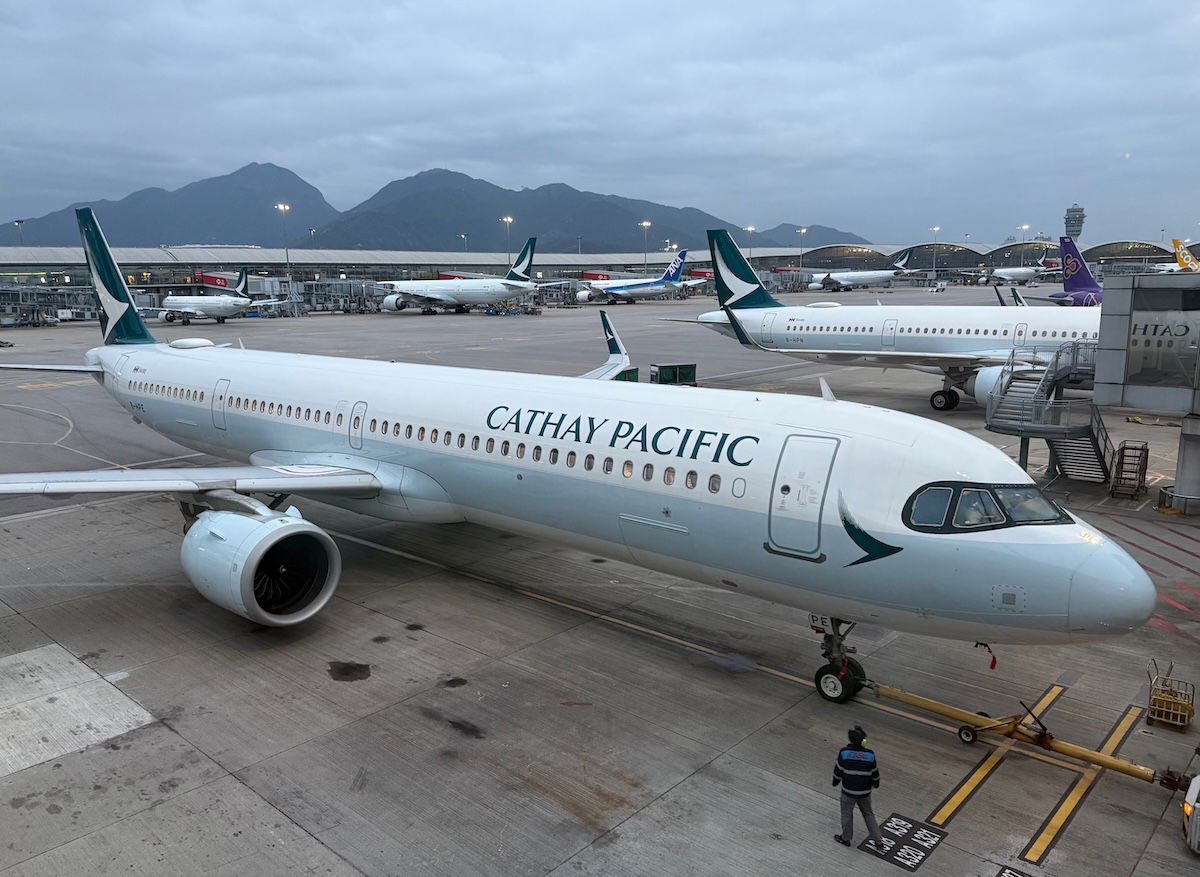
Cathay Pacific has a total of (at least) 30 Airbus A321neo aircraft on order, with roughly half of those planes having already been delivered. This is the Hong Kong-based carrier’s only narrow body plane, and the backstory is quite interesting.
These planes were first ordered for Cathay Pacific regional subsidiary Cathay Dragon, but Cathay Pacific decided to merge Cathay Dragon into the mainline fleet several years back, and in the process, these narrow body planes also joined Cathay Pacific’s fleet. Since then, the airline has even expanded its order, recognizing the value these planes bring to the fleet.
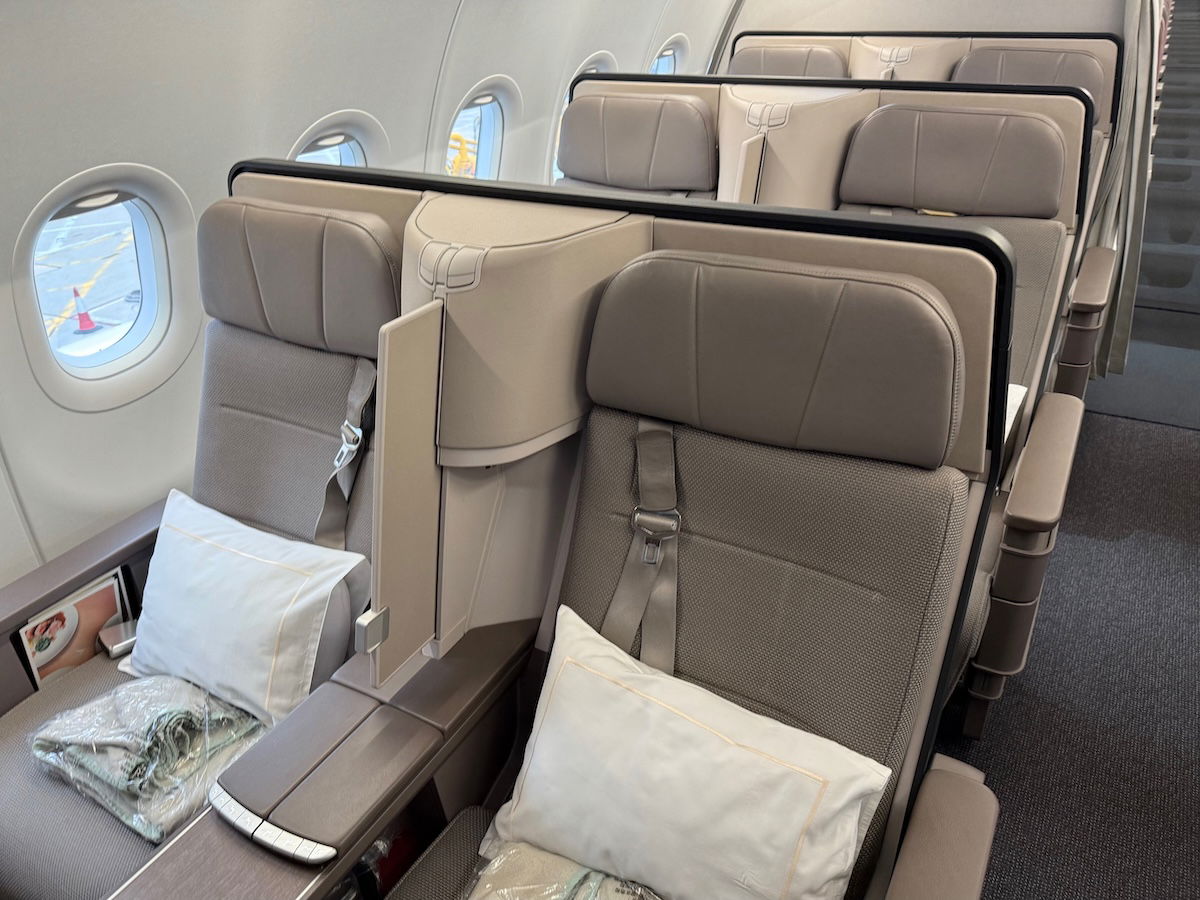
While Cathay Pacific has very high service standards across the board, these planes definitely aren’t the most comfortable in the fleet, as you’d expect. The planes have a total of 202 seats, including 12 recliner business class seats and 190 economy class seats.
With that in mind, Cathay Pacific has committed to introducing a new layout on these planes, centered around a few improvements:
- Cathay Pacific will partially increase seat pitch in economy, so the airline will be removing some seats in order to improve legroom; economy seat pitch on these planes is currently 30″, which compares unfavorably to the rest of the fleet
- Cathay Pacific plans to move a couple of the rear lavatories forward of the rear doors, in order to make them more spacious; currently the A321neos have a couple of those super tight lavatories that have become pretty standard on A320-family aircraft
- Cathay Pacific plans to increase rear galley space, to make it easier for the crews to work; this is made possible by moving the lavatories forward
Unfortunately the airline also doesn’t have plans to introduce new business class seats, even as rivals increasingly introduce flat beds on some regional narrow body aircraft (China Airlines, Korean Air, Singapore Airlines, Thai Airways, etc.).
If you’re curious about how the layout is changing, below are the seat maps comparing the old and new layout.


The updated interior will boast 195 seats, including 12 business class seats and 183 economy seats, meaning that a total of seven seats have been removed.
What I actually find most noteworthy is how the emergency exit setup is changing. The planes go from having one set of mid-cabin exit rows and one set of rear exit rows, to having two sets of mid-cabin exit rows, which is definitely more efficient.
There’s also a general renumbering of rows, to more closely match row numbers you’d find on long haul aircraft. You wouldn’t expect to find a row 69 on a narrow body plane!
The timeline with which Cathay Pacific plans changes
When can we expect Cathay Pacific’s new Airbus A321neo layout? Cathay Pacific currently has 16 A321neos in its fleet, and plans to take delivery of its 17th shortly (in the coming weeks), and that should be the first plane with the new layout. The remaining A321neos to be delivered will also all come with these cabins installed.
On top of that, in the coming weeks, the airline plans to retrofit its 16 existing A321neos, as fleet consistency is a priority. That project is expected to be carried out pretty quickly, so it could be that this entire project is done by the end of 2026.
Bottom line
It’s incredibly rare to see an airline remove seats from a plane in order to improve comfort, but that’s exactly what Cathay Pacific is doing on its narrow body aircraft. In the coming weeks and months we should see some changes to Cathay Pacific’s A321neo fleet, including an increase to seat pitch in economy, more spacious lavatories in the back of the plane, and more galley space.
The planes will go from having 202 seats to 195 seats, but the efficiency gains are even bigger than that, due to how exit rows are being reworked. This is a mighty customer friendly move for an airline to make, and that’s not something we often see.
What do you make of Cathay Pacific’s A321neo plans?




As I've mentioned before, the current batch of aircraft were inherited from Dragon. While it was the regional "arm" if you will, it was still considered a separate brand, so they could've gotten way with a more dense configuration. Now that it has been fully integrated into the parent brand, it makes sense to have a consistent experience across the fleet from narrow-body to wide-body. The IFE system is one of the best out there...
As I've mentioned before, the current batch of aircraft were inherited from Dragon. While it was the regional "arm" if you will, it was still considered a separate brand, so they could've gotten way with a more dense configuration. Now that it has been fully integrated into the parent brand, it makes sense to have a consistent experience across the fleet from narrow-body to wide-body. The IFE system is one of the best out there with Panasonic's NEXT system which is 4K. While not the ASTROVA which is basically the top of the line OLED system , it's still a fantastic system that can be found on JALs A35K.
Regarding Business Class, the recliners are not my thing for those readers who know me already. This is just a educated hypothesis of mine, but I can see the seats being upgraded once all of their A321neos are fulfilled as they have plenty on their plate right now in regards to CAPEX from lounges and wide-body retrofits, to new aircraft orders.
It depends on how long of flights CX uses these aircraft for.
The Airspace rear lavs is not standard but an option. Some airlines have them on some Airbus A320 family aircraft but not on others.
The motivation to change the configuration is not the lavs but the galleys.
You can't do a meal for all of economy, esp. a hot meal, with the Airspace galleys.
Tim is exactly right on the technical constraint, the Airbus Cabin Flex rear galley configuration was optimized for LCCs selling buy on board, not legacy carriers staging 190 hot meals. You physically cannot cycle carts in that footprint without blocking the lavatories, creating a bottleneck that destroys crew efficiency. However, the strategic decision to de-densify is baffling. Cathay is effectively deleting 3-4% of their narrowbody capacity just to protect a hot meal service on 2-hour...
Tim is exactly right on the technical constraint, the Airbus Cabin Flex rear galley configuration was optimized for LCCs selling buy on board, not legacy carriers staging 190 hot meals. You physically cannot cycle carts in that footprint without blocking the lavatories, creating a bottleneck that destroys crew efficiency. However, the strategic decision to de-densify is baffling. Cathay is effectively deleting 3-4% of their narrowbody capacity just to protect a hot meal service on 2-hour hops to Taipei or Shanghai? That is a massive CASM penalty to pay for "soft product" nostalgia. The smart move would have been to keep the density and switch to high quality cold boxing or a premium buy-on-board model. Sacrificing hard product revenue potential for the sake of an economy meal service is legacy thinking that will get them crushed by the agile Mainland carriers who know exactly what their CASM floor needs to be.
Nothing baffling about this. Cathay is focused on service in a premium part of the world. Not everywhere is in a race to the bottom like Trumpland.
Haha. NickW only ever appears to defend Tim thus far. It is very cute.
"However, the strategic decision to de-densify is baffling. Cathay is effectively deleting 3-4% of their narrowbody capacity just to protect a hot meal service on 2-hour hops to Taipei or Shanghai?"
Nothing baffling about that, it's just what their competitive market-space demands.
The inverse is how European airlines can get away with offering economy seats as "business class," which would be beyond baffling to an east Asian carrier. Yet that's what Europe's competitive market allows....
"However, the strategic decision to de-densify is baffling. Cathay is effectively deleting 3-4% of their narrowbody capacity just to protect a hot meal service on 2-hour hops to Taipei or Shanghai?"
Nothing baffling about that, it's just what their competitive market-space demands.
The inverse is how European airlines can get away with offering economy seats as "business class," which would be beyond baffling to an east Asian carrier. Yet that's what Europe's competitive market allows.
Fairly straightforward.
I've flown both CX's A321neos and their regional A330s, and I can tell you the A321neos are noticeably tighter. I'm not tall, but while the A330s feel pretty spacious (32" pitch), the A321neos (30") are tight and my knees are practically up against the seat back. Yes, US carrier econ seats are just as tight, but CX's seat is better padded and has more stuff on the seat pocket, eating up into legroom.
It's also...
I've flown both CX's A321neos and their regional A330s, and I can tell you the A321neos are noticeably tighter. I'm not tall, but while the A330s feel pretty spacious (32" pitch), the A321neos (30") are tight and my knees are practically up against the seat back. Yes, US carrier econ seats are just as tight, but CX's seat is better padded and has more stuff on the seat pocket, eating up into legroom.
It's also about market segmentation to some degree. CX also owns HK Express, a ULCC, with 29" pitch. Probably helps create a slightly larger point of differentiation.
"It depends on how long of flights CX uses these aircraft for."
The same way they're being used now!
Singapore would pushing it for them, but hopefully with the arrival of the 330neos, Singapore gets all wide-bodies again.
I’ve (5’10”) sat in this plane, and my knees were against the front of the seat in front of me. It was impossible to be comfortable.
The problem is the seats are too thick. The seat pitch doesn’t take into account the seat’s thickness in front of you so you end up losing several inches. The actual useable space is much lower than 30”.
Well would you look at that! A non-American airline focusing on something other than pure segmentation / revenue extraction.
With no respect at all: show us the last time a European or Australian major airline did similarly either.
ImmortalSynn is right. All Due Respect’s comment was just dumb. Not only about when was the last time you have seen an Australian or European carrier doing something like this but can you imagine Air Canada doing something actually good for the passengers.
USA-based airlines don't have low-cost subsidiaries like Cathay Pacific does
@ betterbub it is sad how Ted and Song did not work out. I thought Song was a good low cost subsidiary of Delta. Not sure about Ted.
Crazy to think that British Airways used to fit only 180 seats in their slightly larger 757s, and this was with European style Business Class. Probably one of the reasons they left the fleet a little early too though haha
I noticed that the CX share price was up today and wondered why. Probably just coincidence.
It looks like a nice comfortable ride and worth a squirt, for those less vertically challenged …. :-)
They schedule these narrow bodies also on 4 hours treks like KUL, Indonesia, Japan, Seoul and also on red-eyes, they compete with other airline (and also their own) wide-bodies, so in order to make them more popular with travellers, they have to improve.
They still have 333 and 773 in recliners though.
Select A330s will be getting new lie-flat seats. Older A333s along with the 773 (non ER) will keep the recliners until they are retired so it doesn't make sense to include them in the retrofit; some of the 773s and A333s are still from 1998-onwards, so while they are tired and have older seats, they're still airworthy.
Just another educated guess of mine, but as soon as the retrofit gets going, I can see more...
Select A330s will be getting new lie-flat seats. Older A333s along with the 773 (non ER) will keep the recliners until they are retired so it doesn't make sense to include them in the retrofit; some of the 773s and A333s are still from 1998-onwards, so while they are tired and have older seats, they're still airworthy.
Just another educated guess of mine, but as soon as the retrofit gets going, I can see more of the more higher-yielding destinations get them while the likes of Manila, Surabaya, Cebu, Phnom Penh, et al. get the recliners.
I see Lucky picked up this story from Australia's Executive Traveller website. This CX story is fine. But if you dip into Executive Traveller further, be warned this site leans heavily towards and is biased in favour of Qantas in their 'reporting'. Not surprising given the perks. Good luck finding anything positive about Virgin Australia on that site! Or for that matter, anything negative about Qantas. Aussies in particular will know what the deal is..
@John ... er, no - not correct.
Somewhat recently, Ben ran the story of QF's first delivery (3 frames) of their order of A321XLR's with their 200 seat configuration. Mainly focused on the seat density and the number and placement of available toilets.
Cathay (with their 202 seat configuration) - is simply doing the same refit as QF. Mainline brands and differentiation from their LCC brand layout.
QF's first 3 frames are to be reconfigured...
@John ... er, no - not correct.
Somewhat recently, Ben ran the story of QF's first delivery (3 frames) of their order of A321XLR's with their 200 seat configuration. Mainly focused on the seat density and the number and placement of available toilets.
Cathay (with their 202 seat configuration) - is simply doing the same refit as QF. Mainline brands and differentiation from their LCC brand layout.
QF's first 3 frames are to be reconfigured within the near future to be reduced from 200 to 197 seats - and all future deliveries are arriving in the 197 seat configuration.
QF's local LCC subsidiary Jetstar (JQ) runs a different and more dense configuration - which will remain unchanged. These aircraft will primarily fly domestic Australian routes, with the 'possibility' of trans-Tasman (AU to New Zealand) operations.
However, QF mainline does have subsequent orders covering fleet additions of the A321XLR's which will be used for QF *regional* international. These will feature significantly less dense cabins - with expected full lie-flat J Class cabins and an increased Y set pitch. Full details of this sub-fleet are yet to be fully announced by QF - but should be confirmed in the upcoming months..
Look at the substantial pricing difference on their narrow bodies vs rest of fleet, and it's quite clear why.
These are the most horrible seats ever. HK express the ULCC arm on paper has 29inch and that felt much roomier than this! I tried to avoid A321neo on CX at all cost and would much rather fly ULCC given how abysmal it is…
Smells like deep rooted Criminal Corruption to me! The shareholders will not be happy with the loss of revenue
Jessica, the shareholders are content with our return on the investment in CX. Furthermore, there is no known smell of “Criminal Corruption”. Why would anyone say such a thing without knowing a thing about the company?
Your post adds only a click to Ben’s click count, of which I am sure he will be grateful.
It's great to see an airline remove seats to increase passenger comfort. Too bad they are not adding lay-flat seats up front. Maybe in the next reconfiguration.
202 seat mean they need 5 cabin crew
Remove 2 seat means they cut 1 manpower
in HKG, Civil Aviation Authority requires 1 crew per door (normal sized ones, not the small overwing ones). Since the A321neo for CX has 6 doors, they are required to have 6 crews. Even if the pax count drops, if the doors do not go away, they cannot deviate from this minimum standard.
@AeroJ, it looks like in the new configs the sets of mid doors are being replaced in favor of overwing exits. Maybe they still keep 6 fas though...
Cathay aircraft already had more than 5 crew. Asian airlines don’t staff to the service minimum, like in third world countries.
I think they have 6 crew on now..... 2 in J and 4 in Y.
FAA can't bully airplanes that doesn't enter their jurisdiction.
Doesn’t matter the region, 5+ hour redeyes should have lie-flat in premium cabin, even on narrow-body aircraft. Delta 757, United 757, American (321T, XLR), jetBlue Mint, Singapore 747, TAP 321neo, La Compagnie 321neo, and others have had iterations of this over the years. Why all airlines, especially those attempting to cater to wealthy clientele, haven’t invested in this is astounding.
1990, it is nice to see that you are adding further narrative to the post, thank you Ben.
This is actually great news for CX fliers and it shows that these A321 NEOs are part of CX's long term plan. The current A321s are truly hated by every passenger. CX really charges a premium price here in Hong Kong and these A321s will be used on the Jakarta flights soon. For European airlines, they can get away with it because they compete with ULCCs and their flight lengths are much shorter. But not...
This is actually great news for CX fliers and it shows that these A321 NEOs are part of CX's long term plan. The current A321s are truly hated by every passenger. CX really charges a premium price here in Hong Kong and these A321s will be used on the Jakarta flights soon. For European airlines, they can get away with it because they compete with ULCCs and their flight lengths are much shorter. But not here in Asia. The bathrooms are truly terrible and the smaller galley means service truly struggles.
About business class, they really need a lie flat product, but given the current supply line issue, CX really has no choice but to keep these awful seats until they go through another reconfiguration in another five years or so. Plus unlike some Asian countries, CX is not going to use these A321s on flights on longer flights. Jakarta is possibly the furthest that this plane will go.
Anyway I am glad that CX listens to us for once, and the bathroom situation will be great. But I hope they will keep the row numbers of the extra legroom seats to be the same, so there won't be unpleasant seat changes.
Once all the current A321neos are reconfigured, I could see them rolling out a new business class product next as they seem to be the only major holdout left without a lie-flat product on a narrowbody. While EVA doesn't receive their first neo until 2029, I'm certain it will be a lie-flat product.
I tried to use AI to do the math, the seat pitch would still be horrible…
It would now be nominally 30-31inch but once you minus the cushion? It’s gonna suck.
CX A321neo is truly way worse than HK express or even Ryanair.
People kept saying is because it’s for dragonair? That’s BS, coz dragonair is also a premium brand, is the silk air to SQ. The current configuration is not even suitable for UO!
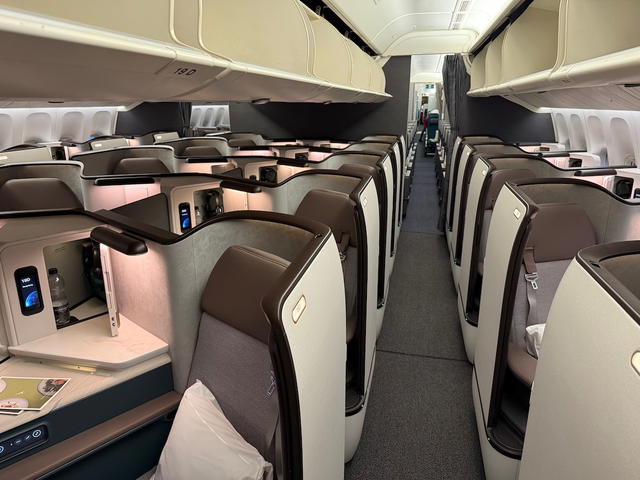
To be clear, Cathay is introducing lie flat business seats, just not on the A321:
https://thealviator.com/2026/02/cathay-pacific-new-regional-business-class-reveal/
I still see an all lie-flat fleet eventually, but not in the immediate horizon as they have a lot on their plate with regards to capex. Lounges, new aircraft orders, the Aria Studio not to mention the A350 which I'm sure is next in line.
A321neo . . . graphic 2 . . . where is doors 3L / 3R? ? ? :-o
Has Airbus a new A321neo w/o doors 3? . . . only 1,2,4 R/R? ;-)
What sorcery are they doing to delete doors at 3? The over wing exit is just a plug, but the doors are significantly more complex than that. I’m shocked to learn that the ACF program is ACTUALLY that flexible.
I flew on a CX aircraft from Hong Kong to Singapore last year ,I think this A321neo.The seats were very cramped and I am only 5foot 11 inches . I wrote a letter of complaint to Cathay .
"The planes go from having one set of mid-cabin exit rows and one set of rear exit rows, to having two sets of mid-cabin exit rows, which is definitely more efficient."
I guess it depends on how you measure efficiency?
It looks like they’re going from one overwing exit + one aft-wing door to two overwing exits per side.
I’ve always thought that doors are much faster for evacuating passengers. At a door, just...
"The planes go from having one set of mid-cabin exit rows and one set of rear exit rows, to having two sets of mid-cabin exit rows, which is definitely more efficient."
I guess it depends on how you measure efficiency?
It looks like they’re going from one overwing exit + one aft-wing door to two overwing exits per side.
I’ve always thought that doors are much faster for evacuating passengers. At a door, just jump, jump, jump one person another. Whereas at an overwing exit it’s a slower “leg, body, leg” process.