
For obvious reasons, there has been a lot of talk lately about aviation safety. With the way that information is shared nowadays, there’s also a lot of misinformation, and perhaps alarm in areas where there shouldn’t be. Along those lines, a reader asked me a question that I figure might be worth addressing at large (to be clear, there’s no misinformation in his question, but it covers the same topic).
What causes airplane go arounds?
Reader Will asked me the following question, regarding a go around (often referred to as an aborted landing, missed approach, or rejected landing) that he experienced on a flight today:
Today, I had an interesting experience on flight SK502 from London Heathrow (LHR) to Copenhagen (CPH), and I wanted to reach out with a question.
During our descent to CPH, there was a sudden and noticeable increase in altitude, and the cabin crew announced that our landing had been aborted. A few minutes later, the captain explained that the landing was aborted due to a slow-moving aircraft in front of us. We went around and landed without incident approximately 10 minutes later.
I’ve heard of aborted landings due to weather conditions, but this is the first time I have encountered an aborted landing due to another aircraft. Have you ever experienced anything similar on your travels? I’d love to hear your thoughts or any insights you might have on this situation.
Looking at Will’s specific flight, it appears that the aircraft descended down to just under 1,000 feet, and then terminated its approach, while still a few miles from the airport. As a matter of fact, the plane made its turn to resequence before even passing the airport.
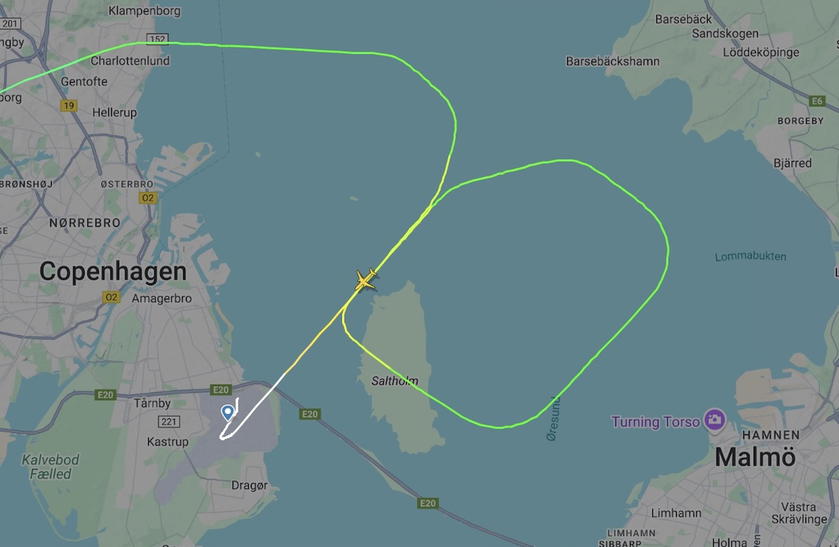
What Will experienced here is extremely common. Generally speaking, go arounds happen for one of several reasons.
As Will mentions, sometimes go arounds happen due to weather or other flying conditions. It could be that there’s sudden wind shear on final approach, or that that visibility is below minimums, or that the aircraft is too high or too fast, etc. There’s a human element to aviation, and landing a plane is rather complex, so sometimes more than one try is needed.
But I’d guess that aircraft spacing and other traffic is at least as common of a reason for go arounds. Now, of course that sounds super scary, with recent incidents like what we saw with a Southwest 737 at Chicago Midway (MDW). Yes, that’s an extreme example, and that was a close call, and the Southwest pilots did a stellar job.
However, in a vast majority of situations, go arounds are totally routine and less dramatic. Why could traffic cause go arounds? Well, many airports are basically at capacity, and during peak periods, they have one plane landing after another. There’s often close to minimum spacing between aircraft, with little margin for things to not go exactly as planned.
So it could be that one plane is coming in a bit slow, while the plane behind it is coming in fast. Or it could be that a plane just takes several seconds too long to clear the runway, because it doesn’t exit at a certain taxiway. Or in some cases, runways are used for both takeoffs and landings, so it could be that a plane is a bit slot to start its takeoff roll.
While air traffic controllers do an incredible job giving pilots instructions that minimize disruptions, there’s still a human element to it. Pilots won’t always follow instructions the second that they’re given, and sometimes things get tricky, like when you have a turboprop in front of a heavy jet (with the aircraft having very different approach and landing speeds).
How common are airplane go arounds?
If you’ve ever wondered how common go arounds are, there’s some data on that. Now, I haven’t seen any reputable data about global go arounds, but the Federal Aviation Administration (FAA) has published data on go around numbers at 30 of the country’s busiest airports.
At those airports, 0.39% of flight arrivals experience go arounds, so that’s roughly one in every 250 flights. Even among those 30 airports, there’s quite a bit of variability — Washington (DCA) has a rate of over 0.8%, while Los Angeles (LAX) has a rate of just over 0.2%. I’d expect the global average to be a bit lower than 0.39%, since this rate is for the most congested airports in the country.
Since Will was asking about my travels, I’d say that as a passenger, I experience a go around an average of around once per year. Most commonly, they’re for the reason Will experienced (due to traffic), but I’ve also had some rough ones in bad weather.
Probably my favorite one goes back over a decade, where I was flying on a British Airways Boeing 747 on a windy day, seated in the nose. You really feel all movement in the nose of the 747, and there’s nothing quite like the (near) full power of the queen of the skies, especially when you aren’t expecting it.
My most recent go around was maybe six months ago, on an American flight from Tampa (TPA) to Miami (MIA). It was very similar to Will’s — we were at around 1,000 feet, and it was due to not enough spacing.
On social media, I’ve increasingly seen some people try to suggest that go arounds reflect a lack of safety culture. Quite to the contrary, go arounds are part of a healthy safety culture, and a go around represents pilots erring on the side of caution and following best practices, rather than just rushing to get on the ground.
Bottom line
Aircraft go arounds are a pretty common occurrence, even though I know that they can rattle some travelers. At the busiest airports in the country, they happen around 0.4% of the time, based on the latest data I’ve seen.
Go arounds typically happen either due to weather or landing conditions, or due to traffic or spacing. Go arounds are a standard procedure that pilots are trained for, so there’s nothing to be worried about. Of course in the Southwest situation above, that absolutely would’ve been something to be worried about, but that represents a tiny minority of go arounds.
If you’ve experienced a go around, what was your experience like?


Membership is free and takes no more information than commenting as a guest. Earn status points for good contributions, and see fewer ads as your status grows.