
There’s not a day that goes by where I don’t learn something new about the airline industry — it’s one of the reasons I never get bored. I figured I’d share the “lesson” I learned today (thanks to Noa for pointing this out), since it’s one that caught me off guard.
I’ve always been under the impression that the UK has the world’s highest tax on airline passengers, in the form of the Air Passenger Duty (APD). As it turns out, Pakistan absolutely puts the UK to shame, with taxes on premium cabin airline tickets that make the APD look like a bargain, by comparison.
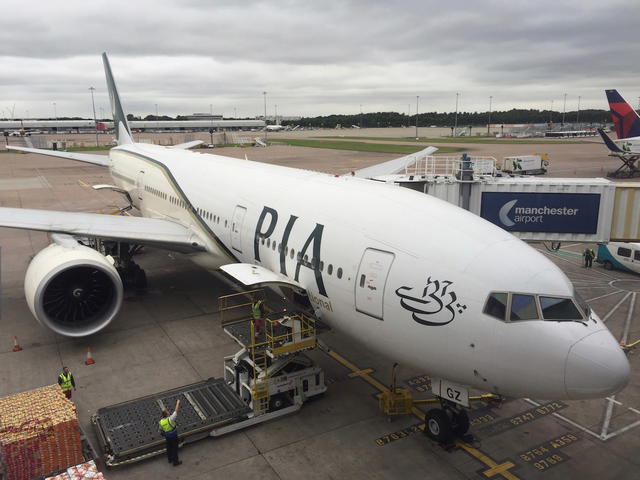
Federal excise duty on airline tickets from Pakistan
Virtually all countries charge taxes of some sort on airline tickets, though Pakistan really takes it to the next level. The country charges a federal excise duty on itineraries originating in Pakistan. So you don’t pay these taxes if you’re simply connecting in Pakistan, or if you’re traveling to Pakistan, but instead you pay them for any portion of a trip that originates in Pakistan.
How bad are the taxes? Well, in economy and premium economy, they’re not so bad, at least relatively speaking. The federal excise tax is 12,500 PKR (~45 USD), regardless of where you’re traveling to. That’s kind of steep for a short haul international flight, though not unreasonable for a long haul international flight.
However, it gets much more costly if you’re traveling in a premium cabin. There the cost varies based on where you’re traveling to. For tickets in first and business class:
- Pakistan charges 350,000 PKR (~1,263 USD) for tickets to North and South America
- Pakistan charges 210,000 PKR (~758 USD) for tickets to Europe, much of Asia, Australia, New Zealand, etc.
- Pakistan charges 105,000 PKR (~379 USD) for tickets to the Middle East and Africa
Keep in mind that the above amounts are just one aspect of the taxes you pay, as there are other taxes and fees, both for the origin and destination country. This is also separate from any carrier imposed surcharges an airline may add to the cost of a ticket. The tax also applies when redeeming miles for a ticket.
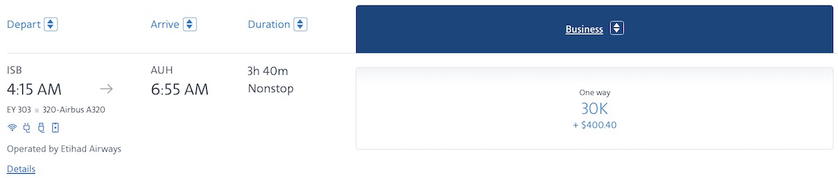
For example, if you’re redeeming American AAdvantage miles from Islamabad to Abu Dhabi in Etihad business class, you’d pay $400.40 in taxes and fees.
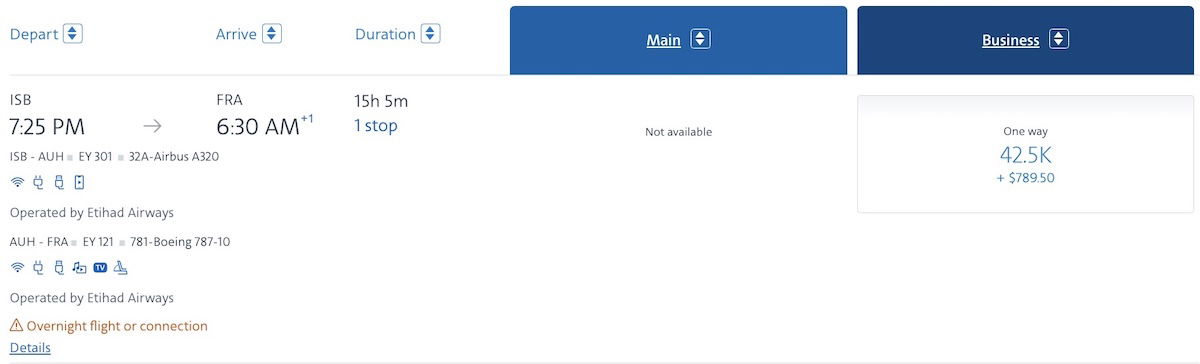
If redeeming miles from Islamabad to Frankfurt via Abu Dhabi in Etihad business class, you’d pay $789.50 in taxes and fees.
If redeeming miles from Islamabad to New York via Abu Dhabi and Amman in Etihad and Royal Jordanian business class, you’d pay $1,323.61 in taxes and fees.
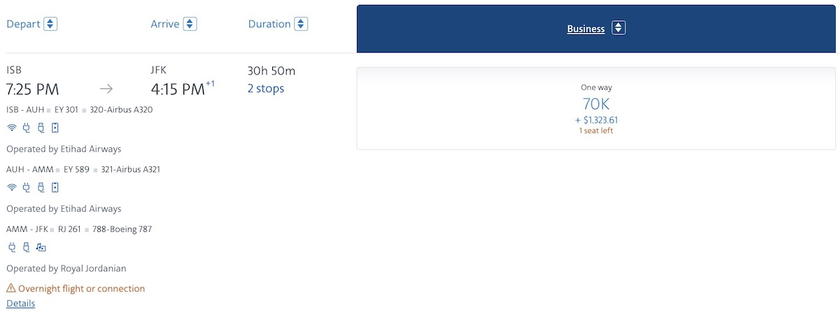
Ouch!!
That tax can’t be easy for airlines
Pakistan is a challenging aviation market. The country’s national carrier, Pakistan International Airlines, has struggled endlessly with both operating reliably and staying in business. The country has also struggled with consistently maintaining long haul service from other carriers.
I can of course understand the balance that governments have to try to find between getting the funding they need to operate, while not making things unaffordable. I see the logic of heavily taxing premium cabin tickets, since those are generally going to be the least price sensitive customers, and there’s also a huge wealth gap in Pakistan.
At the same time, taxing passengers $750+ for any flight that’s more than several hours makes matters really difficult for airlines. I would imagine that in many cases, Pakistan’s federal excise duty on airline tickets is significantly greater than the typical profit margin for a flight (especially for an airline with a big premium cabin).
I suppose if the government views demand for air travel (especially in premium cabins) as being highly inelastic, then maybe the country is onto something. However, I think the math isn’t quite that straightforward, and that these kinds of taxes probably impact the extent to which some airlines offer service to the country.
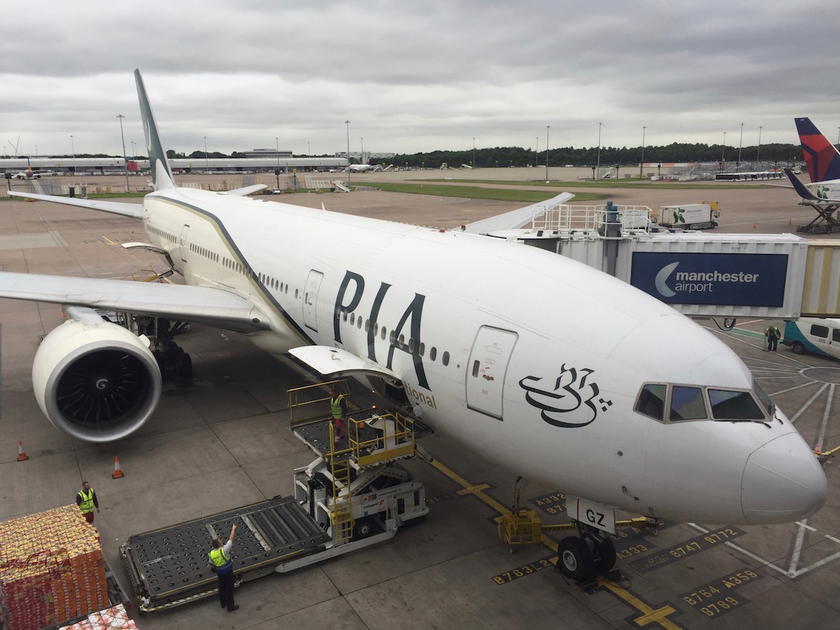
What’s funny is that Pakistan International Airlines has actually found a loophole to avoid having to charge these kinds of taxes. Nowadays the airline markets its business class as “executive economy,” so since that’s considered premium economy, the higher fees aren’t due.
Now, I suppose the government is probably happy with that loophole, since passengers on foreign air carriers are on the hook for this, while those flying with the national carrier aren’t. At the same time, it’s pretty dumb to not set parameters around what constitutes first and business class, and what doesn’t.
Bottom line
It’s news to me, but Pakistan seems to have the world’s highest taxes on premium cabin passengers. For a short flight within the Middle East, a business class passenger is on the hook for a fee of nearly $400, while for a flight to the Americas, that tax increases to over $1,200. I always enjoy learning something new, so hopefully I’m not the only one who finds this interesting.
What do you make of Pakistan’s incredibly high airline taxes?


Membership is free and takes no more information than commenting as a guest. Earn status points for good contributions, and see fewer ads as your status grows.