

While the concept of basic economy has now been around for well over a decade in the United States, we’ve known that airlines in the United States are planning to expand that concept to premium cabin tickets. Executives at the “big three” US carriers — particularly Delta and United — have been clear about their intentions to roll this out ASAP.
There’s now a major update, as United has announced plans to introduce tiered fares across cabins, and that includes the introduction of “basic” premium cabin tickets.
In this post:
United wants to segment business class revenue more
United has announced a new tiered fare structure, which is described as making it easier for customers to find the flight experience that best matches their preferences.
As part of this, the airline will offer three fare options — basic, standard, and flexible — in premium cabins for many flights, including long haul international, transcontinental, and select Hawaii flights. This change is expected to launch as of some point this month (April 2026) in select markets, and it will expand to additional markets throughout the year.
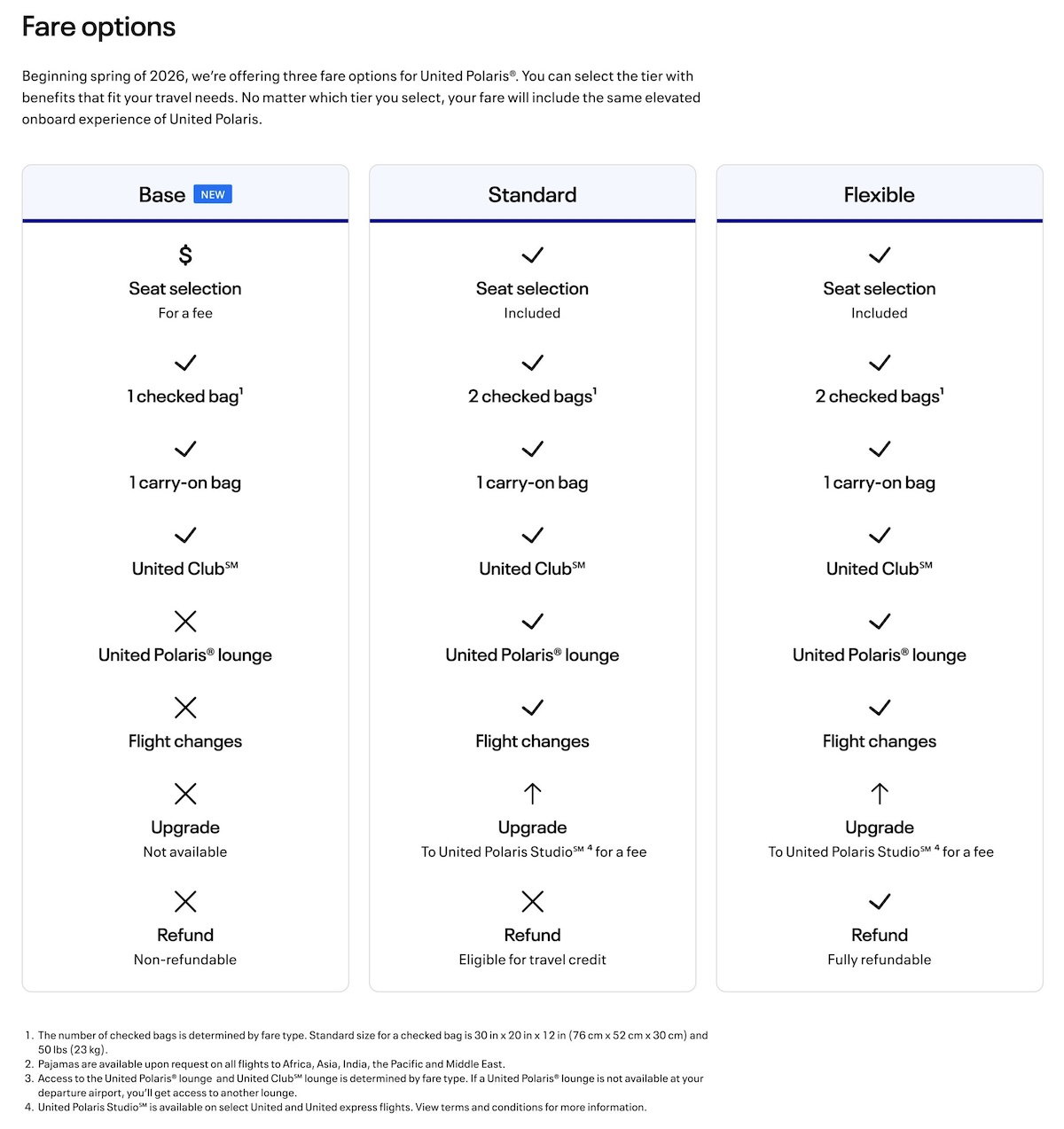
So, what new restrictions will come with these basic fares? Travelers booking the basic fares in Polaris business class:
- Will have to pay to select seats (compared to them being included)
- Will get one free checked bag (compared to two free checked bags)
- Will receive United Club access, but not United Polaris Lounge access
- Will not be eligible for changes or refunds (standard fares allow changes, while flexible fares allow refunds)
- Will not be eligible for paid upgrades to the United Polaris Studio
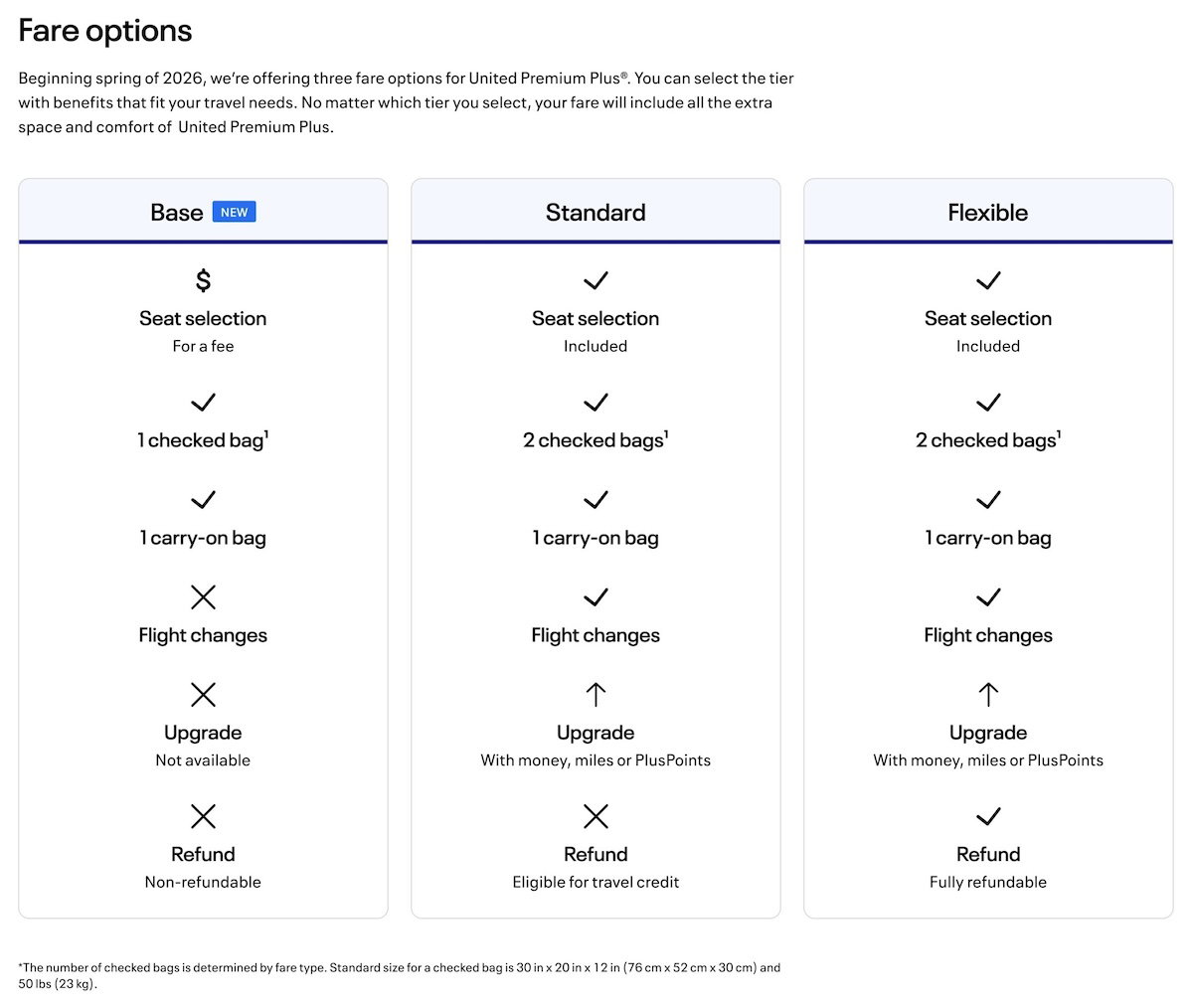
The restrictions will be similar for basic Premium Plus premium economy tickets. You’ll have to pay to select seats, will have a more limited checked bag allowance, won’t be able to upgrade, and tickets won’t be flexible.
I suspect that before the end of 2026, we’ll see these basic premium cabin fares at all major US carriers. This announcement comes just a day after United completely changed how it awards miles for flying, as it’s now all about whether you have a United credit card or not.
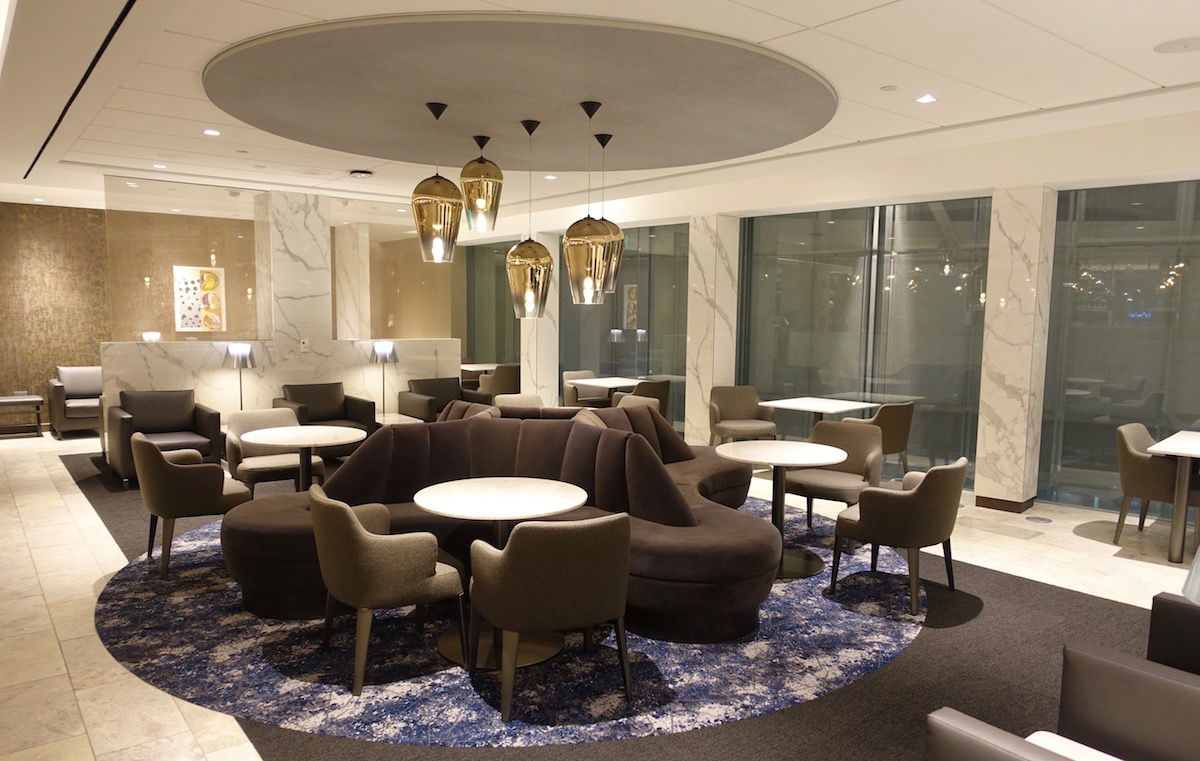
It’s also interesting (and perhaps logical) to note that Polaris Lounge access is on the chopping block. United just announced that the forward cabin on premium transcontinental flights will soon be marketed as Polaris, meaning those passengers will finally get Polaris Lounge access. One wondered how crowding would be handled in light of that, and I guess these basic fares are one way to address that.
Will customers benefit from basic business class fares?
Over time, we’ve seen the concept of basic economy become pretty widespread, whereby the cheapest economy fares include the fewest perks. The purpose of this is twofold — to expand a carrier’s potential customer base, and to get existing customers to “buy up” to a higher fare, in order to avoid punitive restrictions.
The concept of basic business class is similar. These basic fares are always framed as being good for customers, and giving them more choice, and allowing them to only pay for the services that they want. But make no mistake, that’s not actually how the implementation of these fares typically works.
I wouldn’t expect basic business class fares to be materially cheaper than existing business class fares. Instead, I suspect that more often than not, the current cheapest fares will be made the basic fares, in an effort to get people to buy up to more expensive fares. I wouldn’t consider that to be good for consumers.
At the same time, I’m not surprised to see the trend. Premium leisure demand is strong, while business travel hasn’t fully recovered. Leisure travelers are often willing to pay a lot for business class, but they’re typically not willing to pay $10K+, as some corporate customers previously may have. So it’s not surprising to see airlines using whatever strategies they can to get people to part with more of their money when flying business class.
The thing to keep in mind is that adding basic business class fares in long haul markets requires a bit more coordination, given the joint ventures that the major airlines belong to, which create metal neutrality. So I’d expect to find these fares across Star Alliance transatlantic joint venture partners in the near future, given how these kinds of flights are sold. It’s not surprising I guess that Lufthansa also recently rolled out basic business class fares.
I should mention that it remains to be seen what elite status perks will apply on these fares. Furthermore, it remains to be seen what fare bundle upgrades and awards book into. I have to imagine that we’ll also soon see the concept of awards and upgrades booking into specific bundles with different pricing.
Bottom line
For quite some time, United executives have been hinting that the introduction of basic premium cabin fares would be imminent. This is now official — United is introducing new fare categories across cabins, and the idea is that we’re going to also see basic premium cabin fares.
In the case of the new United Polaris business class basic fares, they only allow seat assignments for a fee, have a reduced checked bag allowance, don’t allow changes or refunds, and only allow United Club access, rather than United Polaris Lounge access.
Make no mistake, this is a way to generate more revenue, and I’d view this as being a fare increase if you want the same as before, rather than some amazing new discount opportunity for premium cabin tickets. Expect Delta and American to also match in the very near future.
What do you make of United introducing a basic Polaris business class product?




I think the airlines are missing a key psychological point here with the lounge access thing.
People love Polaris Lounge and it adds a halo effect to United. But no one will want to pay like $1000 extra for it knowingly. And if you blatantly advertise that that’s the cost to get in, people won’t do it. But if you just quietly tuck it into the cost of a ticket, people will be like “well that’s my vacation I’m splurging”
(shrug) Let's see the prices. Once the Centurion a EWR opens, I couldn't care less about Polaris. One checked bag is fine - as often as not, we travel with carryons. No refunds may be an issue.
Any difference in mileage earning?
Why not add to Standard and Basic business class? Have Sub-Basic business class. No seat selection, cannot change assigned seats, no meals, no check luggage allowance, no carry on allowance except personal item, no lounge access, pillow or blanket is a paid extra, board last, must use economy section lavatory unless dire emergency, must remain seated and deplane last, must not speak with an FA except in an emergency, cannot use kiosk for check in...
Why not add to Standard and Basic business class? Have Sub-Basic business class. No seat selection, cannot change assigned seats, no meals, no check luggage allowance, no carry on allowance except personal item, no lounge access, pillow or blanket is a paid extra, board last, must use economy section lavatory unless dire emergency, must remain seated and deplane last, must not speak with an FA except in an emergency, cannot use kiosk for check in but must print boarding pass at home or at a hotel, save electricity by turning off IFE for your seat, etc.
Regarding refunds, will basic fares allow refund to travel credit (which is fine)? Or no refund at all?
>will basic fares allow refund to travel credit
No, at least according to Ben's post. Basic == no refunds, Standard == travel credit.
I just don't get these fares. There's almost zero marginal cost to most of the stuff they're "unbundling". I'll pick the more generous carrier. And they won't have a significantly higher cost basis for being so. I don't see how this works in competitive markets
The marginal cost of the perks is immaterial. What matters is how much people will pay for them. In addition, there really is a two-tiered market, with the traditional corporate or very wealthy customers being very insensitive in price, as well as the huge and growing market of people who want to fly business but not at the super high prices. This allows UA to take advantage of both market segments.
For example, take...
The marginal cost of the perks is immaterial. What matters is how much people will pay for them. In addition, there really is a two-tiered market, with the traditional corporate or very wealthy customers being very insensitive in price, as well as the huge and growing market of people who want to fly business but not at the super high prices. This allows UA to take advantage of both market segments.
For example, take the case of a current $1000 business class fare, and let's say the marginal cost of providing those extra services is $50. United could jack up the standard fare to $1500 and lower the basic fare to $800. Very wealthy customers will pay the $1500 (price-insensitive) and more of us plebes will be able to afford an $800 fare than a $1000 fare. If UA can sell equivalent numbers of both those fares, the average fare would be higher than $1000. So UA makes a lot more money while saving a tiny bit on the marginal costs.
I'm sure the exact math is different, but you get the idea. UA almost certainly did not do this to cut marginal costs. It did it to attract more revenue.
Customer friendly move. Boycott United.
So premium.
We will soon have front and back sections of business section. You get economy food, angled lay flat and no service. Coming to a major us airline near you!
This change doesn’t affect me at all. I always pay the highest fare. If you’re too poor , then sorry not sorry.
LOLOLOLOLOLOL!!!!!!!!1!!!1!!!!!!
WHATS YOURE PROBLEM!!!
"WHATS YOURE PROBLEM!!!"
Problem? No problem, you are amusing is all. Go on. Keep commenting. We need the laughs.
United is becoming the airlines for people who spend OPM (Other Peoples Money)
One can only pity the suckers who are stuck flying UA business vs. just about any other foreign carrier's biz. UA is utterly uncompetitive, from the mid service levels to the mid food, and now, to the mid biz. packages.
“I don't want more choice, I just want nicer things!”
-Edina Monsoon, AbFab
this is correct. Why anyone would fly a US carrier internationally is beyond me. Always fly foreign flag carriers abroad.
On many routes, United Polaris business has way better hard product than BA, Lufthansa, Swiss and Virgin Atlantic because they are still flying a mix of new and dated business class configurations.
Some non stop routes are only served by one airline
For me a big factor in "basic" fares is do frequent flyer perks still apply? Such as free seat selection and increased luggage allowance.
You have to appreciate that some lounge access is still included here, that's usually the first perk to get removed from basic business fares, and only makes overcrowding in credit card lounges even worse
Thanks Delta for leading the way with shitty, customer unfriendly innovations!
European and ME carriers have been doing this for years, including the ones that are consistently claimed as among the best in the world.