

It has been a wild few weeks for global aviation, particularly for airlines based in the Middle East. For many years, carriers like Emirates and Qatar Airways have been transporting passengers traveling across the globe, and their success with this has largely been due to the safe image these destinations have.
Suffice it to say that recent times have really challenged that. We’ve seen Gulf carriers frequently have to suspend operations due to incoming missiles, and one imagines that this conflict won’t end overnight. Along those lines, could the major Gulf carriers be considering a more creative strategy to keep operations going, without disruption?
In this post:
Sri Lanka offers hub to Emirates & Qatar Airways
It’s being reported that the government of Sri Lanka has initiated preliminary discussions with both Emirates and Qatar Airways, with the intent of offering one of Sri Lanka’s airports as an alternative hub for the foreseeable future.
This doesn’t center around Colombo Bandaranaike International Airport (CMB), the country’s largest airport. Instead, this is about Mattala Rajapaksa International Airport (HRI), often referred to as the country’s “ghost airport.” The billion dollar airport opened back in 2013, and unfortunately has seen very little commercial service, so it has been a bit of an embarrassment for the country.
At least the airport now has some additional seasonal service — you can fly Russia’s Red Wings from Chelyabinsk, Kazan, Mineralnye Vody, Samara, Sochi, and Tyumen!
Both airlines have reportedly “expressed strong interest” in moving some of their operations to the southern Sri Lankan airport. Now, it’s anyone’s guess how serious that interest is, but that’s seemingly what the government is claiming.
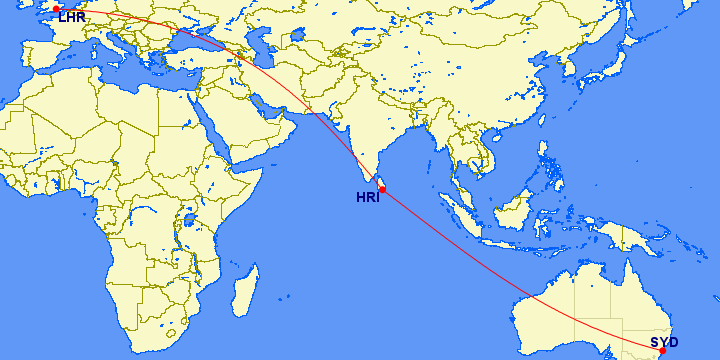
When you consider the percentage of Emirates’ network that involves moving people from Europe and Africa to Asia and the South Pacific, then you realize the geography of this hub is potentially quite good, as it sits along popular Indian Ocean east-west aviation corridors, and it’s also far south of the current conflict zone.
Sri Lanka hopes that such a setup could provide a vital economic lifeline to the country, especially as the current situation in the Middle East has caused a steep decline in tourism to Sri Lanka, due to flight cancelations.
Something creative will need to happen, but…
It’s really hard to know how this conflict will play out. Currently, it seems like airlines are approaching this as a short term challenge that will be resolved soon, and expect full operations to resume ASAP. I’m certainly no expert on geopolitics, but I have to imagine there’s also a very real possibility that this could go on for many weeks, months, or possibly even years.
Presumably if airlines knew things wouldn’t be fully back to normal for a year, they’d start making some alternative arrangements. As I see it, Sri Lanka’s idea here isn’t half bad. Sri Lanka does have good geography, and Sri Lanka has the “good fortune” of having a basically abandoned airport that has huge capacity but no demand — talk about a once-in-a-lifetime opportunity to make something of it. 😉
Given what a large percentage of Emirates’ network is connecting, I could see merit to rerouting some of the most common connecting itineraries via Sri Lanka. For example, you could operate flights to London, Sydney, etc. We’ve already seen Qatar Airways operate point-to-point routes from Europe to Asia (simply skipping Doha), so this hardly seems like the wildest idea.
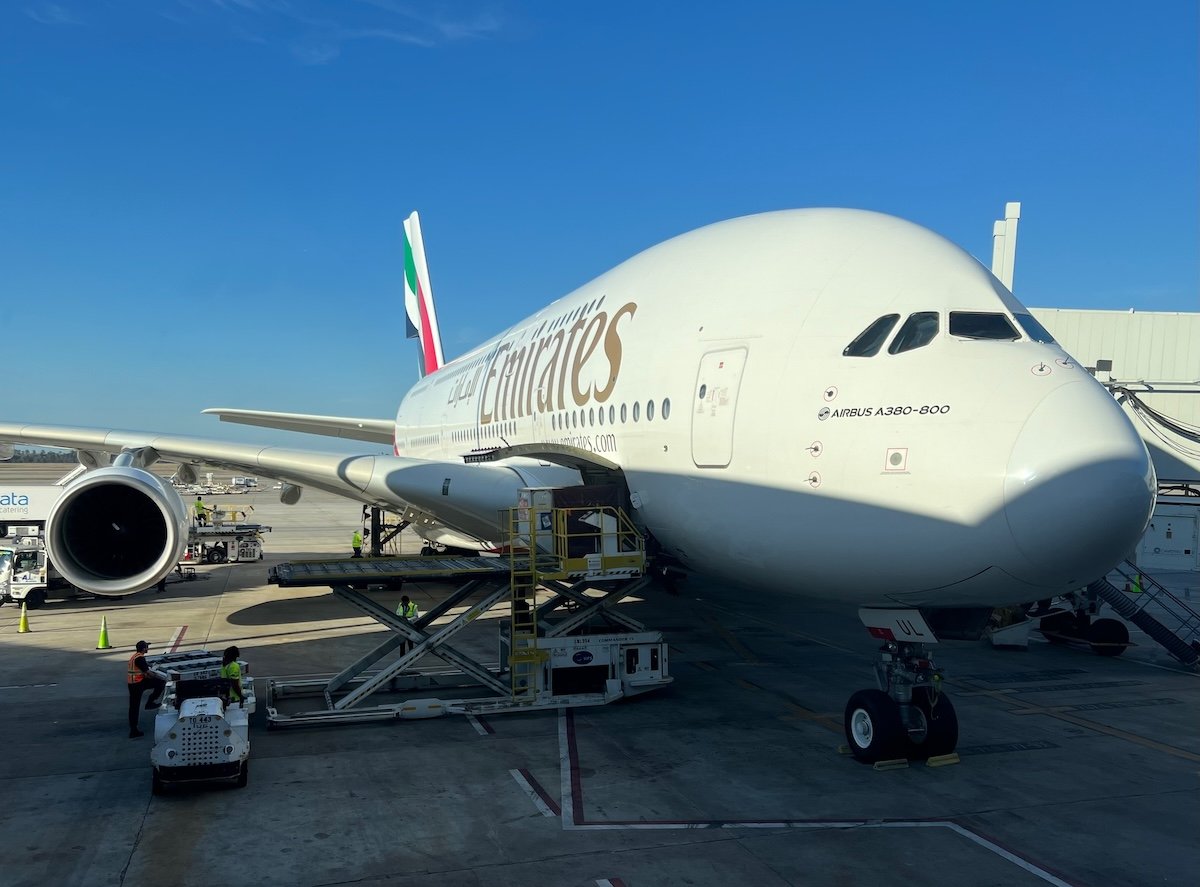
As I see it, the biggest challenge is how quickly you can really ramp up operations. Sure, the airport is technically big enough to accommodate A380s, but how long would it actually take to get all the ground equipment, set up catering, have sufficient housing and hotels near the airport, etc.? This is all easier said than done, and I imagine this would be viewed as too much of a headache for a temporary situation.
Bottom line
Sri Lanka is offering up its “ghost airport” as a hub for airlines like Emirates and Qatar Airways, with government officials claiming that the airlines are interested. If it does become necessary to route operations via other regions, then a large, nearly abandoned airport, with good geography, seems like a decent choice.
While I obviously see the upside here for Sri Lanka, I have to imagine this is unlikely to happen in the near future, given the amount of preparation that would be required to get this up and running.
What do you make of the concept of a Gulf carrier setting up a hub in Sri Lanka?




*here .... autocorrect
Everyone hear is thinking it so ill just say it.
The world needs global airlines, its their time to shine
Why does the flight path you suggest (in red) fly right through the heart of Iran? Is that supposed to make the flight safer than flying via Dubai, Abu Dhabi or Doha?
I think the biggest issue with ME carriers using HRI is a nearly complete lack of infrastructure in that region. Hambantota is very remote, even by Sri Lankan standards. There is a huge commercial port (built by China, I think) and not much else. I was on a cruise ship that stopped there once and had difficulty getting back to the port after a tour because roads flooded after heavy rains. Guess what? It rains...
I think the biggest issue with ME carriers using HRI is a nearly complete lack of infrastructure in that region. Hambantota is very remote, even by Sri Lankan standards. There is a huge commercial port (built by China, I think) and not much else. I was on a cruise ship that stopped there once and had difficulty getting back to the port after a tour because roads flooded after heavy rains. Guess what? It rains there a lot, especially in monsoon season. That could be a problem.
Secondly, Sri Lanka's location might work well for some of the ME carriers' route network but not so much from North America. A lot of connections from North America are to/from Africa and India. Sri Lanka is much farther from North America than the Gulf and it's also a pretty good distance beyond Africa if originating in North America. And, if headed to India, it's still a bit of an overshoot. Using HRI would be e expensive to start up if only applicable to a portion of these carriers' route in networks.
For sure not for North Americ, what made you think the Americans will use it. However although it is remote as per your observations the travel time to Colombo from Hambanthota is only around 2.5hours and there are quite few luxury hotels less than a hour away. In serious terms I see it a very viable option for the Middle Eastern Airlines due it's strategic location. Let's wait and see if the necessary infrastuctural needs...
For sure not for North Americ, what made you think the Americans will use it. However although it is remote as per your observations the travel time to Colombo from Hambanthota is only around 2.5hours and there are quite few luxury hotels less than a hour away. In serious terms I see it a very viable option for the Middle Eastern Airlines due it's strategic location. Let's wait and see if the necessary infrastuctural needs are met for this to happen. A very good proposal I would say.
Thanks for that information. It will be interesting to see what, if anything, comes of this.
Center around: which is it?
Sri Kanka is lovely tourist destination. I'm all for this. Hopefully repairs the damage done to cause EK to sell out UL.
Gulf Air operates a similar scheme by running limited return flights between Dammam and Bangkok, London and Mumbai, as their national airspace is totally closed to the traffic, I believe
Won’t be happening
Reason?
Neither the airport nor the country (Sri Lanka) has the infrastructure to support something like this.
Not yet.
Be nice if the earth was not flat because then you could go round the other way. Longer but safer. Seattle and Vancouver airports would boom.
Interesting idea but I don't see it happening. SEA isn't physically capable of handling A380s. YVR is, but I doubt it could handle enough of them to accommodate EK's needs. More to the point, neither the USA nor Canada recognizes the concept of transit passengers. Both countries require all arriving passengers to go through border crossing formalities and that alone would kill this idea.
Canada don't... I've transited in YVR and no luggage or customs required... There was a small fee I recall but much smoother than the US.
Smoother, yes, but actually smooth? Maybe today, but subject to change. It isn't the same as transiting at an airport that truly recognizes international transit passengers and my guess is that you did have to go through passport control at YVR. That would subject arriving passengers to any and all visa requirements, etc. So, whether or not transiting via Canada is easy may very well depend upon one's passport. The ME carriers handle passengers from...
Smoother, yes, but actually smooth? Maybe today, but subject to change. It isn't the same as transiting at an airport that truly recognizes international transit passengers and my guess is that you did have to go through passport control at YVR. That would subject arriving passengers to any and all visa requirements, etc. So, whether or not transiting via Canada is easy may very well depend upon one's passport. The ME carriers handle passengers from many countries where this could still be a problem.
Did Canada get rid of the concept of transit? When I flew through it right before covid on CX from HKG-YVR-JFK I didn't have to enter the country.
Did you even check Google maps? This airport is way too tiny. Jet bridge can’t hold wide body aircraft’s.
Guess they'll be using the stairs...
Entire tarmac from satellite view barely has space for maybe 5 big jets at most
Strange, because Russian carriers are flying 777’s there daily I think. I’ve driven by it a few times and it’s quite modern.
The A380 has infrastructure needs that other wide-bodies don't require--being able to load both passenger decks directly, accommodations for huge wingspans, reinforcing the tarmac for much heavier weights, etc.
The Times reports that long haul flights are at risk anyway:
https://www.thetimes.com/uk/transport/article/long-haul-flights-easter-holiday-travel-g2rfsn623
Oof. Fuel rationing could be an issue far beyond the ME.
Great idea.
Win win
I hear there are some available runway slots at Gan, as well...
Which Gan?
(Sorry, Maldives humor. There are three 'Gan's. Of course, I'd imagine you meant the one with the international airport in the Addu Atoll, but there's also one in Laamu and Gaafu Dhaalu.)
I hear there are some available runway slots at Gan, as well...
That'll be GAN / VRMG.
It would be unbelievably expensive and logistically difficult to make this happen. They'd have to hire and train thousands of workers, move GSE, crews, re-build flight schedules, etc. It would take years to create a meaningful operation which replicates what they have in the middle east.
Not yet.You may be being too pessimistic. Sri Lanka's workforce is skilled and highly educated and, with government blessing, we may be surprised at how quickly services could be ramped up. Anyway, developing a neutral, well located venue like Mattala may well be in the interest of ME airlines in the long term because of the constant risk of conflict escalation in the home zone.
Main problem will be fuel. Right now with restricted traffic in the gulf as well as destructions of oil and gas facilities, most of South/South-East Asian countries can not even run their regular operations at home and offices with fuel shortage and some countries already started applying restrictions such as driving, cooking gas delivery etc. Where will the fuel to power these jets come from ?
This is not even considering the skyrocketing Aviation fuel...
Main problem will be fuel. Right now with restricted traffic in the gulf as well as destructions of oil and gas facilities, most of South/South-East Asian countries can not even run their regular operations at home and offices with fuel shortage and some countries already started applying restrictions such as driving, cooking gas delivery etc. Where will the fuel to power these jets come from ?
This is not even considering the skyrocketing Aviation fuel and shortage (SK and NZ already announced plans to cancel flights) and Gulf carriers will not have the cheap oil
Okay, who wants to setup a Kickstarter to send Ben on a Red Wings flight from Columbo to Samara?? Come on, Ben, that would have to rank up there in your wishlist of flights you haven't taken yet! :)
Don't forget the issues of traffic rights. If Lufthansa can successfully lobby to government to not give Emirates traffic rights to/from Berlin, I can't imagine it would be easy for Emirates to get traffic rights between Germany and Sri Lanka. Sure, some countries will be less problematic, but many won't.
Yeah, I think this is the biggest issue. Emirates would have to negotiate fifth freedom rights from all of these countries to be able to fly to sri lanka, unless they do some financial jujitsu and base a subsidiary in Sri Lanka.
Dare I say, that's a lot harder than even restarting a largely closed airport.
During a war situation and not permanently.
Plus, I doubt Sri Lanka even has traffic rights with some countries.
QR, EK, EY really should make arrangements elsewhere, for however long it takes, because if this goes on for months and months (or even years), like the pandemic, they will need to adapt.
I've driven by HRI; it's weird. They do have actual flights there, but not many. Think, Russian airlines. It's near some of the nicer beaches in the south of Sri Lanka and the Yala National Park.
Much easier said than done, and who's to say how long the region will be unstable? Everything from facilities to crew to catering to fuel contracts will have to be negotiated and established in totally new business environments operating with totally new sets of laws, and if this situation doesn't last then all of that effort will be for nothing.
When's the breaking-point then? After a month? 3 months? BAH is closed; DMM is already the equivalent for MEA these days. EK/EY seem to be using MCT. Still, those are in-region, exposed.
I dunno I don't work at these airlines
This is excellent, as the Emirates is not reliable due to flooding or other disruptions in the Middle East. I hope the airlines strategize to have a second hub.
If Air India had more new A350s, it could use this crisis as a way to make itself and its Delhi hub a viable alternative to the Gulf carriers. If I was AI, I would be wet-leasing as many planes with modern cabins as I could, or offering Delhi as a temp hub for QR or Ethiad.
Would Pakistan allow a wet-leased Air India plane into its airspace? Right now most traffic between Europe and SE Asia is going north of Iran, then over the stans. United and Air Canada Delhi flights also take this route. But Air India flights have to go the long way around Saudi Arabia and Egypt with a refueling stop in Europe going west.
BOM works better to avoid Pakistan airspace.
Too bad AI uses DEL for their A350 base and BOM for the beat-up legacy 777. I am booked on AI 101 this May, would rather spend an extra couple of hours on a new A350 than go on a flying Mahindra.
Airport isnt big at all, just 2 gates with jet bridges and single runway. Hard to believe how this cost a billion to build based on satellite image of the airport.
Perhaps some airports in India/Pakistan (which might be underutilizing its capacity) are better equipped for handling some of the gulf load, besides locations in Saudi/Oman
Yeah I'm reading about this airport and it has significantly less capacity than Boise lmao
Ben, could they set up a temporary hub in your favorite airport? ;)
Ben, I have to say - it's a little funny to characterize this new hub a superior option while the pictured route from LHR runs right through the center of Iran ;)
On a more serious note and relatedly - the flight community is seeing lots of zeroed out space without formal cancellations. This might merit a separate post and I'll bet any insights would generate lots of interest...
Very innovative but with challenges. Add JetA-1 to list which is already starting to impact some counties and their airlines like Vietnam.
Would Brunei make sense as an alternative? I don't think they get much traffic.
BWN is too far out east and would only make sense for traffic connecting to AUS, NZL and maybe Philippines. Sri Lanka is a better geographical replacement that won't involve any 'backtracking' to SE Asian countries.
The big issue with Sri Lanka geographically (beyond other issues like fuel or terminal capacity) is it suddenly involves backtracking for a lot of the Europe --> India traffic, which is a huge market for the Gulf carriers.
MAA, BLR, TVM and COK are around an hour's flying from CMB today. HYD is another 40 mins. So it's not that bad for a big chunk. But BOM and DEL, with 9 daily flights, will be affected significantly. As also AMD and CCU. Perhaps a split operation may work?
What better options do they have?
I thought of Brunei as they're empty compared to Colombo. And @VS below mentioned Sri Lanka is experiencing a shortage of fuel. Brunei is not experiencing a fuel shortage as they're a major oil & gas exporter. And being one of the wealthiest countries in the world helps.
you could peel off some Europe to Australasia demand and connect it someplace other than the Middle East but no other airports can handle the amount of flights that run through the Middle East - and the connectivity of the remaining flights is significantly reduced.
This is an existential moment for the Gulf carriers and their prominence in global aviation could be significantly reduced not just this year but well into the future.
The biggest...
you could peel off some Europe to Australasia demand and connect it someplace other than the Middle East but no other airports can handle the amount of flights that run through the Middle East - and the connectivity of the remaining flights is significantly reduced.
This is an existential moment for the Gulf carriers and their prominence in global aviation could be significantly reduced not just this year but well into the future.
The biggest beneficiaries are the Euro flag carriers as well as the Indian and other SE Asian carriers that are seeing capacity over the Middle East pulled out; even as capacity returns, there will be lingering doubts about the safety of the Middle East until there is no possibility of Iran acting out again.
"could be significantly reduced not just this year but well into the future" --> serious question, what is the scenario where this has implications well into the future? After all, the gulf airlines are all government funded so going out of business isn't really much of a concern here.
And in terms of people's willingness to travel through the region after the conflict ends, I would simply posit that people have short memories and an...
"could be significantly reduced not just this year but well into the future" --> serious question, what is the scenario where this has implications well into the future? After all, the gulf airlines are all government funded so going out of business isn't really much of a concern here.
And in terms of people's willingness to travel through the region after the conflict ends, I would simply posit that people have short memories and an even greater love of cheap fares (which I am sure the Gulf airlines will be offering abundantly immediately after the conflict ends)
Acting out? Are you that dense? Your DL BS is well known, but being a dense MAGAt is a step even farther. This is Trump and Israeli aggression and nothing else.
Would make more sense if they ramp up operations from Saudi airports the same way other -albeit smaller- Gulf airlines have.
DMM is easily reachable by land from DOH and fifth freedom rights have been granted to others in record time. RUH also just completed a large renovation with a big increase in capacity and it’s a 6-hour drive away, Riyadh air won’t be filling these extra spots any time soon.
Riyadh and Jeddah make more sense to me. I don't know why Dammam with it's proximity to Iran and oil fields nearby would be any safer than DXB or AUH.
There is only one minor problem with this plan - Sri Lanka doesn't have enough aviation fuel. Even in normal times, Sri Lankan Airlines had fueling stops in India for months at a time, because the country was virtually out of foreign reserves to import any oil.
That one problem is solvable. Emirates or Qatar etc. have plenty of USD to buy the fuel and have it tankered there. Everything else about this PR stunt doesn't make any sense.
True enough, but under the circumstances, if this plan goes ahead, I am sure these two airlines will ensure delivery of sufficient stocks to the nearby Hambanthota port.
a whole refinery is planned to come up in the vicinity (Hambanthota port) in the future.