

A tiny, remote island in the South Pacific may lose its airport. On the surface, that’s understandable, given that maintaining it requires a nine-figure investment, and only a few dozen people live on the island. However, the fight over the airport’s future goes way beyond that, as it could impact airlines around the globe. Heck, it could even impact the economics of the world’s longest flight.
Midway Atoll Airport is run down, faces uncertain future
Midway Atoll Airport (airport code MDY) is known as Henderson Field, and is a public airport located on Sand Island, in Midway Atoll, which is an unincorporated territory of the United States. This is a 2.4 square mile atoll in the North Pacific Ocean, and it’s the only island in the Hawaiian Archipelago that’s not part of the state of Hawaii. It’s around 1,300 miles northwest of Honolulu, right near the International Dateline, so it’s around the halfway point between North America and Asia.

The Midway Atoll population is tiny — around 40 people live on the atoll, primarily consisting of staff of the United States Fish and Wildlife Service (FWS), as well as contract workers.
As a result, the airport serves primarily as an emergency diversion airport for transpacific flights — there’s a 7,800-foot runway there, so it’s plenty long for a large plane to land (and to take off with limited fuel). In theory, it also provides access to the Midway Atoll National Wildlife Refuge. However, that’s only by charter, because the airport last saw commercial service nearly 25 years ago, in 2002.
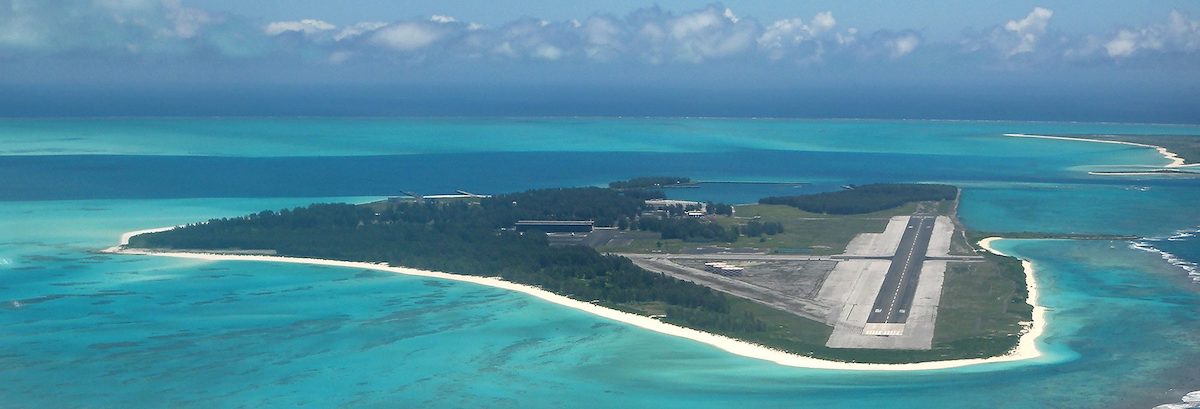
Midway Atoll Airport is a Part 139 certified airport, and it’s unique in that it’s operated by FWS, and isn’t a joint use airport. It serves a specific need in global aviation, in terms of being a diversion point for both military and commercial flights.
That brings us to the current situation, which is that the airport’s condition is deteriorating rapidly, and it’s expected that it may lose its current certification within five years, if it doesn’t get at least a $100 million investment. The Department of Transportation (DOT) is currently trying to decide on the airport’s future:
FWS is currently utilizing the FAA’s congressionally mandated $2.5 million per year in Airport Improvement Program (AIP) funds designated under the 2003 FAA Reauthorization Act to maintain MDY’s airfield infrastructure, and the FWS contributes an additional $2.6 million in annual funding to maintain minimum operational capability.
However, the funding designated is only a small portion of the airfield’s needs according to the 2021 Midway Atoll Comprehensive Master Plan. MDY’s runway is expected to reach a severe level of deterioration within the next five years. The estimated cost for major airfield rehabilitation at MDY exceeds $100 million for milling, repaving, and seawall repairs—an amount significantly higher than the annual AIP funding allocations. Additional non-airfield improvements, such as harbor upgrades to support shipment of construction materials, may also be needed.
Midway Atoll Airport closure would be issue for airlines
There’s always the risk of planes having engine failures (or other issues). As long haul aircraft increasingly have two engines (instead of three or four), they have to comply with ETOPS regulations. ETOPS stands for “Extended-range Twin-engine Operations Performance Standards.” Or jokingly, it stands for “Engines Turn Or People Swim.” 😉
There are different factors that determine a plane’s ETOPS rating, but the rating could be ETOPS 120, ETOPS 180, ETOPS 240, etc. That number represents how many minutes a plane is allowed to fly on a single engine to get to the nearest suitable diversion point. So if a plane is operating with ETOPS 120, it needs to be within 120 minutes of its nearest diversion point at all times.
That brings us to the issue here, which is perhaps best explained by the Aircraft Dispatchers Federation (ADF). They are strongly against the closure of Midway Atoll Airport, arguing it’ll impact airline operations across the Pacific, and in some cases, will require more circuitous routings. As the ADF explains:
With Russian airspace closed to U.S. carriers for the foreseeable future, every flight between the mainland or Hawaii and Japan, China, South Korea and Southeast Asia depends on a small set of mid-ocean and Aleutian airports to stay inside that limit. PMDY is the one in the middle.
Without PMDY, Pacific ETOPS coverage would rest on four airports, and the loss of any one of them, PASY above all, would open holes in the ocean that cannot be closed under ETOPS-180. Covering them would require ETOPS-207 or ETOPS-240 operations, contrary to FAA guidance, along with added equipment costs for carriers. Hawaii-to-Japan flights would fall back on Wake Island (PWAK), and beyond that on Kwajalein (PKMJ), which plays little role in Pacific ETOPS today.
The airport is not theoretical. The docket itself records 11 diversions into PMDY between 2003 and 2021; at least four in the last fifteen years were Part 121 airline flights carrying more than 800 passengers and crew combined, diverting for smoke in the cabin, a cracked windshield and low engine oil pressure.
Here’s perhaps the most interesting example of how the closure of Midway Atoll Airport could impact airlines. In 2027, Qantas will launch its “Project Sunrise” flights between Sydney (SYD) and London (LHR), which will be the world’s longest flight.
The expectation is that the westbound portion of this journey (from Sydney to London) will actually fly north from Australia toward Alaska, and then continue south from there. That optimal route relies on Midway Atoll Airport remaining a diversion point.
If Midway Atoll Airport weren’t an acceptable diversion point, Qantas claims it would need to load an extra 2,200 kilograms of fuel, and that would come with a payload penalty of over 20 passengers. The economics of ultra long haul flying are challenging in the first place, and that most definitely wouldn’t help.
As the airline explains, “compounded by ongoing geopolitical constraints on airspace availability, and the longer routings those constraints require, these impacts increase the risk to the long-term viability of Project Sunrise.”

Bottom line
The future of Midway Atoll Airport is uncertain. The airport requires $100+ million worth of upgrades in order to remain an acceptable diversion point for airlines flying across the Pacific. That’s a lot of money for an airport that doesn’t get service, but then again, the airport also serves an important function.
Yes, airlines absolutely could go without this, and a vast majority of the time, it wouldn’t even require a detour. However, for some flights, and definitely when things go wrong (including volcanic activity near Russia), this becomes a much more important airport.
I suspect that ultimately the airport will get the investment it needs to remain Part 139 compliant, but who knows how this plays out.
How do you see this Midway Atoll Airport situation playing out?




Hey, Ben: you’ve got it right in the second paragraph, but not in the first. Midway Atoll is in the North Pacific, not the Sourh!
Umm, Midway is really important for so many reasons; this is an essential investment for national security, as well as safe, reliable TPAC commercial aviation. How is this even a debate?
I can see a strong argument for airlines that "use" this airport should pay for the upgrades. By "use," I'm suggesting airlines that would have to fly a less-efficient route if the airport loss certification. I do not expect this to occur.
I wonder why the FAA ETOPS 180 route planning rule is not more challenged.
All modern wide-bodies are certified close to 300 min since the 777. Why does the FAA keeps applying an extra-conservative FAA 180 min blanket rule? If routings were calculated based on aircraft actual capabilities, the effects of Midway closure would be limited to older aircraft, namely A330ceos and 767s, the number of which, for TPAC passenger non-stops, is close to...
I wonder why the FAA ETOPS 180 route planning rule is not more challenged.
All modern wide-bodies are certified close to 300 min since the 777. Why does the FAA keeps applying an extra-conservative FAA 180 min blanket rule? If routings were calculated based on aircraft actual capabilities, the effects of Midway closure would be limited to older aircraft, namely A330ceos and 767s, the number of which, for TPAC passenger non-stops, is close to negligible.
Am I missing something here ?
Well, here is an interesting thought: let the airlines relying on this airport cough up the money needed. Why should the government be on the hook for that? I see the point that the government should finance airports that are actually serviced, because they provide benefits for their respective communities. MDY however seems to exist mainly as plan B.
In case of a diversion the airlines pay fees It’s the US government’s responsibility here.
"Why should the government be on the hook for that?"
Well, mostly because it's in the USA's best economic interests to facilitate ease of movement between points on the globe, which includes facilitating a viable Plan B for safety reasons, especially for commerce commencing or terminating in the USA. Agree that it wouldn't be unfair to ask other *nations* whose carriers rely on trans-Pac routes to chip in, but then the USA would likely need...
"Why should the government be on the hook for that?"
Well, mostly because it's in the USA's best economic interests to facilitate ease of movement between points on the globe, which includes facilitating a viable Plan B for safety reasons, especially for commerce commencing or terminating in the USA. Agree that it wouldn't be unfair to ask other *nations* whose carriers rely on trans-Pac routes to chip in, but then the USA would likely need to give up sovereignty of the (still very strategic) island, and that's likely not going to happen.
This is certainly interesting given it's proximity to Guam and Hawaii. I located 3 diversions there since 2011. All 3 seemed like they could have turned into serious issues if not addressed.
I do think that Guam and Hawaii should be the major diversion points going forward and airlines should carry less fuel and passengers for those long flights. Mainly because those airports have hotels and facilities if overnight stays are required/crews time out. For...
This is certainly interesting given it's proximity to Guam and Hawaii. I located 3 diversions there since 2011. All 3 seemed like they could have turned into serious issues if not addressed.
I do think that Guam and Hawaii should be the major diversion points going forward and airlines should carry less fuel and passengers for those long flights. Mainly because those airports have hotels and facilities if overnight stays are required/crews time out. For those 3 diversions, they were dependent on a plane being brought in from Hawaii. Which is a lot of work in itself and certainly isn't quick. What if no plane is available and it takes 24 hours? Where in Midway would they stay? Obvious preserving life is of a much higher value but still.
I'm curious whether any of the affected airlines are willing to kick in to support the operation?