

In early February 2026, we saw a wild incident, whereby a Scandinavian Airlines (SAS) plane attempted to takeoff of on a taxiway at a major airport. This incident was truly a head-scratcher, so I’d like to provide an update, as authorities have now published their preliminary report into the incident… and it’s still hard to make sense of how such a big screw-up was possible.
In this post:
SAS pilots accelerate to 107 knots on Brussels taxiway
For some background, this incident happened on Thursday, February 5, 2026, and involves SAS flight SK2590, scheduled to operate from Brussels (BRU) to Copenhagen (CPH). The 470-mile flight was supposed to be operated by an Airbus A320neo with the registration code SE-ROM, and there were 135 people onboard.
The plane was running behind schedule — while it was supposed to depart at 8:30PM, it ended up only departing around 10PM. However, it never actually got off the ground.
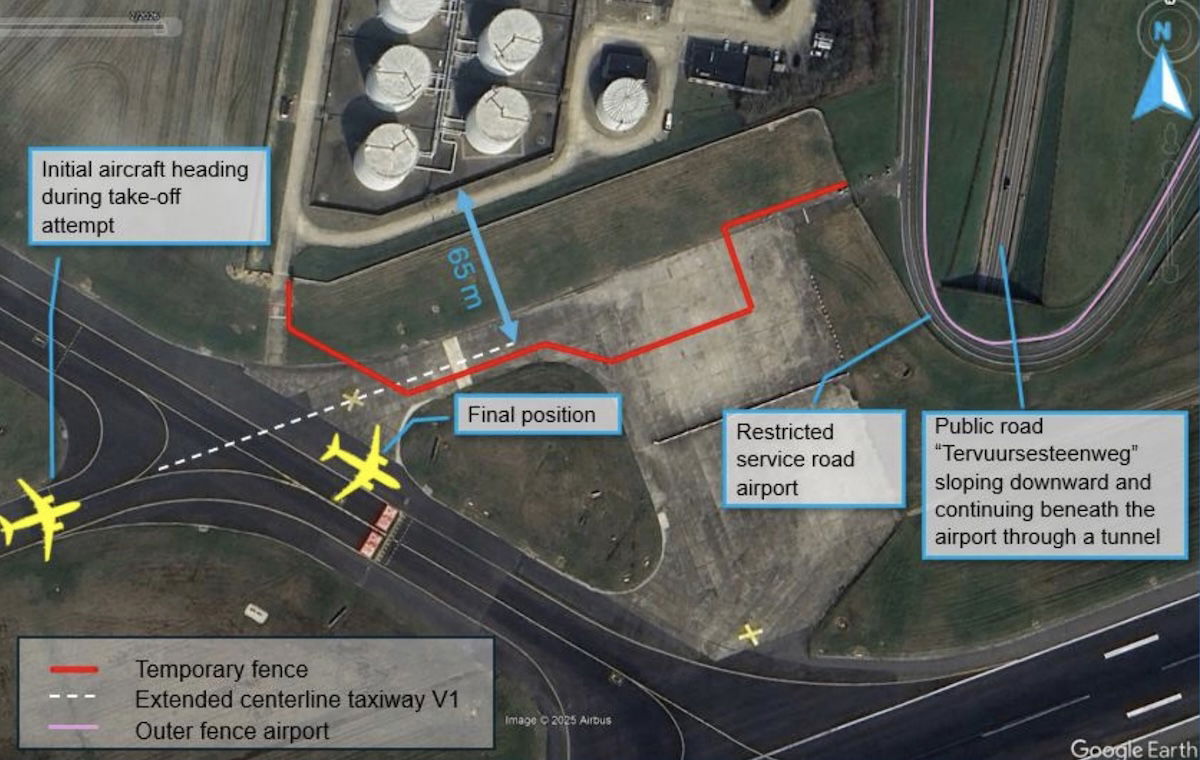
The pilots were supposed to taxi out to runway 7R, and were planning on doing a midfield takeoff from the intersection at taxiway C6. Instead, they turned too early, and ended up starting their takeoff roll on three sets of taxiways — E1, F2, and V1, which are parallel to the runway. The pilots accelerated on the taxiway, to the point that the plane reached 107 knots (123 miles per hour), which is approaching the plane’s typical takeoff speed (130+ knots).
The thing is, the taxiway is way shorter than the runway, so they were quickly running out of space for their takeoff roll. Not only that, but the taxiway isn’t even straight, and even gets narrower.
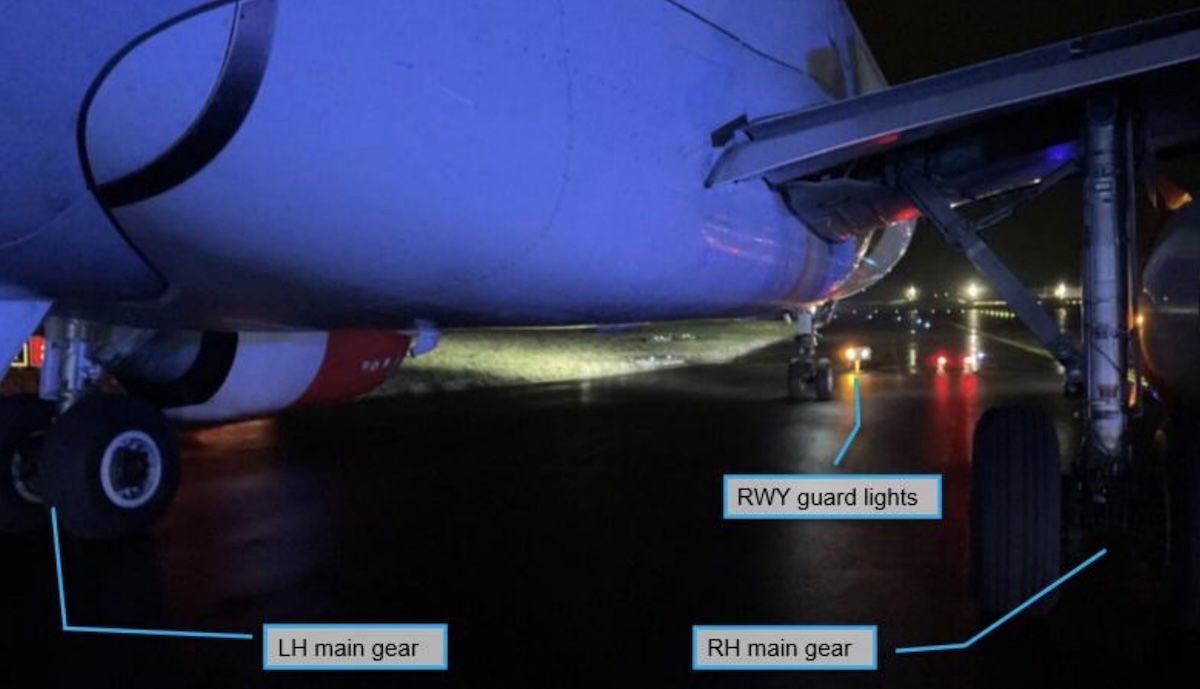
So roughly 300 meters from the end of the taxiway, they started decelerating. The plane ended up at the end of the taxiway, made a sharp right turn onto another taxiway, and even eventually ended up slightly off the taxiway, with overheated brakes. Passengers and crew had to get off the plane via stairs, and take buses to the terminal.
Those onboard describe this as a terrifying incident, with the plane coming to a very abrupt stop. The area where the plane came to a stop was very close to the airport’s fuel tanks, so thank goodness it didn’t get any closer to those, as that could’ve had an even worse ending.
Weather conditions at the time of the incident were fine, so that doesn’t appear to be a factor. While there’s no air traffic control audio from the incident (recording it is prohibited in Belgium), below is a VASAviation video about the plane’s movements, plus what was said based on the preliminary incident report.
This is really bad, and this was a very close call
This isn’t the first time that pilots have tried to take off on a taxiway, and it also certainly won’t be the last. It’s by no means common, but it does happen.
That being said, this is one of the worst versions of this that I’ve ever seen. That’s because this was an incredibly close call. A vast majority of the time when this happens, the pilots quickly realize what’s going on, and come to a stop with room to spare.
In this case, the plane got to such a high speed that it was only able to come to a stop at the very end of the taxiway, even needing to make a turn to avoid a full overrun.
This is a real head-scratcher. With the number of flights that operate every day, some incidents are bound to happen. Still, runways and taxiways look completely different in terms of their lighting, so it’s amazing that neither of the two pilots realized something was wrong when they started their takeoff roll. That says nothing of the fact that the taxiway they were on didn’t even have a straight centerline.
It’s bad enough for this to happen in the first place, and for pilots to quickly realize the mistake. But to accelerate for that long, only to then run out of taxiway, is really puzzling. So, does the preliminary report have any possible explanation as to how this could happen?
On this flight, the very experienced 56-year-old captain with 15,000+ hours was the pilot flying, while the more junior 26-year-old first officer with just under 1,000 hours was the pilot monitoring. Everything seemed to be normal until the plane was well into its acceleration:
- The first officer made the “100 knots” callout in the flight deck as the plane accelerated, but the captain didn’t initially respond, which the first officer found strange
- Moments later, the first officer realized what was going on, and yelled “no, this is wrong,” and issued the command “stop, stop, stop, stop,” at which point the captain immediately initiated the stop
- 22 seconds after the takeoff roll started, the thrust levers were moved to full reverse, and braking was applied
Bottom line
Several weeks ago, an SAS Airbus A320neo tried to take off from a taxiway at Brussels Airport. The pilots lined the plane up with a taxiway parallel to the runway, accelerated the aircraft, and it reached 107 knots, before they aborted the takeoff.
The issue is, the taxiway was much shorter than the runway, so the pilots found themselves with an unenviable choice, where they neither had sufficient distance to stop with a safety margin, nor did they have enough distance to take off. Fortunately the plane managed to safely come to a stop, with no passengers being injured.
I was very curious to see what an investigation would reveal. The initial report has now been published, and for better or worse, it doesn’t actually have any great insights. The pilots seemingly didn’t realize anything was wrong until they were accelerating through over 100 knots, which is kind of wild. Even more alarming is that it was the very senior captain, rather than the very junior first officer, who was flying the plane.
What do you make of this SAS A320neo takeoff mess?




The captain should be tested for mental fitness, he could be suffering from cognitive decline. The FO is still pretty green and perhaps thought the captain knew what he was doing. Anyway it's very bizarre, akin to driving on the sidewalk
This was posted on OMMAT a few weeks ago.
I thought there may have been an update but I can not see any.
Is it just a re-hash of the previous article?
This was posted on OMMAT a few weeks ago.
I thought there may have been an update but I can not see any.
Is it just a re-hash of the previous article?
How SASsy.
How this article was promoted on X:
An initial report about the incident has just been published, shedding some light on how this happened.
Conclusion in article:
The initial report has now been published, and for better or worse, it doesn’t actually have any great insights.
From the emerging pattern, it seems these incidents are most likely to happen in dark conditions, with the crews not fully alert. I thought that there were now automated runway orientation and announcement systems in most planes, and maybe warnings if takeoff thrust is applied on a non-runway, but I might be mistaken.
You still have the single biggest reason behind deadly accidents as part of the equation, humans.
Maverick was able to take off from a cratered taxiway in Top Gun: Maverick. Just saying...
It's Mav doing some of that pilot sh*t. Just saying..
I also take an occasional wrong turn, but then I am not a pilot. It is inexcusable for a pilot (two, here) for not being able to distinguish between a runway and taxiway.
If you fly enough you know that a runway and taxiway are very different. Runways are clearly marked with signs and lighting. It's hard to understand how two pilots could mistake a taxiway for a runway.
***Glug glug glug***
If you fly enough you know that a runway and taxiway are very different. Runways are clearly marked with signs and lighting. It's hard to understand how two pilots could mistake a taxiway for a runway.
Well it was a significant delay on a short flight. Pilots: "Whatever, we'll just drive instead."
"On this flight, the very experienced 56-year-old captain with 15,000+ hours was the pilot flying, while the more junior 26-year-old first officer with just under 1,000 hours was the pilot monitoring."
oh man, you know Fielder is going to have Some Thoughts about this here dynamic
@ digital_notmad -- Hah! At least First Officer Blunt wasn't afraid to speak up!
The layout of the runways is so complex. Pilots can't figure it out. It must be Bilt's fault.