

With the amount of inflation we’ve seen to luxury hotel rates in recent years, it can sometimes be hard to make sense of hotel pricing. However, I’d argue the greatest mystery in hotel pricing isn’t anything related to a room rate, but instead, the cost of a certain ice cream sundae that can be ordered via room service. I apologize in advance if I’m the only person who finds this interesting…
In this post:
The world’s most indulgent room service dessert
The Plaza Hotel New York was featured in Home Alone, and there’s a scene where Kevin orders an ice cream sundae through room service, and it’s prepared for him tableside… well, bedside.
Given that some people choose to stay at the Plaza Hotel due to the Home Alone connection, the hotel lets guests order the iconic ice cream sundae via room service.
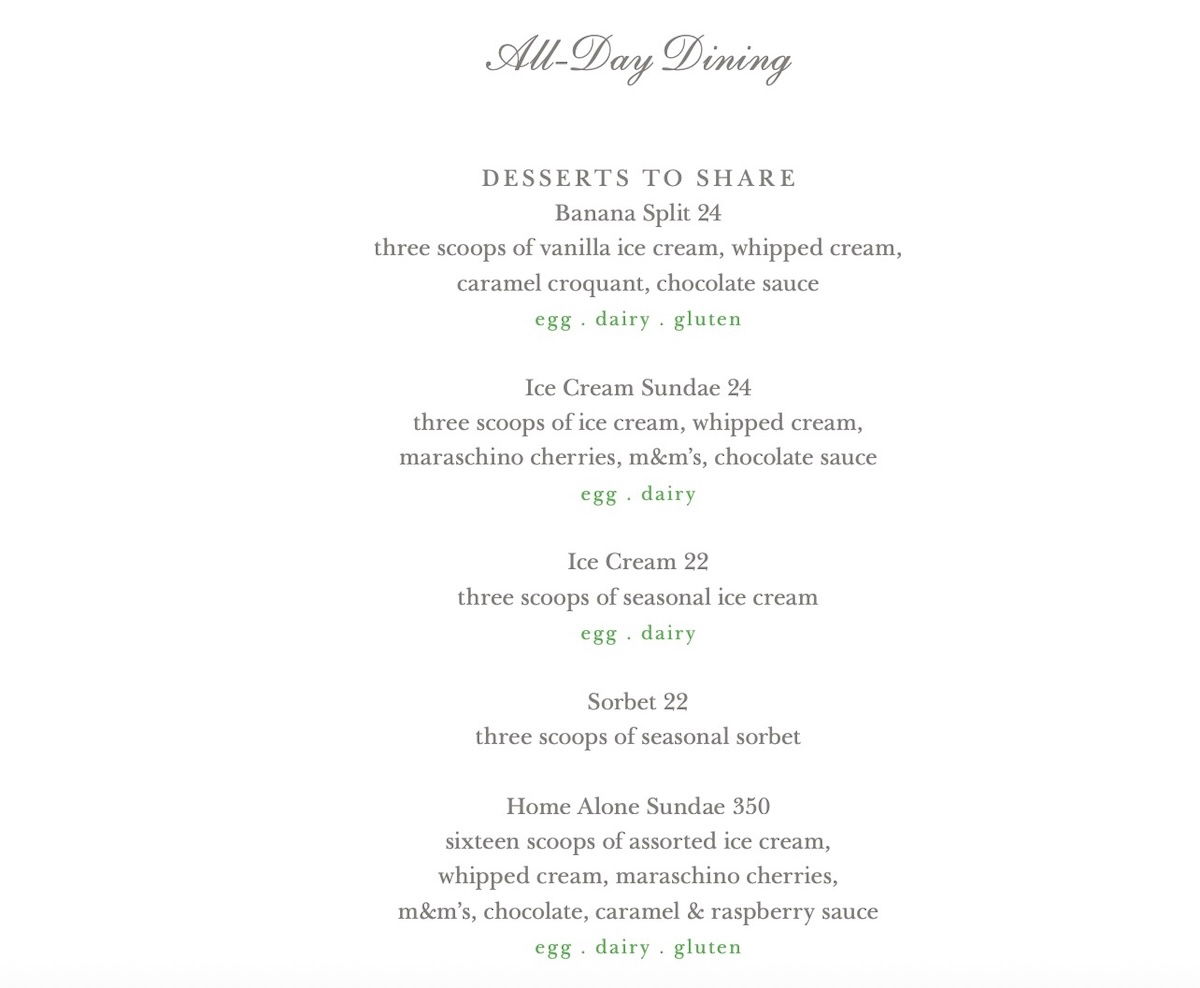
Specifically, the Home Alone Sundae includes 16 scoops of ice cream, three toppings (whipped cream, maraschino cherries, and m&m’s), and three sauces (chocolate, caramel, and raspberry).
The cost for the sundae is $350, and that’s before the 22% service charge, 8.875% sales tax, and $12 delivery charge. So when all is said and done, this sundae will cost you $470.06, and that assumes you don’t add any extra tip (not that you should, but…).
I guess I saw this on social media a few days ago, and thanks to the algorithmic world we live in, half of what I see on social media now is people ordering the Home Alone Sundae at the Plaza Hotel…
How can anyone make sense of the price, though?
I’m probably putting more thought into this than I should, but am I the only one who is scratching my head about the ice cream sundae cost?
So for $24, you can get an ice cream sundae with three scoops, three toppings, and one sauce. Meanwhile for $350, you can get an ice cream sundae with 16 scoops, three toppings, and three sauces.
So you’re getting 5.33x as much ice cream, while you’re paying 14.6x as much. So they’re charging you nearly three times as much per scoop. Typically if you place a larger order you get some sort of a volume discount, or at a minimum, you don’t pay a premium.
I’d be tempted to stay here and order six ice cream sundaes, but ask if they could put them all in one bowl. 😉 Honestly, the margins here must be amazing. What is the cost of these ingredients, really? $10 at most?
I suspect the simple answer with the pricing is that they charge that much because they can, and not because it has any basis in reality. For that matter, I can’t help but wonder if the insane pricing is almost designed for the benefit of the person buying the sundae.
- I imagine that just about everyone ordering this sundae films the whole thing, and puts it on social media, or something
- If you’re going to post on social media about an ice cream sundae, you’re going to get more views if it’s a $500 sundae than a $100 sundae
- Maybe the argument is that the Plaza Hotel is actually doing guests a favor, because it allows them to get more clout on social media, so think of it as a $300+ social media “tax”
As I see it, this basically boils down to “pay $500 for an ice cream sundae so that you can brag that you paid $500 for an ice cream sundae.” Which, in 2026, seems rather on point, I suppose…
Bottom line
The Plaza Hotel New York has a special Home Alone Sundae on its room service menu, with 16 scoops of ice cream, three toppings, and three sauces. While this is a cute concept, the pricing is kind of wild. While a three-scoop sundae will cost you $24, a 16-scoop sundae will cost you $350, and that’s before the delivery charge, service charge, and taxes, which drive the cost up to $470.
What do you make of the Home Alone Sundae, and in particular, the pricing?




I can make sense of the price. They know only an idiot would order a 16 scoop sundae and that idiot would also be willing to pay a stupid price for something they aren't going to eat. Idiot marketing 101
What a time to be alive
Another example of everything that is wrong with America / Land of AIPAC and Epst*ein protectors.
Yeesh. Not our best hotel, honestly. Tacky at best, even for NYC. Come downtown, try Greenwich Hotel (great shower) or Capa Cipriani (nice jazz club, views of the Statue, etc. )
No, thank you. We'll be back at The Mark, as usual.
Classic, if you're into Upper East Side old-school fine-hotels.
Not my part of town, though. You do you, mate.
A lie-flat business class seat takes about 3x more space than economy (e.g., Delta A350) and a domestic first class seat takes about 1.4x more space than an economy seat. Yet cash fares can be 5-6x. Yes, service is better but weight wise (where it matters) 3 Y passengers with luggage must weigh more than 1 person in a business seat every time, no?
I've done this experience before through a charity auction 6 or 7 years ago. The donation ended up being around $800 for a February 1 night stay at the Plaza and the home alone ice cream experience. Looks like a great deal now!
Why $470? Because they can...
I’m sure if you ran the economics on your average $15k international F seat, you’d find a similar COGS analysis
The girl in the first video had a small bowl. Assuming she had a second helping, as did her parents, what happens to the rest which I assume goes to waste ?
Food waste is an American tradition, if you don't over order, over consume, but still have enough to throw out to feed a small village, you're either not American or not working hard enough to be earn a "normal" amount to make your family happy.
This is actually insane. It doesn't even look that good. For the price I'd want an ice cream cart in my room for the afternoon. They'd probably still make money on that
For that price it should come with a personalized Cameo video from Macaulay Culkin. (He's not on Cameo though, I just checked.)
You do it because you are a filthy animal who smooches with Cliff . . . as well as Moe with the gimpy leg.
Makes about as much sense as buying concert nose bleed seats for over a thousand bucks. But people do things for an experience. I happen to adore the plaza. Great room service set ups with my favorite meal from the kids menu ( a terrific hot dog ) . The Fairmont management is kind and accommodating to a late night hermit such as myself. And no SM required.
16 scoops of ice cream.." Really? who can eat 16 scoops of ice cream? This has to be an item to be shared by a minimum of 8 people. Unless the scoops are just 1 tablespoon each. Makes no sense me to either way.
I love how the room service menu says that "sixteen scoops of assorted ice cream" and the flavors that are delivered within the sundae (in the video) are...vanilla and chocolate.
There’s some precedence for this with gelato stands in Italy where not all prices are displayed. Many stories, especially in Florence, of schemes such as one scoop costing €3, 2 scoops are €6, 3 scoops are €9, and 4 scoops are €20. The scheme works on a “greed tax” where unsuspecting tourists order larger than normal portions. You can guess what nationality primarily gets caught up in this scam!
Because people are disgusting? Donate $450 to help the poor and get a pint of ice cream at the corner store.
Spot on. This completely flips normal cost-based surplus pricing on its head. You aren't paying a premium for the ingredients; you're paying a 'clout tax.' It's intentional FOMO pricing designed to select for a very specific, wealthy demographic whose main goal is to brag about buying a $500 sundae.
You're just playing the monopoly price. This product can only be bought there, hence they'd prefer to sell few of it - but with maximum profit/sale.
Not maximum profit per sale (raise the price to $500 net and get a higher margin per unit, but less units sold). You want to max margin times units in total
@BigT3x...The lemonade stand analogy isn't really a good one, because those typically would work more like things are supposed to in classical economics theory. In other words, there is a traditional demand curve, in which consumers are acutely price sensitive. As the price goes up they will buy less lemonade and eventually choose alternatives to lemonade. Also in traditional economics, competing stands will efficiently drive the price down.
Many of the products featured in OMAAT...
@BigT3x...The lemonade stand analogy isn't really a good one, because those typically would work more like things are supposed to in classical economics theory. In other words, there is a traditional demand curve, in which consumers are acutely price sensitive. As the price goes up they will buy less lemonade and eventually choose alternatives to lemonade. Also in traditional economics, competing stands will efficiently drive the price down.
Many of the products featured in OMAAT defy standard Econ 101 theory. Mostly they are price insensitive up to a point (business class seats and nice hotels, most of which are paid for by employers or wealthy leisure travelers who want that seat or room and are are not overly concerned about what they cost).
What Ben is describing here is one of those areas with what is effectively a reverse demand curve--to a point, these goods are more attractive to the consumer at a high price point than a lower one.
In this category are luxury goods (Prada, Krug, and so on), certain real estate (the Hamptons, and other places where wealthy and well-connected people want to be near each other) and some parts of higher ed (Stanford and Yale and the like have no market pressure to compete on cost with families who don't want a bargain--they want a prestige degree)...
Far from not understanding economics, Ben's post shrewdly illuminates that classical economical theory is imperfect. In the real world market, choices are always shaped by psychology and the fact that humans are not always rational economic actors.
As an example of a more traditional market in action, look not to the front of the plane but the back. Airlines know that most consumers are keenly sensitive on price. They have gotten very efficient at setting prices to match the demands of each consumer and how much they value certain things (nonstop vs connection, ability to choose a seat in advance, and so on.) The market is so efficient and competitive that as...
As an example of a more traditional market in action, look not to the front of the plane but the back. Airlines know that most consumers are keenly sensitive on price. They have gotten very efficient at setting prices to match the demands of each consumer and how much they value certain things (nonstop vs connection, ability to choose a seat in advance, and so on.) The market is so efficient and competitive that as Ben has highlighted airlines don't make money on flying.
They make profits on what is--for most consumers--the non rational market of mileage programs. As Ben has said, except for people who look carefully for outsized value, most travelers would be better off simply choosing the flight and seat they want at the best fare they can find and paying with a credit card that gives them cash back or a broadly redeemable award currency....and just forget about loyalty to a specific airline.
You just made the same point as me except four times the length while calling me wrong
John, I am an actual economist. The correct answer is *monopoly pricing*, not Veblen good, which you're trying to describe somewhat clumsily.
The reason you can get away with charging 470 dollars for a Home Alone Sundae at the Plaza is ... you can only get it there.
You can walk down on the street and get *a* sundae.
But that sundae? Only there. The price makes sense in that light.
Makes sense. But why is it $470 and not $1470 or any other stupid high price? How many people are there who can stomach (pun intended) setting $470 on fire but would balk at 2, 3, or 10x that?
I'm not challenging your point, just genuinely curious how the Plaza and other luxury brands set their prices for the money-is-no-object crowd.
But what is the "it" that you can only get there?
It is the experience of being able to post and/or tell your friends about the frivolously indulgent but ultimately harmless thing you did at the Plaza.
I hadn't previously thought of Veblen but even as you say this is not validation of his theories it seems precisely what he meant--again, in a small way that's not hurting anyone--by his famous phrase about...
But what is the "it" that you can only get there?
It is the experience of being able to post and/or tell your friends about the frivolously indulgent but ultimately harmless thing you did at the Plaza.
I hadn't previously thought of Veblen but even as you say this is not validation of his theories it seems precisely what he meant--again, in a small way that's not hurting anyone--by his famous phrase about "conspicuous consumption."
I am not saying it doesn't represent monopoly pricing, but it is for a good that has scant utility beyond the public dimension of ordering it.
In any event, they charge it because at least some people will pay it and the value of the publicity is great. I bet they could make more revenue by lowering the price and increasing the value but the total revenue from this item isn't the point--it is the revenue that comes from the aura of exclusivity and excess of the Plaza brand, even as there are many good and less expensive alternatives in Manhattan. Again: Veblen nailed it in his classic, "The Theory of the Leisure Class."
John, the answer is already there, and everyone else already understood it.
A 16 scoop sundae at the Plaza, which Kevin has in Home Alone, can only be had at ... The Plaza. Hence monopoly pricing.
I can explain this to you, I can't understand it for you.
---
Little tip: don't use AI to assist your answers. It's very obvious.
The economist answered Ben’s question well as it is a one of a kind experience that can only truly be had at that hotel as no other hotel can really call it a Home Alone sundae experience that is tied to the iconic film.
I’d think you’d know more about economics by now. All prices are determined by the amount people will pay. If I have a lemonade stand and people are happily paying $5 a glass, do I cut the price when there is a sale on lemons and my costs go down? No. Of course not.
@ BigT3x -- Well no, but if you had a lemonade stand and sold a quart of lemonade for $5, I'd expect that a gallon of lemonade wouldn't be listed on the same menu at the cost of $120. :-)
Yes but the expensive one would come in a Taylor Swift themed “limited edition” glass
*Patiently* Yes, BigT3x, but people are not willing to pay a huge multiplier for a larger amount of the product. Economies of scale being what they are, people expect to pay less for volume, and this is almost universally applied.
Thus Ben is asking why this would be different - why people would be willing to pay MORE for volume when it comes to an ice cream sundae, and his article comes to a conclusion.
*patiently* Clearly they ARE willing to pay a huge multiplier. It’s on the menu for that price.
yes! That’s the conclusion he draws. I’m starting to think you didn’t read the article
Yeah, but I know the math. If you are maximizing profits at $5/glass and your input costs go down, you are going to make more with a lower price. A 10 cent reduction in cost per glass will lead to about a 5 cent reduction in price with a simple linear downsloping demand curve.
Influencer tax!
Social media is a cancer on society.
"What is the cost of these ingredients, really? $10 at most?"
You're thinking of how much a banana costs, Lucille.
I'm happy with Häagen-Dazs especially the Macadamia Nut. Got that from you btw! I wish they carried it here in the U.S..
Writing this sundae off on your taxes is a confirmed first class ticket to an IRS audit.
but, but... it was a 'business' sundae...